Cardiology Research, ISSN 1923-2829 print, 1923-2837 online, Open Access
Article copyright, the authors; Journal compilation copyright, Cardiol Res and Elmer Press Inc
Journal website https://cr.elmerpub.com

Original Article

Volume 16, Number 6, December 2025, pages 525-532


Total Regurgitant Fraction to Predict Aortic Valve Surgery in Patients With Concomitant Aortic and Mitral Regurgitation

Figures

Figure 1.
Figure 1. Obtention of the mentioned volumes and regurgitant fractions in velocity encoding phase contrast imaging (left) and its schematic representation in left cardiac chambers. ARF: aortic regurgitant fraction; ARV: aortic regurgitant volume, FV: forward volume; LA: left atrium; LVEDV: left ventricular end-diastolic volume; LVESV: left ventricular end-systolic volume; LVSV: left ventricular stroke volume; MRF: mitral regurgitant fraction; MRV: mitral regurgitant volume; TRF: total regurgitant fraction; TRV: total regurgitant volume; VR: venous return.
Figure 2.
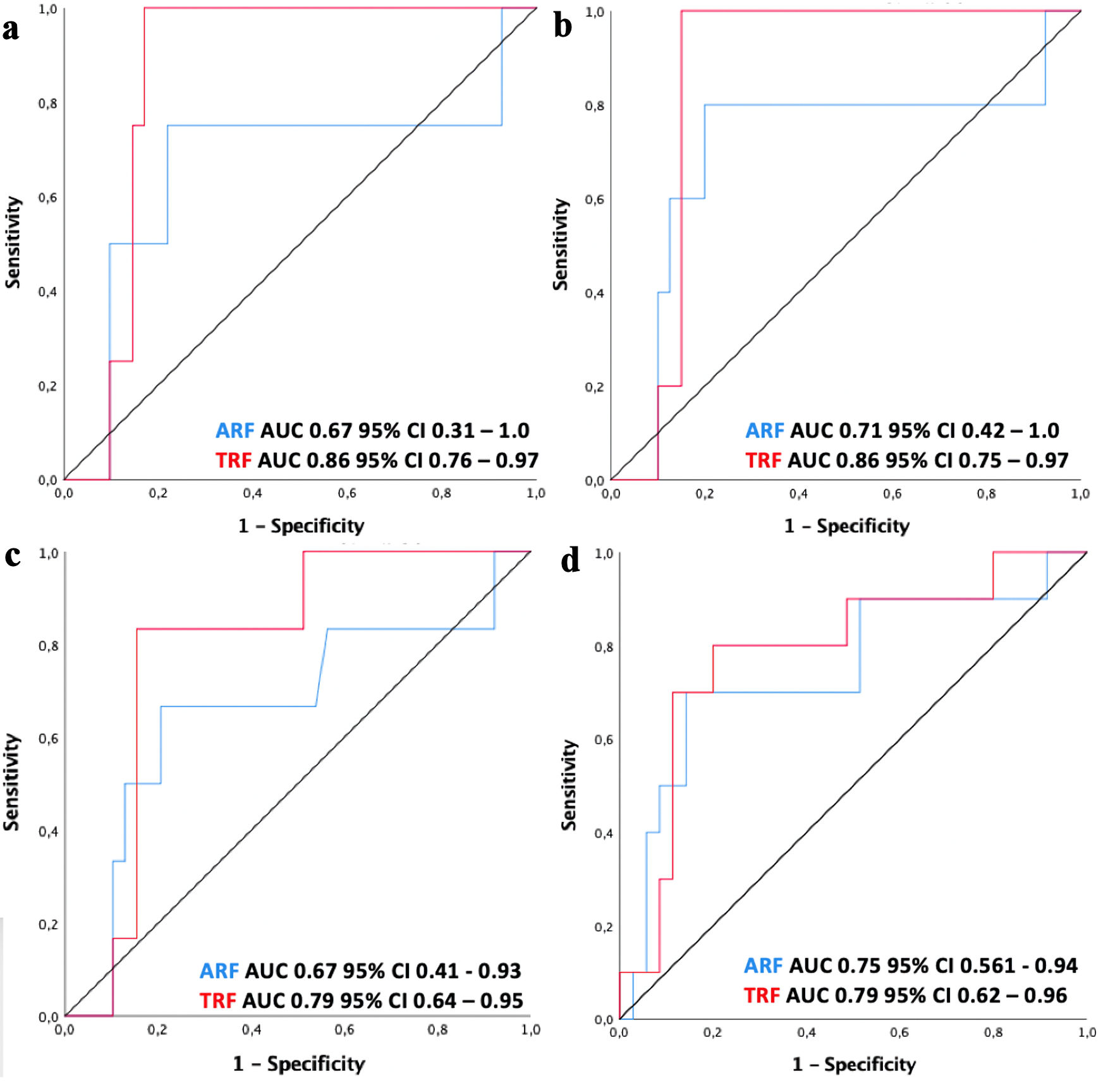
Figure 2. ROC curve representing capacity of ARF (blue line) and TRF (red line) to identify patients at risk of developing surgery indications at 1 year (a), 2 years (b), 3 years (c) and at the end of follow-up (d). ARF: aortic regurgitant fraction; TRF: total regurgitant fraction; CI: confidence interval; AUC: area under the curve; ROC: receiver operating characteristic.
Figure 3.
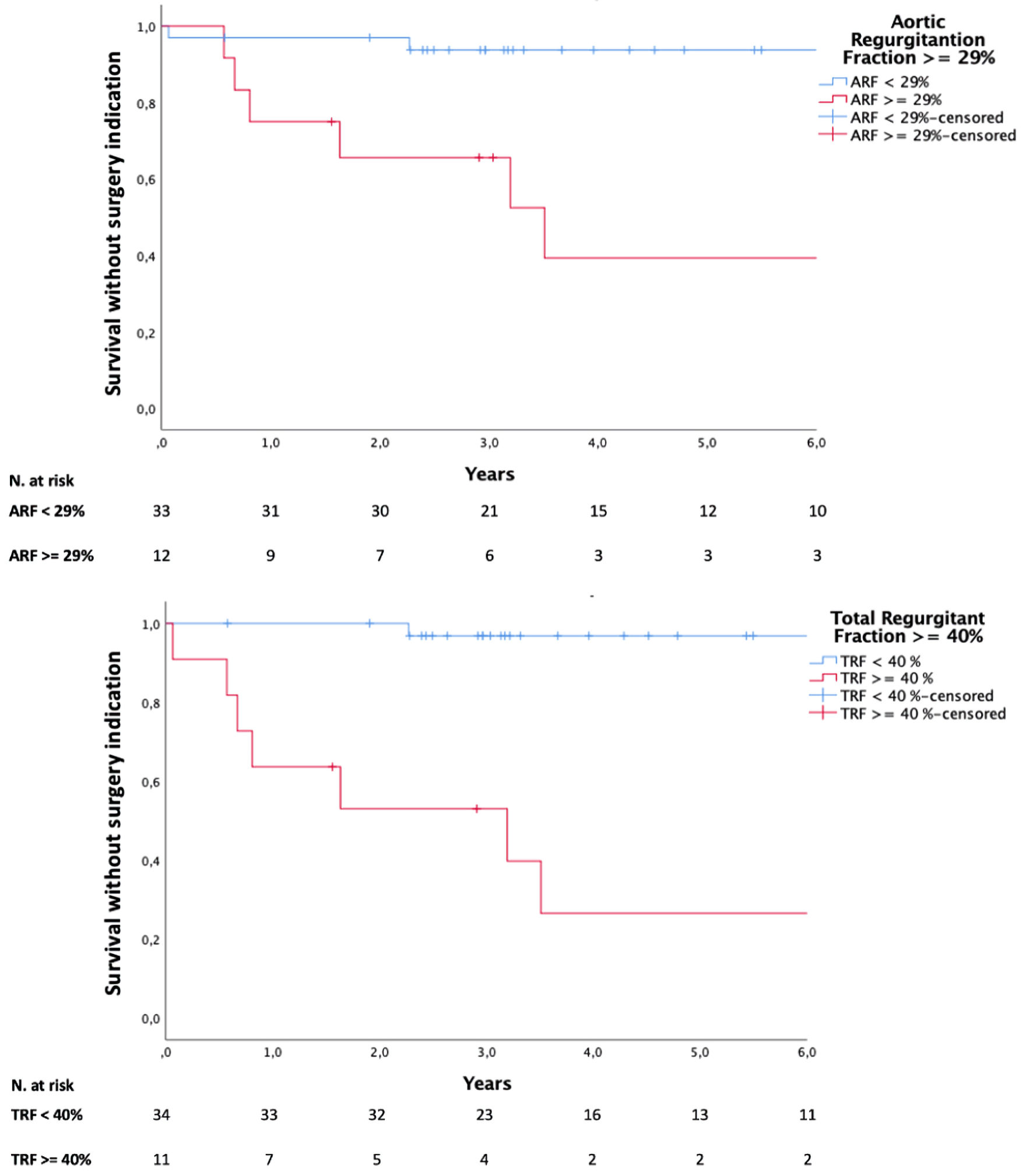
Figure 3. Surgery-indication free survival by ARF (superior panel) and TRF (inferior panel) best cut-offs determined by Youden method in ROC analysis. ARF: aortic regurgitant fraction; TRF: total regurgitant fraction; ROC: receiver operating characteristic.

Tables

Table 1. Main Clinical Baseline Characteristics
 
All (n = 45)No indication of surgery (n = 35)Surgery indication (n = 10)P value
AF: atrial fibrillation; HBP: high blood pressure; DAA: dilated ascending aorta; DM: diabetes mellitus; DL: dyslipidemia; BMI: body mass index; CKD: chronic kidney disease; BAV: bicuspid aortic valve.
Age (years)61.5 ± 16.762.2 ± 16.359 ± 190.58
Male (%)34 (75.6%)26 (74.3%)8 (80%)0.71
HBP (%)28 (62.2%)22 (62.9%)6 (60%)0.86
DM (%)1 (2.2%)0 (0%)1 (10%)0.22
DL (%)15 (33.3%)10 (28.6%)5 (50%)0.20
BMI (kg/m2)26.7 ± 4.626.9 ± 4.526.3 ± 5.40.72
Smoker (%)5 (11.1%)4 (11.4%)1 (10%)0.89
Former smoker (%)18 (40%)14 (40%)4 (40%)1.0
AF (%)10 (22.2%)7 (20%)3 (30%)0.71
CKD (%)6 (13.3%)4 (11.4%)2 (20%)0.48
BAV (%)21 (46.7%)18 (51.4%)3 (30%)0.23
DAA (%)6 (13.3%)4 (11.4%)2 (20%)0.48


Table 2. Comparison Between Patients Without and With Surgery Indication During Follow-Up
 
All (n = 45)No indication of surgery (n = 35)Surgery indication (n = 10)P value
aDAFR was examined in only 29 patients. LVEDV: left ventricular end diastolic volume; LVESV: left ventricular end systolic volume; LVSV: left ventricular stroke volume; FV: forward volume; LVEF: left ventricular ejection fraction; ARV: aortic regurgitant volume; ARF: aortic regurgitant fraction; MRV: mitral regurgitant volume; MRF: mitral regurgitant fraction; TRV: total regurgitant volume; TRF: total regurgitant fraction; RVEF: right ventricular ejection fraction; DAFR: descendent aorta flow reversal.
LVEDV (mL)186.3 ± 55.5183.8 ± 54.2195.1 ± 62.10.57
LVESV (mL)76.6 ± 32.377.7 ± 32.572.8 ± 33.10.67
LVSV (mL)109.7 ± 29.6106.1 ± 27.9122.3 ± 33.30.12
FV (mL)95.5 ± 26.193.4 ± 24.1103.8 ± 32.20.26
LVEF (%)60.0 ± 8.458.9 ± 8.463.9 ± 7.20.09
ARV (mL)23.0 ± 13.220.3 ± 11.832.2 ± 14.60.01
ARF (%)22.9 ± 9.221.0 ± 8.129.5 ± 10.10.01
MRV (mL)14.2 ± 9.312.9 ± 9.618.5 ± 7.40.09
MRF (%)16.4 ± 8.714.9 ± 7.921.6 ± 9.80.029
TRV (mL)37.1 ± 18.633.2 ± 16.850.7 ± 19.00.007
TRF (%)32.8 ± 10.230.4 ± 9.241.2 ± 9.40.002
RVEF (%)61.6 ± 8.061.5 ± 8.261.9 ± 7.70.88
DAFRa (n = 29)14 (48.3%)a6 (28.6%)a8 (100%)a0.001


Table 3. ROC Data (Comparison of the Ability of Each Parameter to Identify the Patients Who Develop Indications for Surgery at the End of Follow-Up)
 
AUCCut-offP valueSensitivity (%)Specificity (%)
ARV: aortic regurgitant volume; ARF: aortic regurgitant fraction; MRV: mitral regurgitant volume; MRF: mitral regurgitant fraction; TRV: total regurgitant volume; TRF: total regurgitant fraction; ROC: receiver operating characteristic.
ARV (mL)0.75 (0.54 - 0.96)330.0157091
ARF (%)0.75 (0.56 - 0.94)290.0187085
MRV (mL)0.72 (0.55 - 0.89)150.0389065
MRF (%)0.72 (0.53 - 0.90)180.0418065
TRV (mL)0.77 (0.59 - 0.94)470.0117085
TRF (%)0.79 (0.62 - 0.96)400.0067089


Table 4. Cox Proportional Hazard Regression for the Variables With Significant Discriminatory Ability on ROC Analysis
 
Univariate analysisMultivariate analysis
Hazard ratio (B-Exp)P valueHazard ratio (B-Exp)P value
Analysis was binary comparing groups above and below the optimal threshold. Multivariate analysis was adjusted for LVEF. ARV: aortic regurgitant volume; ARF: aortic regurgitant fraction; MRV: mitral regurgitant volume; MRF: mitral regurgitant fraction; TRV: total regurgitant volume; TRF: total regurgitant fraction; ROC: receiver operating characteristic.
ARV (mL)9.77 (2.51 - 38.02)0.0018.10 (1.82 - 36.02)0.006
ARF (%)6.98 (1.77 - 27.44)0.0055.42 (1.29 - 22.72)0.02
MRV (mL)11.46 (1.45 - 90.63)0.029.28 (1.14 - 75.62)0.04
MRF (%)6.66 (1.40 - 31.67)0.025.53 (1.15 - 26.59)0.03
TRV (mL)6.63 (1.71 - 25.69)0.0065.54 (1.40 - 21.90)0.02
TRF (%)12.05 (2.49 - 58.33)0.00211.78 (2.39 - 58.01)0.001