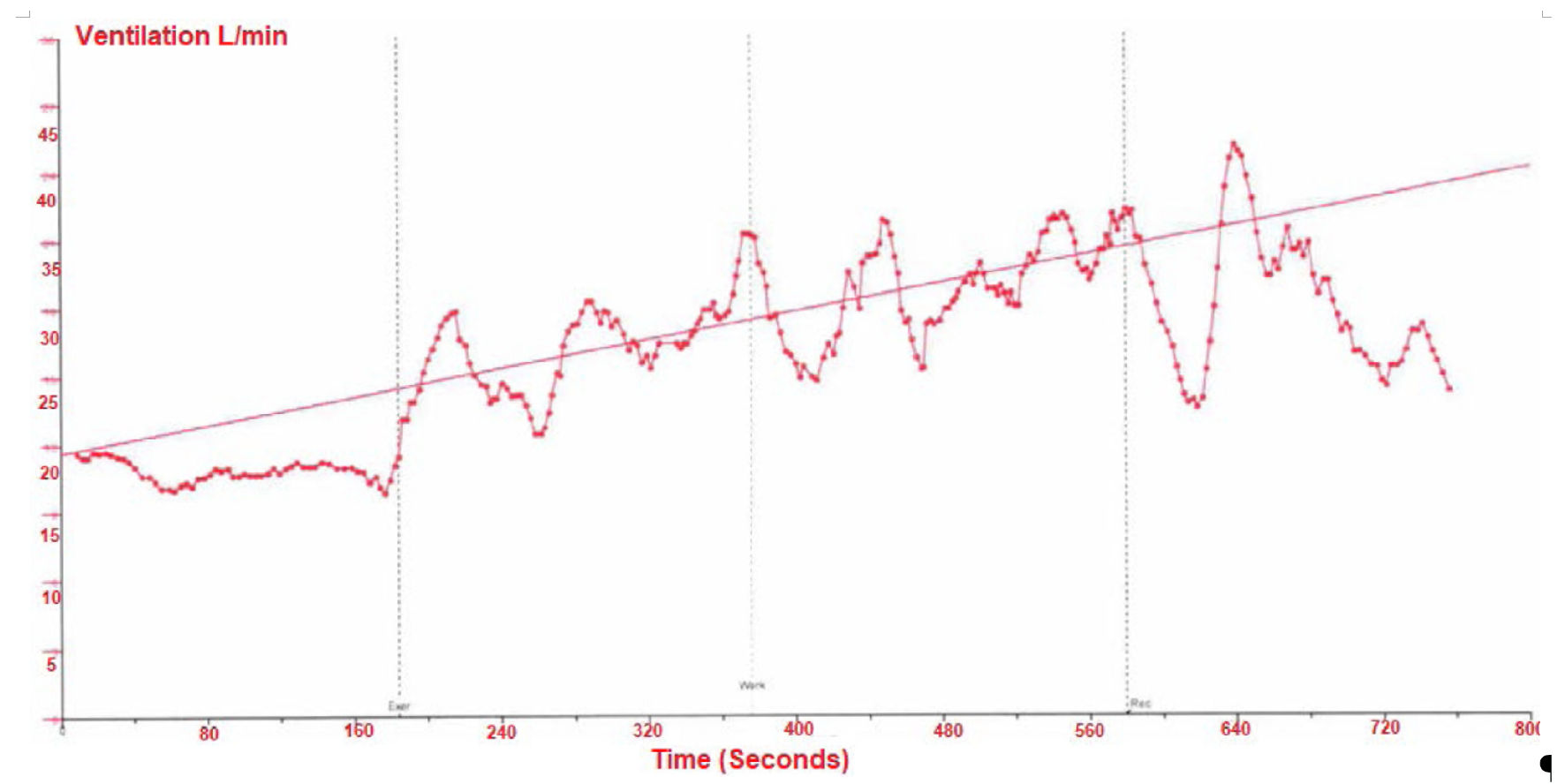
| Ben-Dov et al, 1992 [13] | Three or more consecutive regular oscillations in VE with oscillation amplitude > 25% of average VE and cycle length 30 - 60 s |
| Kremser et al, 1987 [11], and Corra et al, 2006 [12] | Oscillations in VE with a cycle length of approximately 1 min, amplitude > 15% of resting VE, and duration > 60% (> 66%) of exercise duration |
| Sun et al, 2010 [10] | Three or more consecutive cyclic fluctuations in VE, amplitude > 30% of concurrent mean VE, oscillation of ≥ 3 gas exchange variables, cycle length of 40 - 140 s |
| Leite et al, 2003 [2] | Three or more cycles of regular oscillation in VE with standard deviation of 3 consecutive cycle lengths within 20% of the average and minimal average amplitude of oscillation > 5 L/min |
| American Heart Association (AHA) consensus, 2010 [14] | EOV pattern that persists for at least 60% of the exercise test at amplitude 15% or more of the average resting value |