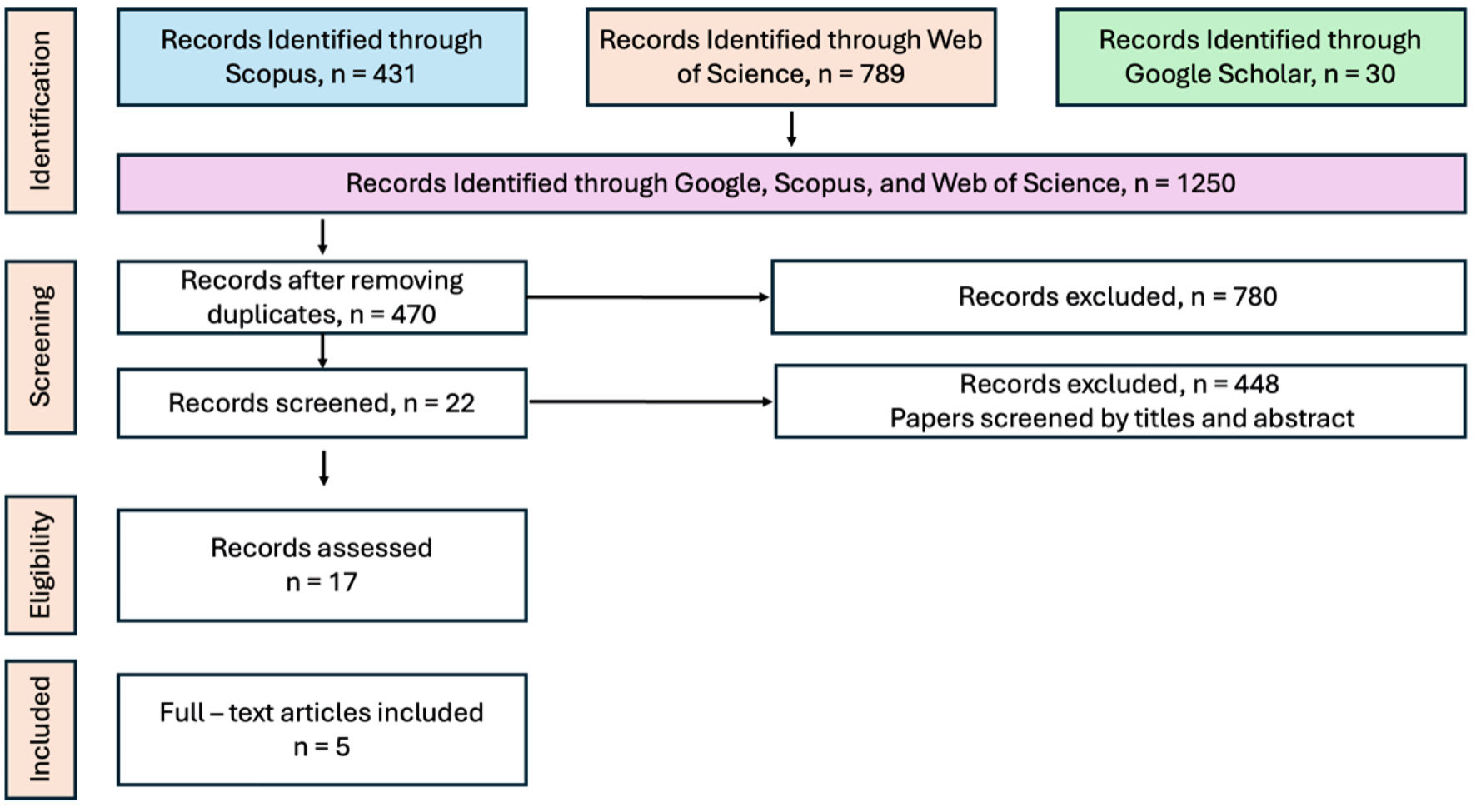
↓ Figure 1. The PRISMA flow diagram for this systematic review. PRISMA: Preferred Reporting Items for Systematic Reviews and Meta-Analyses.
| Cardiology Research, ISSN 1923-2829 print, 1923-2837 online, Open Access |
| Article copyright, the authors; Journal compilation copyright, Cardiol Res and Elmer Press Inc |
| Journal website https://cr.elmerpub.com |
Review
Volume 17, Number 5, October 2026, pages 406-415
Prediction of Risk of Cardiovascular Events in Patients With Stable Angina Using Artificial Intelligence: A Systematic Review
Figure
Tables
| Category | Inclusion criteria | Exclusion criteria |
|---|---|---|
| MI: myocardial infarction; EHR: electronic health record; ECG: electrocardiogram; MACE: major adverse cardiovascular events. | ||
| Population | Adult patients (≥ 18 years) diagnosed with stable angina or chronic coronary syndrome | Patients with acute coronary syndrome, unstable angina, post-MI only cohorts, pediatric populations |
| Intervention/exposure | Studies applying artificial intelligence, machine learning, or deep learning models | Studies using only traditional statistical risk scores without AI/ML components |
| Outcomes | Prediction of cardiovascular events (e.g., MACE, MI, mortality, heart failure, stroke, revascularization) | Studies not reporting cardiovascular outcomes or focused only on diagnostic accuracy without outcome prediction |
| Study design | Observational studies (retrospective or prospective), cohort studies, registry-based studies | Case reports, editorials, letters, commentaries, conference abstracts, posters, dissertations |
| Data type | Use of clinical data, ECG, imaging, EHR, laboratory data, or multimodal datasets | Animal studies, simulation-only studies, non-clinical datasets |
| Publication type | Peer-reviewed journal articles | Preprints without peer review, short communications, reviews |
| Time frame | Published within the last 10 years | Publications which were prior to the specified time window |
| Language | Articles published in English | Non-English publications |
| Reference | Target | Variable | Architecture | Pre-processing | Dataset | Selection Criteria and Outcome | Result |
|---|---|---|---|---|---|---|---|
| ACS: acute coronary syndrome; AHA: American Heart Association; BMI: body mass index; CAD: coronary artery disease; CCTA: coronary computed tomography angiography; CHD: coronary heart disease; CI: confidence interval; CNN: convolutional neural network; CV: cardiovascular; CVE: cardiovascular events; D-F: Diamond–Forrester; DM: diabetes mellitus; ECG: electrocardiogram; EHR: electronic health records; ExtCAD: extensive coronary artery disease; FHx: family history; HF: heart failure; HTN: hypertension; MI: myocardial infarction; ObstCAD: obstructive coronary artery disease; QCG: quantitative electrocardiography; QC: quality control; UA: unstable angina; vars: variables; WHO: World Health Organization. | |||||||
| [17] | AI-ECG detection of obstructive CAD in stable angina | Age, sex, BMI, symptom type, HTN, DM, dyslipidemia, smoking, stroke, FHx + QCG scores + ECG deep features | ResNet-CNN (16 layers, SE blocks, nonlocal); task layers (Adam + focal loss; temp scaling). XGBoost on extracted vectors (80/20; 5-fold CV) | Signal extraction, feature vectors, probability calibration, CV for tuning | SNUBH, 2018–2020, n = 723 | Outpatients with stable angina symptoms undergoing invasive angiography. Excluded: asymptomatic, prior CAD/revascularization, and emergency ACS cases. | AUROC: 0.827 |
| Outcome: any obstructive CAD | |||||||
| [18] | Obstructive + extensive CAD in suspected stable angina | Clinical risk factors + QCG scores | Modified ResNet encoder | Patient-level split (90/10), bootstrap CI (2000) | SNUBH, 2011–2019, n = 21,866 | Outpatients evaluated via invasive angiography/CCTA for chest pain. External validation: independent multi-cohort sample. Excluded: emergency ACS admissions. | AUC: ObstCAD 0.781; severe 0.780; ExtCAD 0.689 |
| Outcome: obstructive CAD | |||||||
| [13] | Obstructive CAD and assess prognosis in suspected stable angina | Age, sex, angina typicality, dyspnoa; risk factors (DM, dyslipidemia, FHx); Charlson index | Statistical models: logistic regression (basic + clinical); Cox regression for prognosis | Symptom classification (typical/atypical/non-cardiac), D-F pre-test probability, registry linkage, 30-day blanking period | Single-center, Denmark, n = 3,903 | Consecutive single-center outpatient referrals. Baseline status: verified free of baseline CAD and heart failure at entry. | AUC: 0.88 |
| Outcome: obstructive CAD | |||||||
| Composite outcome (death, MI, UA, HF, stroke) | |||||||
| [19] | 12-month CVE in stable angina + CHD | Physical activity, Antiplatelet use, Traditional Chinese medicine, Gensini score, SAQ Exertional capacity, SAQ Anginal stability | ML models: XGBoost, LightGBM, RF, AdaBoost, MLP, SVM, KNN, GNB) + logistic regression, | Prospective cohort, random split 7:3, 10-fold CV, missing MICE imputation, SHAP for interpretability | Single-center, n = 827 | Prospective cohort with established WHO/AHA-defined stable coronary disease. Excluded: advanced systemic illness, heart failure, or cognitive barriers. | AUC: train 1.00, validation 0.98, test 0.98 (95% CI 0.97–1.00) |
| Best = LightGBM; also kept multivariable logistic regression (nomogram + online calculator) | |||||||
| Outcome: composite CVE: nonfatal MI, revascularization, all-cause death, readmission (angina/HF/malignant arrhythmia), stroke | |||||||
| [20] | ACS risk in stable CHD | EHR vars → QC → 34 clinical vars (labs + diagnoses + utilization + sociodemographics) | T2G-Former + MLP: build feature-relation graph → transformer embeddings → MLP outputs ACS baselines: CatBoost, LightGBM, XGBoost, RF, SVM, FT-Transformer | Convert heterogeneous variables, imputation, patient-level longitudinal mean, MICE (checked vs k-NN), multicollinearity check 5-fold stratified CV, repeated across 12 seeds | Raw: 268,876 CHD records from 165 institutions, n = 12,336 | Outpatients with stable angina symptoms undergoing invasive angiography. | The F1 scores were 0.666, 0.757, and 0.886 at 6, 12, and 24 months, respectively. |
| Outcome: progression from stable CHD → ACS within 6/12/24 months | |||||||