Cardiology Research, ISSN 1923-2829 print, 1923-2837 online, Open Access
Article copyright, the authors; Journal compilation copyright, Cardiol Res and Elmer Press Inc
Journal website https://cr.elmerpub.com

Original Article

Volume 17, Number 3, June 2026, pages 190-196


Analytical Evaluation of a Point-of-Care Platform for Glycated Hemoglobin and N-Terminal Pro-B-Type Natriuretic Peptide Testing in Cardiometabolic Care

Figures

↓  Figure 1. Method comparison between AFIAS-3 POCT and Tosoh G8 HPLC for HbA1c. (a) Passing–Bablok regression showing strong correlation (r = 0.98, P < 0.0001; slope = 0.95; intercept = 0.32%). The blue area indicates the 95% confidence interval. (b) Bland–Altman plot showing a negligible mean bias of −0.03% (blue line) with 95% limits of agreement (red lines) ranging from −0.60% to +0.53%. HbA1c: hemoglobin A1c; POCT: point-of-care testing; HPLC: high-performance liquid chromatography.
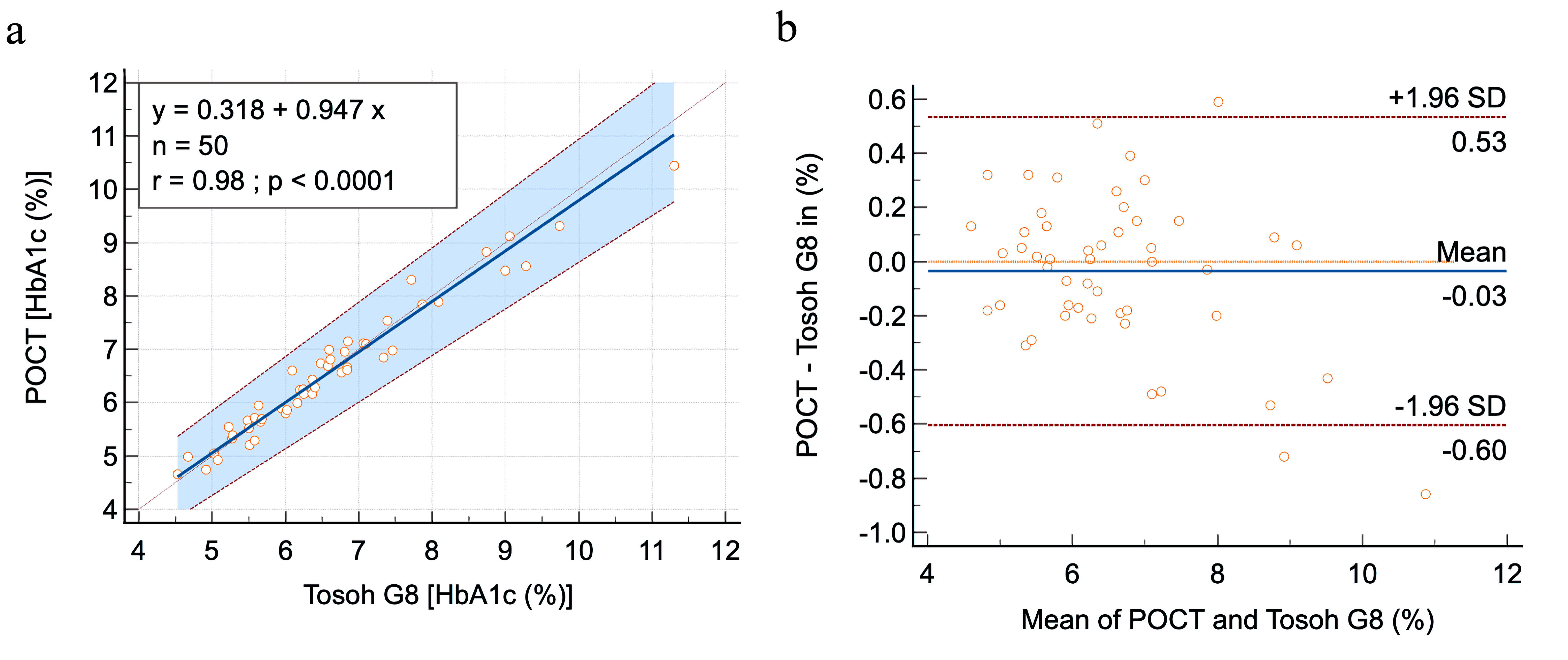
Figure 1.
↓  Figure 2. Method comparison between AFIAS-3 POCT and cobas 8000 e602 (ECLIA) for NT-proBNP. (a) Passing–Bablok regression showing very high correlation (r = 0.99, P < 0.0001; slope = 1.24; intercept = −40 ng/L). The blue area indicates the 95% confidence interval. (b) Bland–Altman plot showing a positive mean bias of +1,145 ng/L (blue line) with 95% limits of agreement (red lines) ranging from −3,281 to +5,570 ng/L, reflecting systematic overestimation at higher concentrations. NT-proBNP: N-terminal pro-B-type natriuretic peptide; POCT: point-of-care testing; ECLIA: electrochemiluminescence immunoassay.
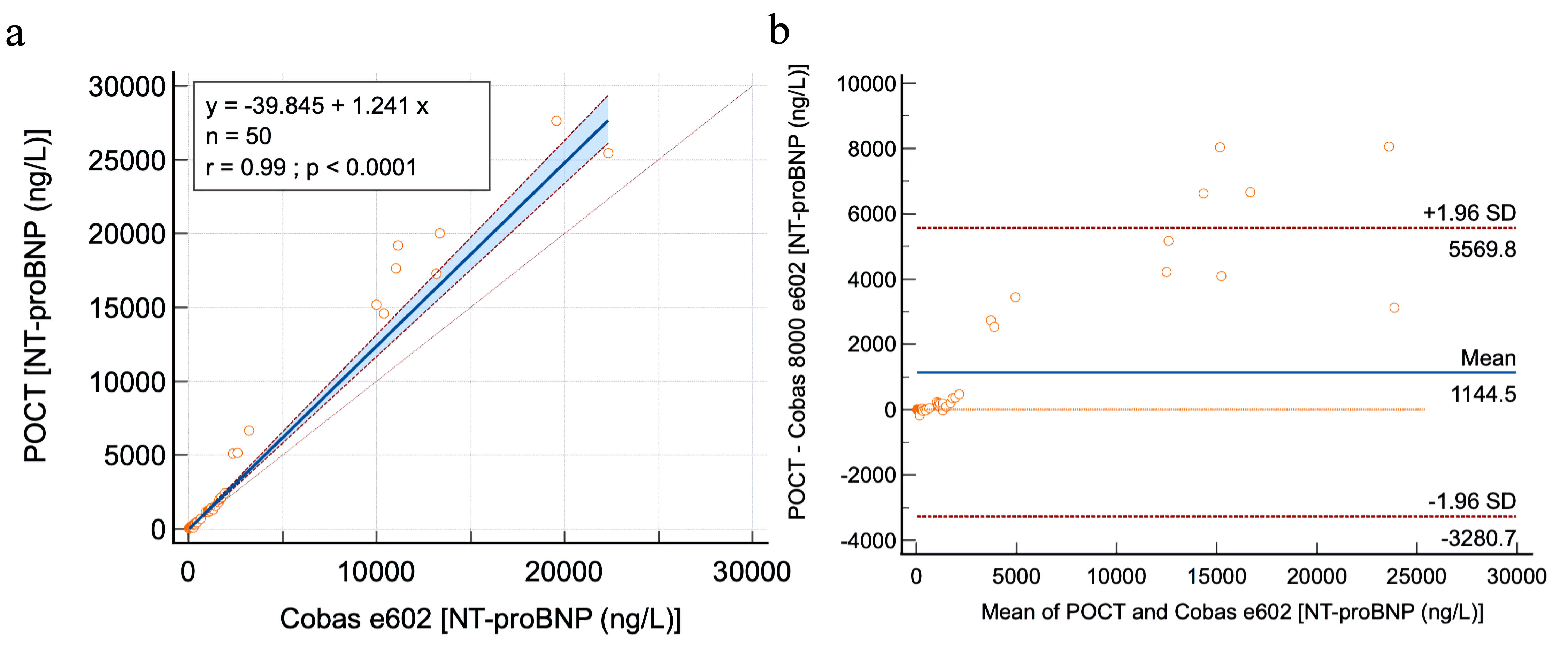
Figure 2.

Tables

↓  Table 1. Precision and Accuracy of HbA1c Measurements at Two Quality Control Levels
 
AnalyteQC levelHbA1c (%)Mean HbA1c (%)SDCV (%)Bias (%)TEobs (%)
HbA1c: glycated hemoglobin; QC: quality control; SD: standard deviation; CV: coefficient of variation; TEobs: total observed error.
HbA1cQC1 (low)5.475.220.101.864.57.57
QC2 (high)9.719.630.171.800.84.30


↓  Table 2. Precision and Accuracy of NT-proBNP Measurements at Two Quality Control Levels
 
AnalyteQC levelNT-proBNP (ng/L)Mean NT-proBNP (ng/L)SDCV (%)Bias (%)TEobs (%)
NT-proBNP: N-terminal pro-B-type natriuretic peptide; QC: quality control; SD: standard deviation; CV: coefficient of variation; TEobs: total observed error.
NT-proBNPQC1 (low)275.00249.9513.235.299.1117.84
QC2 (high)5,495.305,051.15776.8315.388.0833.46


↓  Table 3. Categorical Agreement Between AFIAS-3 POCT and Tosoh G8 HPLC for HbA1c at the 6.5% Diagnostic Cut-Off
 
Cut-off = 6.5%Reference method Tosoh G8κ value
PositiveNegativeTotal
HbA1c: glycated hemoglobin; POCT: point-of-care testing; HPLC: high-performance liquid chromatography; κ: Cohen’s kappa.
POCTPositive262280.92
Negative02222
Total262450


↓  Table 4. Categorical Agreement Between AFIAS-3 POCT and Cobas 8000 e602 for NT-proBNP at Clinical Decision Cut-Offs
 
Cobas 8000 module e602κ value
PositiveNegativeTotal
NT-proBNP: N-terminal pro-B-type natriuretic peptide; POCT: point-of-care testing; κ: Cohen’s kappa.
Cut-off ≥ 125 ng/L
  POCT
    Positive101110.88
    Negative13839
    Total113950
Cut-off ≥ 2,000 ng/L
  POCT
    Positive370370.89
    Negative21113
    Total391150


↓  Table 5. User-Friendliness of the AFIAS-3 for HbA1c and NT-proBNP Point-of-Care Testing
 
CriteriaSatisfactory (S)Intermediary (I)Unsatisfactory (U)HbA1c resultsNT-proBNP results
HbA1c: glycated hemoglobin; NT-proBNP: N-terminal pro-B-type natriuretic peptide; POCT: point-of-care testing; SKUP: Scandinavian Evaluation of Laboratory Equipment for Primary Health Care; QC: quality control; S: satisfactory; I: intermediary; U: unsatisfactory.
Device weight< 5 kg5–10 kg> 10 kgS, S, I, I, UI, I, I, I, U
Device size< 5 × 5 cm5 × 5 cm < x < 30 × 30 cm> 30 × 30 cmI, I, I, I, UI, I, I, I, U
Additional equipment needed (device, cartridges, consumables)No1:2≥ 3S, S, S, S, IS, I, I, I, I
Description of the sample collection processYesIncompleteNoS, S, S, S, SS, S, I, S, S
Description of the test processYesIncompleteNoS, S, S, S, SS, S, S, S, S
Description of how the results are presentedYesIncompleteNoS, S, S, S, SS, S, S, S, S
Function and use of the testYesIncompleteNoS, S, S, S, SS, S, S, S, S
Presence of the necessary instructions for correct useYesIncompleteNoS, S, S, S, SS, S, S, I, I
Training required to collect samplesNoIncompleteYesS, S, S, IS, S, I, I
Training required to use the deviceNoBasic trainingSpecial trainingS, S, S, S, IS, S, I, I
Training necessary for calibration and QCNoIncompleteYesS, S, I, U, US, S, S, I, I