Cardiology Research, ISSN 1923-2829 print, 1923-2837 online, Open Access
Article copyright, the authors; Journal compilation copyright, Cardiol Res and Elmer Press Inc
Journal website https://cr.elmerpub.com

Original Article

Volume 17, Number 4, August 2026, pages 321-329


Non-Biomarker Bedside Risk Scores for One-Year Mortality After Acute Heart Failure Hospitalization

Figures

↓  Figure 1. Receiver operating characteristic curves for non-biomarker bedside scores and the cross-validated routine-care clinical model. ROC curves are shown for five point scores and the cross-validated routine-care clinical model, including OPTIMIZE-HF–inspired and GWTG-HF–inspired domain scores that were not formal external validations of the original weighted equations. No natriuretic peptide value or AHEAD score was included in the primary analyses. AHEAD: atrial fibrillation, anemia, age, renal dysfunction and diabetes mellitus; AUC: area under the receiver operating characteristic curve; CV: cross-validated; GWTG-HF: Get With The Guidelines-Heart Failure; OPTIMIZE-HF: Organized Program to Initiate Lifesaving Treatment in Hospitalized Patients With Heart Failure; ROC: receiver operating characteristic.
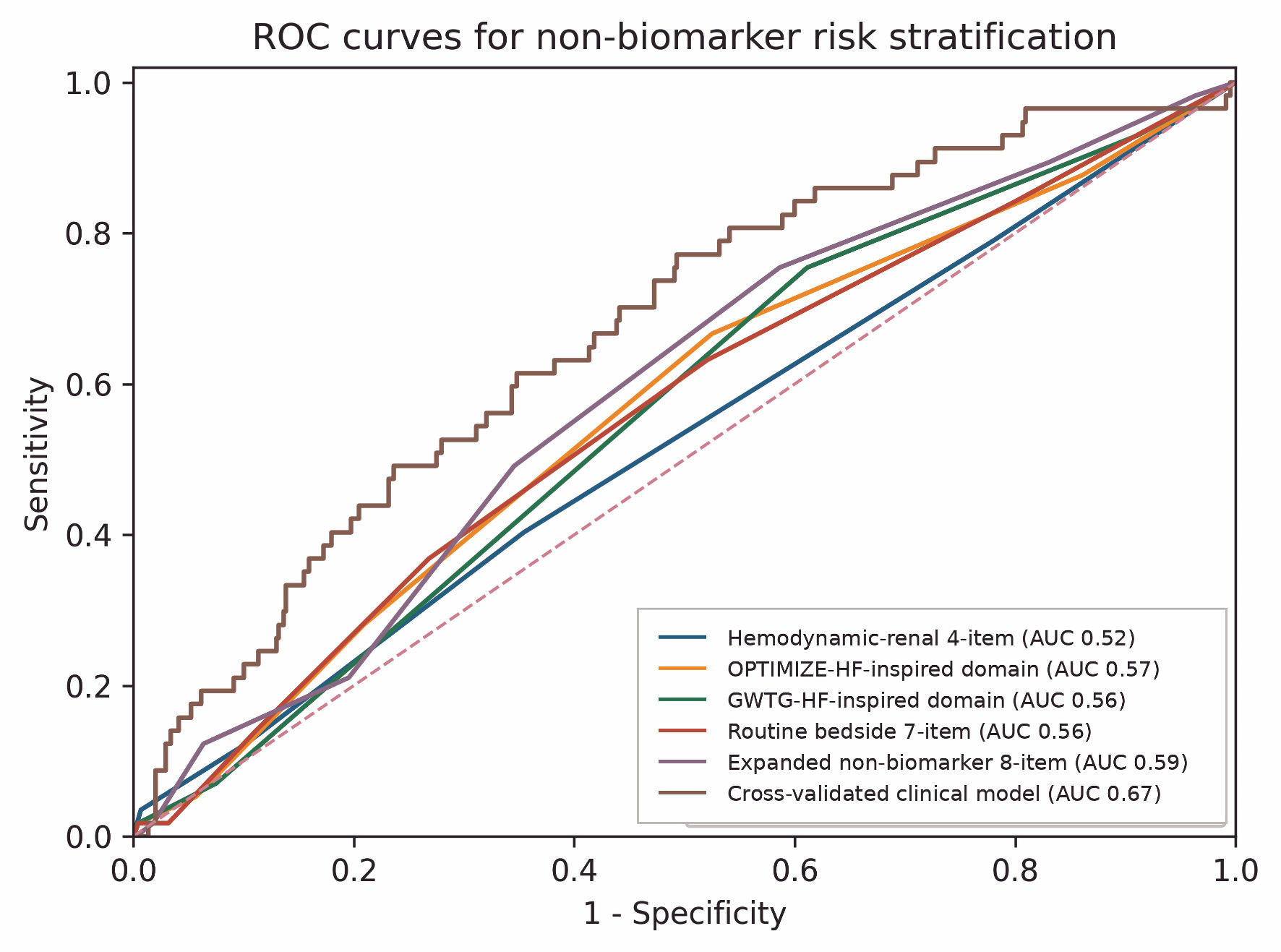
Figure 1.
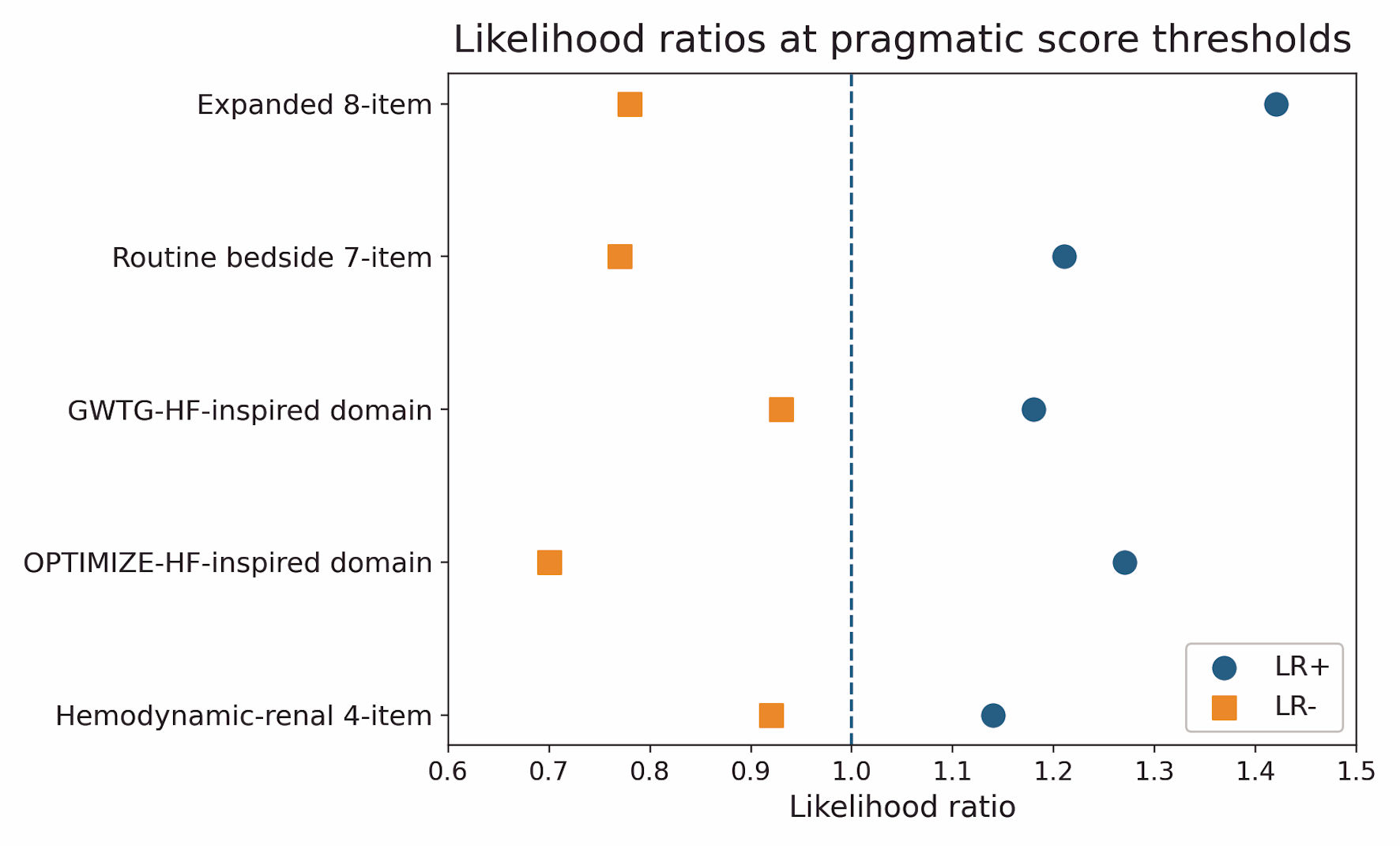
↓  Figure 2. Likelihood ratios at pragmatic score thresholds. Likelihood ratios were modest across the evaluated non-biomarker point scores, including the inspired domain scores, indicating that these scores should not be used as standalone definitive prognostic instruments. LR: likelihood ratio; GWTG-HF: Get With The Guidelines-Heart Failure; OPTIMIZE-HF: Organized Program to Initiate Lifesaving Treatment in Hospitalized Patients With Heart Failure.
Figure 2.
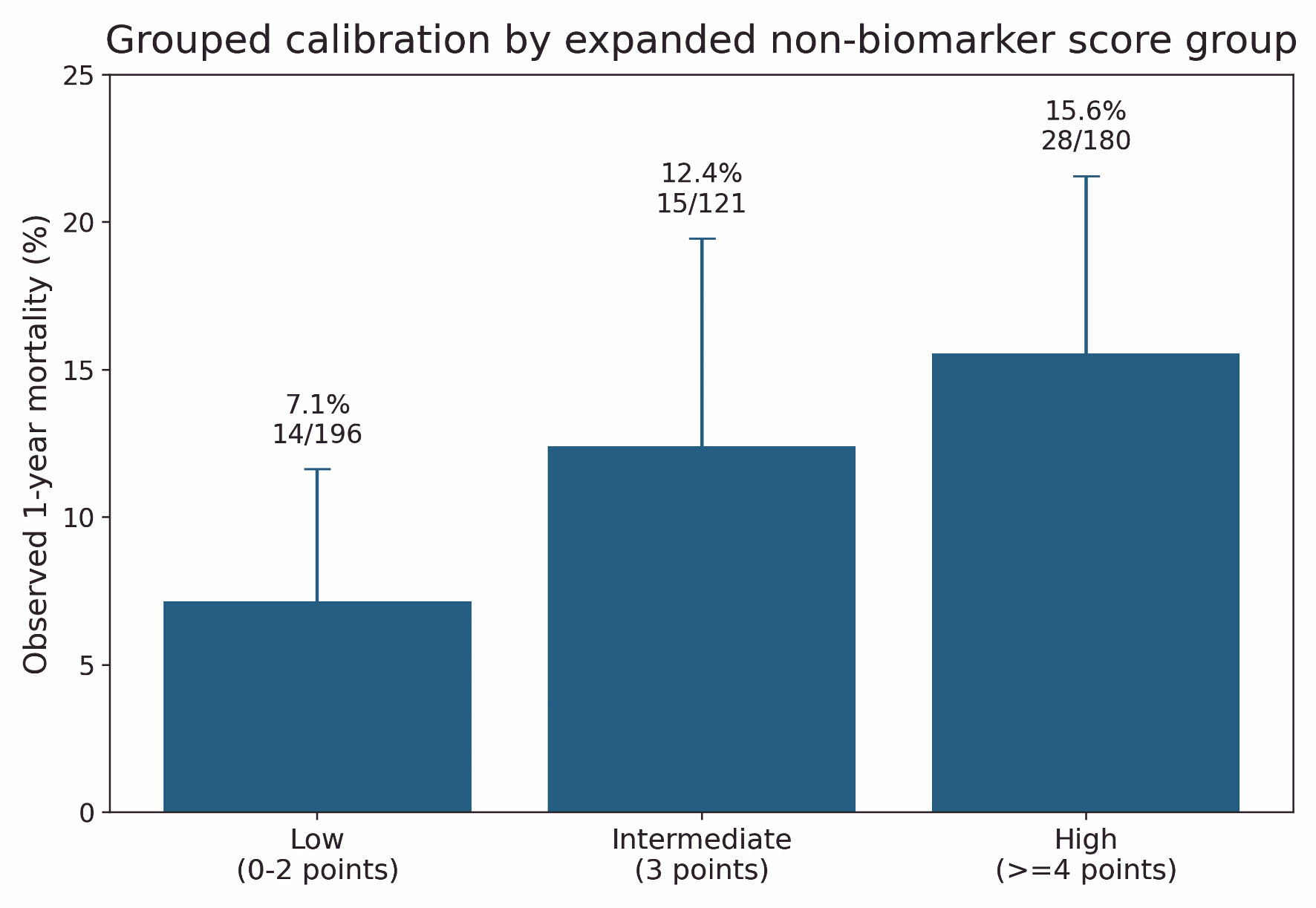
↓  Figure 3. Grouped calibration of observed 1-year mortality by expanded non-biomarker score group. Observed 1-year all-cause mortality with Wilson 95% confidence intervals is shown across low, intermediate and high categories of the primary expanded non-biomarker 8-item score.
Figure 3.

Tables

↓  Table 1. Baseline Characteristics Overall and by 1-Year Mortality Status
 
CharacteristicOverall (n = 497)Survived 1 year (n = 440)Died within 1 year (n = 57)P value
Age, years69.8 ± 15.269.3 ± 15.474.0 ± 13.50.018
Male sex, n (%)284 (57.1%)252 (57.3%)32 (56.1%)0.984
New York Heart Association class III–IV, n (%)379 (76.3%)337 (76.6%)42 (73.7%)0.749
Systolic blood pressure, mm Hg108.9 ± 22.1109.0 ± 22.2108.7 ± 21.20.941
Heart rate, beats/min97.3 ± 15.697.0 ± 15.5100.0 ± 16.20.197
Hemoglobin, g/L120.4 ± 23.0122.0 ± 22.7107.8 ± 21.5< 0.001
Creatinine, mg/dL1.27 (1.09–1.51)1.26 (1.09–1.51)1.31 (1.14–1.53)0.191
Sodium, mmol/L136.6 ± 4.9136.7 ± 4.9136.0 ± 5.00.333
Left ventricular ejection fraction, %33.0 ± 5.933.2 ± 5.731.3 ± 6.70.044
Atrial fibrillation, n (%)82 (16.5%)73 (16.6%)9 (15.8%)1.000
Diabetes mellitus, n (%)143 (28.8%)119 (27.0%)24 (42.1%)0.027
Renal disease, n (%)59 (11.9%)52 (11.8%)7 (12.3%)1.000
Ischemic heart disease, n (%)260 (52.3%)233 (53.0%)27 (47.4%)0.513


↓  Table 2. A Priori-Defined Non-Biomarker Bedside Score Definitions
 
ScoreDefinitionRange
GWTG-HF: Get With The Guidelines-Heart Failure; OPTIMIZE-HF: Organized Program to Initiate Lifesaving Treatment in Hospitalized Patients With Heart Failure.
Hemodynamic-renal four-item score1 point each: systolic blood pressure ≤ 100 mm Hg; heart rate ≥ 100 beats/min; sodium < 135 mmol/L; creatinine ≥ 1.5 mg/dL.0–4
OPTIMIZE-HF–inspired domain score1 point each: age ≥ 75 years; systolic blood pressure ≤ 100 mm Hg; heart rate ≥ 100 beats/min; sodium < 135 mmol/L; creatinine ≥ 1.5 mg/dL; left ventricular ejection fraction ≤ 40%. This is an inspired domain-level approximation and not the original OPTIMIZE-HF weighted equation.0–6
GWTG-HF–inspired domain score1 point each: age ≥ 75 years; systolic blood pressure ≤ 110 mm Hg; heart rate ≥ 100 beats/min; sodium < 135 mmol/L; creatinine ≥ 1.5 mg/dL. Blood urea nitrogen, chronic obstructive pulmonary disease and race were intentionally not approximated; therefore, this is not the original GWTG-HF weighted equation.0–5
Routine bedside seven-item score1 point each: age ≥ 75 years; New York Heart Association class III–IV; systolic blood pressure ≤ 100 mmHg; heart rate ≥ 100 beats/min; sodium < 135 mmol/L; creatinine ≥ 1.5 mg/dL; left ventricular ejection fraction ≤ 30%.0–7
Expanded non-biomarker eight-item score (primary score)Routine bedside seven-item score plus low hemoglobin (hemoglobin < 110 g/L).0–8
Cross-validated routine-care clinical modelL2-regularized logistic regression using non-biomarker routine-care variables: age, sex, systolic blood pressure, heart rate, New York Heart Association class, hemoglobin, creatinine, sodium, left ventricular ejection fraction, atrial fibrillation, diabetes mellitus, renal disease, and ischemic heart disease. Five-fold stratified cross-validation was used.Probability


↓  Table 3. Discrimination and Operational Characteristics for 1-Year All-Cause Mortality
 
ScoreAUC (bootstrap 95% CI)ThresholdSensitivitySpecificityLR+LR-PPVNPV
AUC: area under the receiver operating characteristic curve; CI: confidence interval; GWTG-HF: Get With The Guidelines-Heart Failure; OPTIMIZE-HF: Organized Program to Initiate Lifesaving Treatment in Hospitalized Patients With Heart Failure; LR: likelihood ratio; PPV: positive predictive value; NPV: negative predictive value.
Hemodynamic-renal four-item0.525 (0.446–0.600)≥ 20.4040.6451.140.920.1280.893
OPTIMIZE-HF–inspired domain0.567 (0.492–0.639)≥ 30.6670.4751.270.700.1410.917
GWTG-HF–inspired domain0.562 (0.489–0.630)≥ 30.3330.7181.180.930.1330.893
Routine bedside seven-item0.563 (0.483–0.634)≥ 30.6320.4801.210.770.1360.909
Expanded non-biomarker eight-item0.590 (0.509–0.660)≥ 40.4910.6551.420.780.1560.909


↓  Table 4. Observed 1-Year Mortality by Expanded Non-Biomarker Eight-Item Score Group, With Wilson 95% CIs
 
Primary score groupNDeathsObserved 1-year mortality (Wilson 95% CI)
CI: confidence interval.
Low (0–2 points)196147.1% (4.3–11.6)
Intermediate (3 points)1211512.4% (7.7–19.4)
High (≥ 4 points)1802815.6% (11.0–21.6)