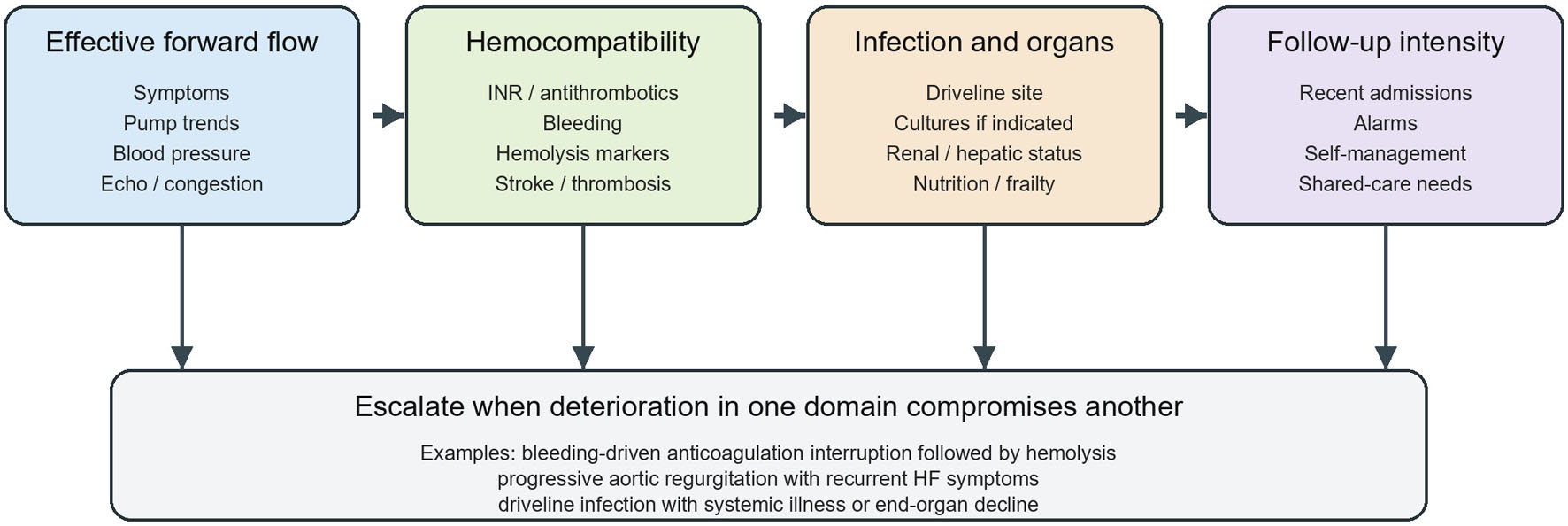
↓ Figure 1. Four-domain surveillance and escalation framework for durable LVAD support. LVAD: left ventricular assist device.
| Cardiology Research, ISSN 1923-2829 print, 1923-2837 online, Open Access |
| Article copyright, the authors; Journal compilation copyright, Cardiol Res and Elmer Press Inc |
| Journal website https://cr.elmerpub.com |
Review
Volume 17, Number 6, December 2026, pages 561-571
Clinically Actionable Prevention and Management of Major Complications During Durable Left Ventricular Assist Device Support: A Contemporary Narrative Review
Figure
Tables
| Complication domain | Main mechanisms | Surveillance signals | Prevention focus | Escalation triggers |
|---|---|---|---|---|
| AR: aortic regurgitation; BP: blood pressure; CRP: C-reactive protein; CT: computed tomography; CVP: central venous pressure; eGFR: estimated glomerular filtration rate; FAC: fractional area change; GI: gastrointestinal; HF: heart failure; INR: international normalized ratio; LDH: lactate dehydrogenase; LV: left ventricular; LVAD: left ventricular assist device; MAP: mean arterial pressure; PAP: pulmonary artery pressure; PAPi: pulmonary artery pulsatility index; PET: positron emission tomography; PVR: pulmonary vascular resistance; RA/PCWP: right atrial/pulmonary capillary wedge pressure; RHF: right heart failure; RV: right ventricular; SAVR: surgical aortic valve replacement; TAPSE: tricuspid annular plane systolic excursion; TAVR, transcatheter aortic valve replacement; TEE: transesophageal echocardiography; TR: tricuspid regurgitation; VKA: vitamin K antagonist; WBC: white blood cell. | ||||
| Right heart failure | RV preload-afterload mismatch, septal shift, pulmonary hypertension, tricuspid regurgitation | CVP or right atrial pressure, PAP/PVR, PAPi, RA/PCWP ratio, TAPSE, RV S', FAC or strain when available, TR severity, septal position, congestion, renal/hepatic indices, inotrope need | Preoperative decongestion, pulmonary vascular optimization, rhythm and ventilatory optimization, intraoperative TEE-guided pump-speed titration, planned RV support strategy in high-risk patients | Persistent low output, escalating inotropes or vasopressors, refractory venous congestion, worsening renal/hepatic function, lactate rise, need for temporary RV mechanical support |
| Aortic regurgitation | Reduced aortic valve opening, commissural fusion, altered aortic root flow, low pulsatility, aortic root remodeling | Symptoms, pulse pressure/MAP, aortic valve opening frequency, AR severity on echocardiography, LV size, filling pressures, pump flow/power trends | Blood pressure control, speed optimization to avoid persistent valve closure when feasible, serial valve assessment, consideration of concomitant valve intervention at implant when indicated | Hemodynamically significant recirculation, recurrent HF symptoms, repeated hospitalization, progressive LV dilation, consideration of TAVR, redo SAVR, valve repair/replacement or closure |
| Pump thrombosis/thromboembolism | Flow disturbance, blood-material interaction, subtherapeutic anticoagulation, infection, cannula/graft malposition, low-flow states | LDH, plasma-free hemoglobin, hemoglobinuria/dark urine, pump power or flow change, alarms, neurologic events, echo ramp response, CT for cannula/outflow graft assessment | Stable VKA-based anticoagulation, protocolized perioperative heparin transition, infection control, BP control, device-position assessment, adherence support | Rising hemolysis markers with device dysfunction, recurrent low-flow/power abnormalities, stroke/systemic embolism, refractory hemolysis, need for thrombolysis or pump exchange |
| Bleeding | Shear-related platelet dysfunction, acquired von Willebrand syndrome, angiodysplasia, antithrombotic exposure | Hemoglobin trend, occult/overt GI bleeding, transfusion need, INR stability, antiplatelet exposure, renal/liver dysfunction | Individualized antithrombotic intensity, anemia surveillance, BP and device optimization, avoidance of unnecessary antiplatelet therapy in selected HM3 recipients | Recurrent bleeding, hemodynamic instability, repeated anticoagulation interruption, transfusion dependence, need for endoscopy or multidisciplinary antithrombotic revision |
| Driveline/device infection | Percutaneous exit-site vulnerability, trauma, dressing disruption, diabetes, malnutrition, prolonged support duration | Exit-site pain, erythema diameter, warmth, induration, drainage amount/character, granulation tissue, driveline instability, DESTINE or modified Sharp Memorial score, cultures, CRP/WBC, blood cultures, ultrasound or CT/PET-CT when deep infection suspected | Driveline stabilization, standardized dressing protocol, exit-site hygiene, patient/caregiver education, early treatment of trauma or drainage, outpatient surveillance | Deep/tunnel infection, pump-pocket or pump infection, bacteremia, recurrent infection, systemic illness, transplant/device-exchange implications |
| Renal and end-organ dysfunction | Venous congestion, low output, perioperative injury, RHF, recurrent adverse events, nephrotoxic exposure | Creatinine/eGFR, urine output, bilirubin/transaminases, lactate, nutrition/frailty, diuretic response, congestion markers | Congestion control, RV protection, medication review, renal-dose adjustment, early complication treatment, nutritional and rehabilitation support | Progressive renal/hepatic dysfunction, refractory congestion, worsening frailty or malnutrition, transplant candidacy impact, need for higher-intensity follow-up |
| Care phase | Core clinical questions | Minimum surveillance elements | Common action points |
|---|---|---|---|
| AR: aortic regurgitation; AV: aortic valve; BP: blood pressure; CT: computed tomography; FAC: fractional area change; INR: international normalized ratio; LDH: lactate dehydrogenase; LV: left ventricular; LVAD: left ventricular assist device; MAP: mean arterial pressure; PAP: pulmonary artery pressure; PAPi: pulmonary artery pulsatility index; PVR: pulmonary vascular resistance; RA/PCWP: right atrial/pulmonary capillary wedge pressure; RV: right ventricular; SAVR: surgical aortic valve replacement; TAPSE: tricuspid annular plane systolic excursion; TAVR: transcatheter aortic valve replacement;TEE: transesophageal echocardiography; TR: tricuspid regurgitation. | |||
| Preoperative/candidacy | Is the patient likely to tolerate LV unloading and long-term support? | RV function, TAPSE/RV S'/FAC or strain, TR severity, RA pressure, PAP/PVR, PCWP, PAPi, RA/PCWP ratio, renal/hepatic function, nutrition/frailty, infection risk, psychosocial support | Optimize congestion, treat reversible pulmonary hypertension, plan RV support strategy, address infection/nutrition, educate patient and caregivers |
| Early postoperative | Is effective forward flow achieved without RV failure, bleeding, or major hemocompatibility disturbance? | Hemodynamics, echo/TEE, septal position, LV size, AV opening, volume status, chest tube output, coagulation profile, renal/liver tests, lactate, urine output, LDH/plasma-free hemoglobin, device trends | Adjust pump speed, titrate inotropes/vasodilators, restart heparin only after bleeding control, stabilize anticoagulation, escalate RV support when needed |
| Stable outpatient follow-up | Is the patient stable across flow, hemocompatibility, infection, and end-organ domains? | Symptoms, MAP/BP, INR and adherence, hemoglobin, LDH, renal/liver function, driveline score/site findings, alarms and device log, interval echo including AV opening and AR severity | Reinforce education, adjust BP/anticoagulation, investigate anemia/hemolysis, standardize driveline care, adjust follow-up intensity by risk |
| Deterioration/recurrent admission | Which complication is driving instability, and has the escalation threshold been crossed? | Focused echo or ramp study when stable, device log review, hemolysis panel, cultures and inflammatory markers, CT when cannula/outflow/deep infection suspected, neurologic assessment, renal/hepatic trend | Multidisciplinary review, intensify surveillance, treat driver complication, consider TAVR/SAVR, RV support, device exchange, transplant pathway, or palliative goals when appropriate |