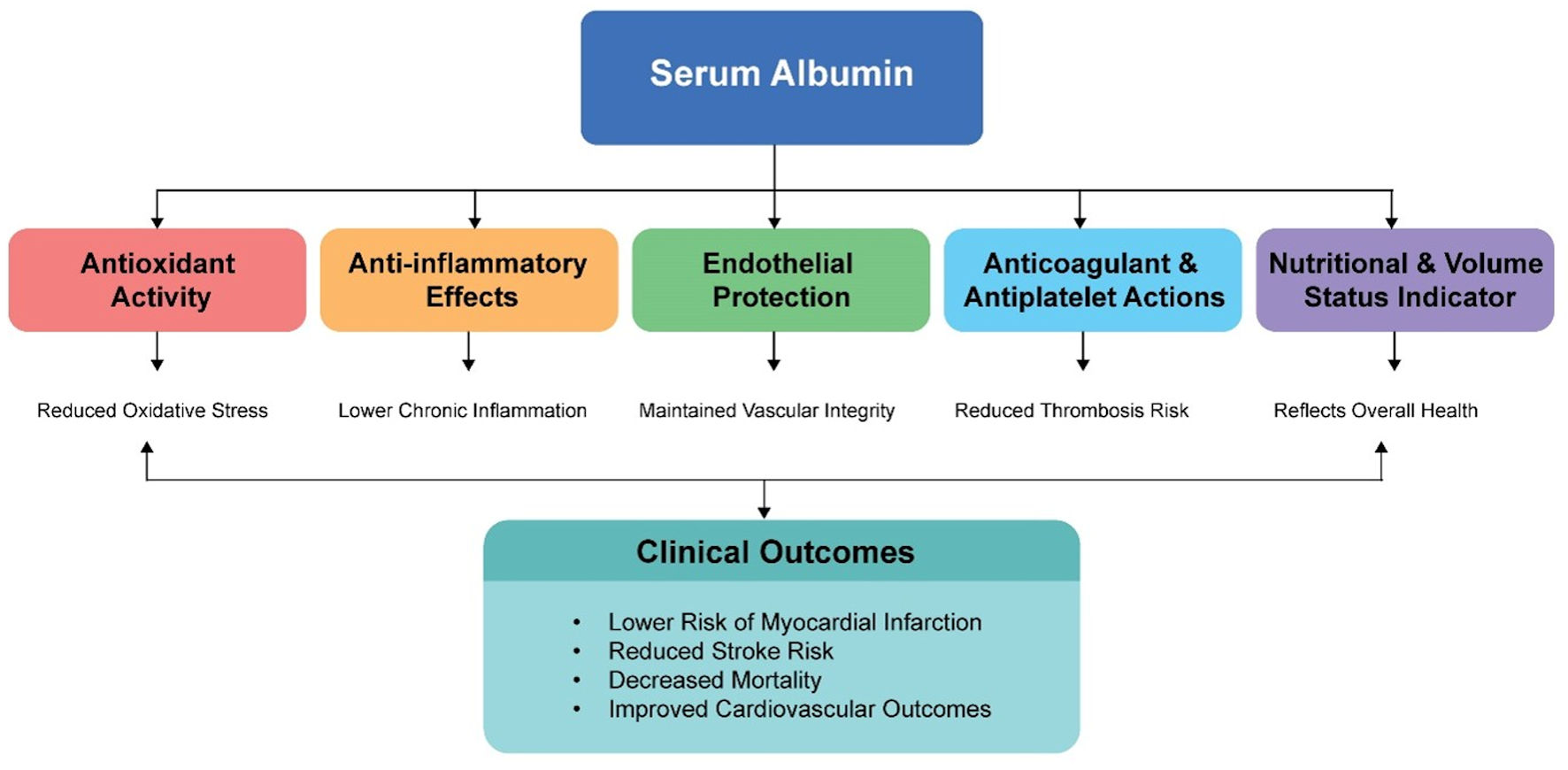
↓ Figure 1. Proposed interaction between SA and CV outcomes (pathophysiological mechanisms by which SA leads to CVD). SA: serum albumin; CV: cardiovascular; CVD: cardiovascular disease.
| Cardiology Research, ISSN 1923-2829 print, 1923-2837 online, Open Access |
| Article copyright, the authors; Journal compilation copyright, Cardiol Res and Elmer Press Inc |
| Journal website https://cr.elmerpub.com |
Review
Volume 17, Number 6, December 2026, pages 587-600
Prognostic Value of Serum Albumin in Elderly Cardiovascular Disease Management
Figure
Table
| Study | Population | CVD type | Albumin threshold | Key findings | References |
|---|---|---|---|---|---|
| A/G ratio: albumin-to-globulin ratio; ADHF: acute decompensated heart failure; aHR: adjusted hazard ratio; AIS: acute ischemic stroke; aOR: adjusted odds ratio; CAD: coronary artery disease; CHF: congestive heart failure; CHD: coronary heart disease; CRT-D: cardiac resynchronization therapy defibrillator; CV: cardiovascular; CVD: cardiovascular disease; HF: heart failure; hHF: hospitalization for heart failure; MACE: major adverse cardiovascular events; mRS: modified Rankin scale; NIDCM: nonischemic dilated cardiomyopathy; PAD: peripheral artery disease; SA: serum albumin; sACR: serum albumin-to-creatinine ratio; SD: standard deviation; SMR: secondary mitral regurgitation; TIA: transient ischemic attack. | |||||
| Prospective (registry) cohort | N = 13,618; mean age, 62.2 ± 11.3 years; China; multicenter national registry; patients with AIS or TIA | AIS and TIA | < 3.5 g/dL | The relationship in each 10 g/L lower albumin with prognosis was consistently inverse (aOR, 1.17; aHR, 1.86) | Zhou et al, 2021 [48] |
| Cross-sectional study | N = 10,900; mean age, 63.9 ± 9.3 years; China; cross-sectional, hospital-based cohort; adult patients with hypertension | Chinese hypertensive patients | 4.0 g/dL | Lower SA was associated with the prevalence of PAD only in males but not in females | Ding et al, 2020 [49] |
| Retrospective study | N = 378; mean age, 67.1 ± 11.2 years; Italy; single-center cohort; patients with chronic HF | HF | 3.5 g/dL | Patients with chronic HF who exhibited low SA levels showed a higher risk of MACE, hHF, and total mortality | Armentaro et al, 2024 [50] |
| Randomized COAPT trial | N = 614; mean age, 71–74 years; multinational; randomized controlled trial; HF with SMR | HF and SMR | 4.0 g/dL | 559 patients (91.0%) had baseline SA levels (median, 4.0 g/dL; interquartile range (IQR) 3.7–4.2 g/dL). Patients with albumin levels < 4.0 g/dL were older and more likely to have ischemic cardiomyopathy and hospitalization within the year before enrolment compared with those with albumin levels ≥ 4.0 g/dL | Feng et al, 2023 [51] |
| Retrospective study | N = 3,057; median age, 58 years; Turkey; multicenter cohort; patients with ST-segment, elevation myocardial infarction undergoing PCI | ST-segment elevation myocardial infarction | - | sACR was inversely associated with short-term clinical outcomes in patients with STEMI after PCI | Turkyilmaz et al, 2022 [52] |
| Retrospective study | N = 1,058; mean age, 67–69 years; China; hospital-based cohort; elderly patients with NIDCM | NIDCM | 3.5 g/dL | Hypoalbuminemia was associated with an increased risk of in-hospital and long-term mortality in elderly patients with NIDCM | Li et al, 2023 [34] |
| Retrospective cohort | N = 321; age ≥ 65 years; Taiwan; single-center cohort; elderly patients with stable CAD | Stable CAD | < 3.75 vs ≥ 3.75 g/dL | Patients with albumin ≥ 3.75 g/dL had significantly lower long-term cardiovascular mortality vs those with < 3.75 g/dL. HR about 0.20 for CV mortality in the ≥ 3.75 group after adjustment | Cheng et al, 2024 [45] |
| Retrospective cohort | N = 119; age ≥ 65 years; United States; single-center study; patients hospitalized with ADHF | ADHF | ≤ 2.9 g/dL | Low albumin (≤ 2.9) at admission was associated with increased all-cause mortality after a follow-up of 11 years | Mene-Afejuku et al, 2019 [46] |
| Prospective, monocenter study | N = 64; institutionalized elderly; France; monocenter prospective study; patients hospitalized with acute HF | Acute HF (in-hospital outcomes) | <3.0 g/dL (median) | SA < 3.0 g/dL was a strong predictor of in-hospital mortality; high sensitivity (94%) and moderate specificity (68%) for in-hospital mortality prediction | Arques et al, 2008 [53] |
| Observational cohort | N = 873; mean age, 70.9 ± 7.5 years; China; cohort study; elderly patients with chronic aortic regurgitation | Valvular heart disease, chronic aortic regurgitation | 3.5 g/dL | When albumin was < 3.5 g/dL, each 1 g/L decrease corresponded to 25% increased risk of all-cause mortality; hypoproteinemia (< 3.5 g/dL) had an HR of 2.93 | Li et al, 2025 [54] |
| Epidemiologic cohort | 820 elderly men (mean age, 64–84 years) | Coronary heart disease risk/incidence and mortality | Albumin was expressed as a continuous variable; moderate reductions (per SD decrease about 2.5 g/dL) | Moderate to low albumin levels predicted incident coronary heart disease, particularly in those with high cholesterol; lower albumin levels were associated with CHD mortality and all-cause mortality in elderly men | Weijenberg et al, 1997 [55] |
| Cohort study | 546 patients (mean age 78 ± 9 years) | Acute nonischemic HF | < 3.57 g/dL | Hypoalbuminemia (< 3.4 g/dL) was independently predictive of hospital mortality; good sensitivity (78.8%) and specificity (75%) | Ancion et al, 2017 [47] |
| Cohort/retrospective study | 759 patients (mean age, about 68 years) | AIS | ≥ 4.9 g/dL (4.9 g/dL) | Patients with lower albumin levels had higher odds of poor functional outcome (mRS > 3/death) at the 3-month follow-up period | Dziedzic et al, 2004 [56] |
| Prospective study | 11, 298 patients; (mean age = 62 years) | AIS | A/G ratio cutoffs were 1.1 and 1.9, depending on the outcome and time point; clinically relevant cutoff, 1.38 | Lower serum A/G levels were associated with poor functional outcomes and all-cause mortality at 3-month and 1-year follow-up periods in patients with AIS | Wang et al, 2023[57] |
| Retrospective study | 477 patients; (age: T1, 62 (56–69); T2, 67 (61–76); T3, 69 (60–75)) | HF patients with CRT-D | > 0.038 g/dL | Low albumin levels were associated with long-term mortality and appropriate shock treatment in patients with HF, including those treated with CRT-D | Pay et al, 2024[58] |