Cardiology Research, ISSN 1923-2829 print, 1923-2837 online, Open Access
Article copyright, the authors; Journal compilation copyright, Cardiol Res and Elmer Press Inc
Journal website https://cr.elmerpub.com

Review

Volume 17, Number 6, December 2026, pages 553-560


Digoxin Revisited: An Updated Review in the Light of Recent Trials

Figure

↓  Figure 1. Cellular mechanism of digoxin’s positive inotropic effect. Digoxin inhibits the sarcolemmal Na+/K+-ATPase pump (1), causing intracellular Na+ concentration to rise (2). This increase in intracellular Na+ reduces the ability of the Na+/Ca2+ exchanger (NCX1) to extrude calcium, both by diminishing the transmembrane Na+ gradient the exchanger depends on and by triggering allosteric, sodium-dependent inactivation of NCX1 itself (3), reducing Ca2+ efflux from the cell. This leads to increased intracellular Ca2+ concentration (4), which enhances myocardial contractility (positive inotropy) (5).
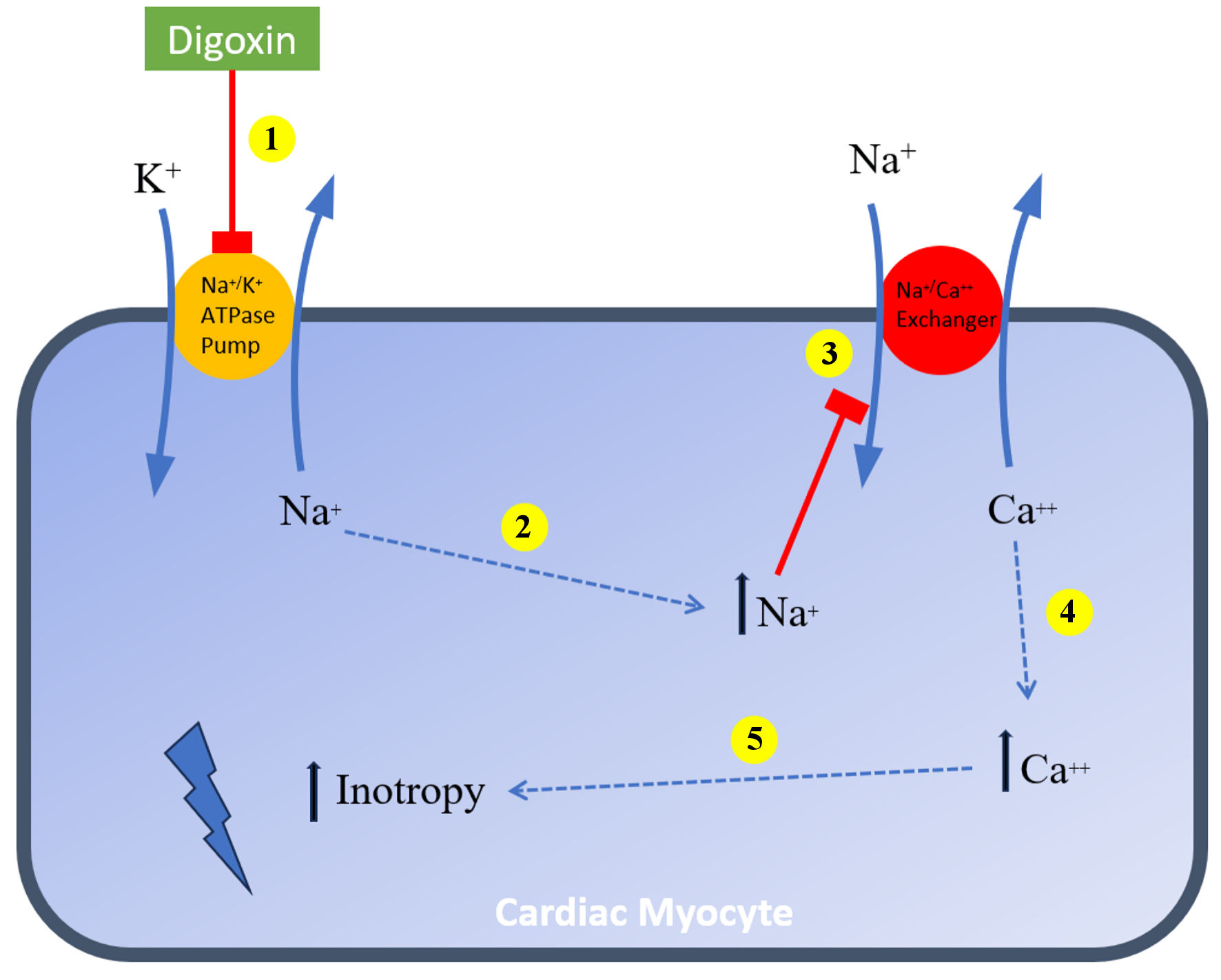
Figure 1.

Table

↓  Table 1. Summary of the Major Trials Related to Digoxin
 
CharacteristicDIG (1997)DIGIT-HF (2025)DECISION (2026)DIG-RHD (2026)
ACEi: angiotensin-converting enzyme inhibitor; ARB: angiotensin II receptor blocker; ARNI: angiotensin receptor-neprilysin inhibitor; BB: beta blocker; CCB: calcium channel blocker; CV: cardiovascular; EF: ejection fraction; GDMT: guideline-directed medical therapy; HF: heart failure; HFmrEF: heart failure with moderately reduced ejection fraction; HFrEF: heart failure with reduced ejection fraction; HR: hazard ratio; mITT: modified intention-to-treat; MRA: mineralocorticoid receptor antagonist; NYHA: New York Heart Association; RHD: rheumatic heart disease; RR: relative risk; SGLT2i: sodium-glucose cotransporter 2 inhibitor.
JournalNEJMNEJMNature MedicineJAMA
DrugDigoxinDigitoxinDigoxin (low-dose)Digoxin
Sample size (n)6,8001,212 (mITT)1,0011,769
PopulationHFrEF (EF ≤ 45%), sinus rhythmHFrEF (EF ≤ 40% NYHA III–IV, or ≤ 30% NYHA II)HFrEF/HFmrEF (EF ≤ 50%)Symptomatic RHD
Age (mean)65 yearsAbout 65 years72 years46 years
Sex (% female)22%About 22%28%72%
Atrial fibrillation0% (excluded)About 25%29%70%
Background therapyACEi (about 95%), diuretics (about 80%); no BB, MRA, ARNI, or SGLT2iBB, ACEi/ARB/ARNI, MRA, SGLT2i (contemporary GDMT)BB (86%), ACEi/ARB/ARNI (89%), MRA (72%), SGLT2i (41%)β-blockers, CCBs, diuretics, anticoagulants (usual care for RHD)
Follow-up (median)37 months36 months36.5 monthsAbout 24 months
Primary endpointAll-cause mortalityDeath or first HF hospitalizationCV death or total worsening HF eventsDeath or new-onset/worsening HF
Primary endpoint resultRR 0.99HR 0.82 (0.69–0.98); P = 0.03RR 0.81 (0.61–1.07); P = 0.133HR 0.82 (0.70–0.97); P = 0.02
Mortality outcomeNo effect (RR 0.99)HR 0.86 (0.69–1.07)HR 0.93 (0.69–1.26)HR 0.94 (0.70–1.26)
HF hospitalization/worsening HF↓ 28% (P < 0.001)HR 0.85 (0.69–1.05)RR 0.76 (0.54–1.05)HR 0.82 (0.69–0.98); P = 0.03