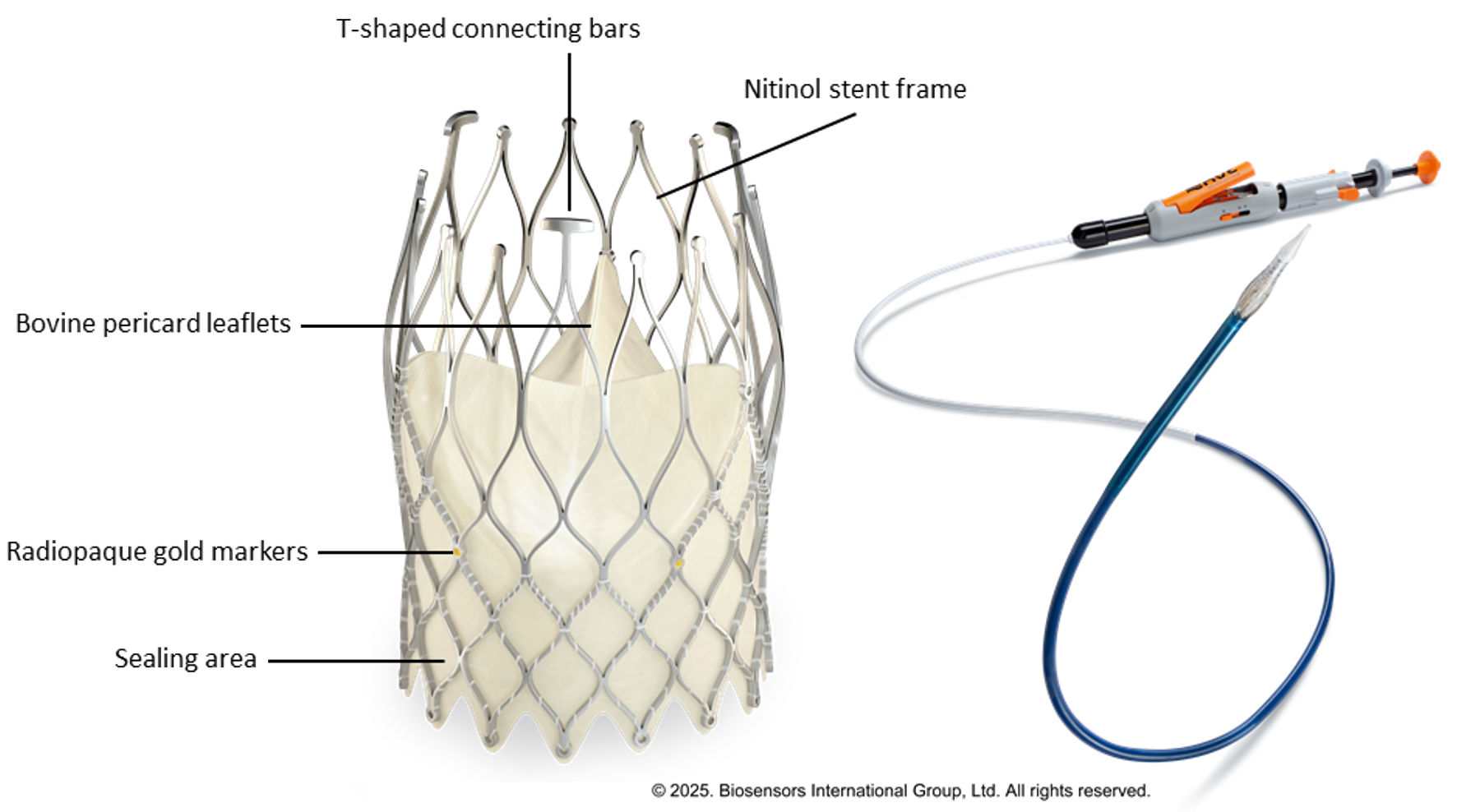
↓ Figure 1. Allegra transcatheter heart valve and transvascular delivery system.
| Cardiology Research, ISSN 1923-2829 print, 1923-2837 online, Open Access |
| Article copyright, the authors; Journal compilation copyright, Cardiol Res and Elmer Press Inc |
| Journal website https://cr.elmerpub.com |
Original Article
Volume 17, Number 6, December 2026, pages 606-615
Outcomes After Transcatheter Aortic Valve Implantation Using the Self-Expanding Allegra Valve in Daily Practice
Figures
Tables
| Data are presented as median, interquartile range, frequency, and percentage. AV: atrioventricular; CABG: coronary artery bypass grafting; COPD: chronic obstructive pulmonary disease; ECG: electrocardiogram; ES: EuroSCORE; GFR: glomerular filtration rate; ICD: implantable cardioverter defibrillator; LVEF: left ventricular ejection fraction; LVEDV: left ventricular end-diastolic volume; MI: myocardial infarction; NT-proBNP: N-terminal pro-brain natriuretic peptide; NYHA: New York Heart Association; PAP: pulmonary artery pressure; PCI: percutaneous coronary intervention; TIA: transient ischemic attack; TEE: transesophageal echocardiography; TTE: transthoracic echocardiography. | |
| Age (years) | 82 (80–85) |
| Female/male (n) | 92/50 |
| Body mass index (kg/m2) | 27 (24–31) |
| NYHA classification ≥ III (n) | 77 (54.2%) |
| Coronary artery disease (n) | 96 (67.6%) |
| Prior MI (n) | 15 (10.6%) |
| Prior PCI (n) | 36 (25.4%) |
| Prior CABG (n) | 20 (14.1%) |
| COPD (n) | 15 (10.6%) |
| Extracardiac arteriopathy (n) | 34 (23.9%) |
| Previous stroke/TIA (n) | 15 (10.6%) |
| ECG | |
| Sinus rhythm (n) | 91 (64.1%) |
| AV block (n) | 25 (17.6%) |
| Bundle branch block (n) | 35 (24.6%) |
| Atrial fibrillation (n) | 64 (45.1%) |
| Pacemaker/ICD (n) | 22 (15.5%) |
| TTE/TEE | |
| LVEF (%) | 57 (50–63) |
| LVEDV (mL) | 86 (68–109) |
| Mitral regurgitation ≥ II (n) | 35 (24.6%) |
| Tricuspid regurgitation ≥ II (n) | 22 (15.5%) |
| Systolic PAP (mm Hg) | 38 (31–46) |
| Creatinine (mg/dL) | 1.0 (0.7–1.2) |
| GFR (mL/min) | 63 (46–80) |
| NT-proBNP (ng/L) | 1,713 (659–5,212) |
| Logistic ES I (%) | 17.4 (12.1–26.7) |
| Logistic ES II (%) | 4.0 (2.6–7.3) |
| Native AS (n = 117) | ViV (n = 25) | |
|---|---|---|
| *P < 0.05, **P < 0.01. Data are presented as median, interquartile range, frequency, and percentage. AV: atrioventricular; CABG: coronary artery bypass grafting; COPD: chronic obstructive pulmonary disease; ECG: electrocardiogram; ES: EuroSCORE; GFR: glomerular filtration rate; ICD: implantable cardioverter defibrillator; LVEF: left ventricular ejection fraction; LVEDV: left ventricular end-diastolic volume; MI: myocardial infarction; NT-proBNP: N-terminal pro-brain natriuretic peptide; NYHA: New York Heart Association; PAP: pulmonary artery pressure; PCI: percutaneous coronary intervention; TIA: transient ischemic attack; TEE: transesophageal echocardiography; TTE: transthoracic echocardiography. | ||
| Age (years) | 82 (80–86) | 80 (73–84)** |
| Female/male (n) | 79/38 | 13/12 |
| Body mass index (kg/m2) | 28 (24–31) | 26 (23–29) |
| NYHA classification ≥ III (n) | 58 (49.6%) | 19 (76.0%)* |
| Coronary artery disease (n) | 77 (65.8%) | 19 (76.0%) |
| Prior MI (n) | 12 (10.3%) | 3 (12.0%) |
| Prior PCI (n) | 29 (24.8%) | 7 (28.0%) |
| Prior CABG (n) | 9 (7.7%) | 11 (44.0%)** |
| COPD (n) | 12 (10.3%) | 3 (12.0%) |
| Extracardiac arteriopathy (n) | 20 (17.1%) | 14 (56.0%)** |
| Previous stroke/TIA (n) | 13 (11.1%) | 2 (8.0%) |
| ECG | ||
| Sinus rhythm (n) | 76 (65.0%) | 15 (60.0%) |
| AV block (n) | 18 (15.4%) | 7 (28.0%) |
| Bundle branch block (n) | 24 (20.5%) | 11 (44.0%)* |
| Atrial fibrillation (n) | 52 (44.4%) | 12 (48.0%) |
| Pacemaker/ICD (n) | 13 (11.1%) | 9 (36.0%)** |
| TTE/TEE | ||
| LVEF (%) | 57 (53–63) | 49 (34–59)** |
| LVEDV (mL) | 81 (65–100) | 119 (81–178)** |
| Mitral regurgitation ≥ II (n) | 22 (18.8%) | 13 (52.0%)** |
| Tricuspid regurgitation ≥ II (n) | 14 (12.0%) | 8 (32.0%)* |
| Systolic PAP (mm Hg) | 38 (30–45) | 43 (36–49) |
| Creatinine (mg/dL) | 0.9 (0.7–1.1) | 1.4 (1.0–2.3)** |
| GFR (mL/min) | 67 (53–81) | 42 (21–64)** |
| NT-proBNP (ng/L) | 1,510 (581–3,538) | 5,278 (1,575–27,500)** |
| Logistic ES I (%) | 15.3 (11.3–23.2) | 35.8 (25.1–78.9)** |
| Logistic ES II (%) | 3.3 (2.5–5.7) | 14.4 (6.6–25.3)** |
| Native AS (n = 117) | ViV (n = 25) | |
|---|---|---|
| *P < 0.05, **P < 0.01. Data are presented as median, interquartile range, frequency, and percentage. ECMO: extracorporeal membrane oxygenation; M-TEER: transcatheter edge-to-edge repair of the mitral valve; TAVI: transcatheter aortic valve implantation; PCI: percutaneous coronary intervention. | ||
| Intervention time (min) | 60.0 (48.5–73.0) | 62.0 (56.5–110.5) |
| Fluoroscopy time (min) | 14.1 (10.3–20.0) | 15.3 (13.2–32.9)* |
| Contrast dye (mL) | 90 (65–130) | 60 (40–80)** |
| Size of Allegra | ||
| 23 mm (n) | 18 (15.4%) | 16 (64.0%)** |
| 27 mm (n) | 62 (53.0%) | 9 (36.0%) |
| 31 mm (n) | 35 (39.9%) | —** |
| Preimplanted aortic prothesis | ||
| Epic supra (n) | — | 1 (23 mm) |
| Hancock II (n) | — | 1 (27 mm) |
| Magna (n) | — | 1 (23 mm) |
| Mitroflow (n) | — | 1 (23 mm), 2 (25 mm) |
| Mosaic (n) | — | 1 (23 mm) |
| Perceval (n) | — | 1 (size S) |
| Perimonut (n) | — | 1 (21 mm), 2 (23 mm),3 (25 mm), 1 (27 mm) |
| Trifecta (n) | — | 2 (23 mm) |
| Preimplanted TAVI prothesis | ||
| Acurate (n) | — | 1 (size M) |
| Evolut R (n) | — | 1 (26 mm) |
| Sapien 3 (n) | — | 1 (20 mm), 2 (23 mm),3 (26 mm) |
| Preimplant balloon dilatation (n) | 114 (97.4%) | 3 (12.0%)** |
| Postimplant balloon dilatation (n) | 68 (58.1%) | 18 (72.0%) |
| Concomitant planned procedures | ||
| Diagnostic coronary angiography (n) | 2 (1.7%) | 1 (4.0%) |
| PCI (n) | 5 (4.3%) | 2 (8.0%) |
| Coronary protection(balloon/stent) (n) | 2 (1.7%) | 2 (8.0%) |
| M-TEER (n) | — | 1 (4.0%) |
| Cerebral protection device (n) | 1 (0.9%) | 3 (12.0%)* |
| ECMO (n) | — | 1 (4.0%) |
| Native AS (n = 117) | ViV (n = 25) | |
|---|---|---|
| *P < 0.05. Data are presented as frequencies and percentages. AV = atrioventricular, TIA = transient ischemic attack. | ||
| Periprocedural mortality (≤ 30 days) (n) | 8 (6.8%) | 3 (12.0%) |
| Neurologic events | ||
| Stroke/TIA (n) | 3 (2.6%) | — |
| Delirium (n) | 4 (3.4%) | 3 (12.0%) |
| Bleeding and transfusions | ||
| Type 1 (n) | 1 (0.9%) | 2 (8.0%) |
| Type 2 (n) | 33 (28.2%) | 5 (20.0%) |
| Type 3 (n) | 3 (2.6%) | 3 (12.0%) |
| Type 4 (n) | — | — |
| Vascular complications | ||
| Major (n) | 6 (5.1%) | 1 (4.0%) |
| Minor (n) | 6 (5.1%) | 1 (4.0%) |
| Cardiac structural complications | ||
| Major (n) | 1 (0.9%) | — |
| Minor (n) | — | — |
| Other acute procedural and technical valve-related complications | ||
| Intraprocedural conversion to open surgery (n) | 2 (1.7%) | 1 (4.0%) |
| Valve embolization (n) | 3 (2.6%) | 2 (8.0%) |
| Ectopic valve deployment (n) | 3 (2.6%) | 1 (4.0%) |
| Conduction disturbances and arrhythmias | ||
| New bundle branch and/or AV block (n) | 6 (5.1%) | — |
| New atrial fibrillation (n) | 1 (0.9%) | — |
| New permanent pacemaker (n) | 22 (18.8%) | —* |
| Acute kidney injury | ||
| Stage 1 (n) | 6 (5.1%) | — |
| Stage 2 (n) | — | — |
| Stage 3 (n) | 1 (0.9%) | — |
| Stage 4 (n) | 3 (2.6%) | — |