| Cardiology Research, ISSN 1923-2829 print, 1923-2837 online, Open Access |
| Article copyright, the authors; Journal compilation copyright, Cardiol Res and Elmer Press Inc |
| Journal website https://cr.elmerpub.com |
Original Article
Volume 17, Number 5, October 2026, pages 476-488

Incidence and Factors Associated With In-Hospital Acute Myocardial Infarction in Patients With Obesity Undergoing Transcatheter Aortic Valve Replacement: A National Inpatient Sample Analysis
Li Li Zhenga, e, Gui Zhen Xua, e, Xiao Jun Zenga, e, Zi Hao Zhoub, e, Hao Xiec, Tao Shia, Long Hua Liua, Yan Zhua, Xiang Hua Caod, Wen Gui Liua, f, Sheng Qi Xiea, f
aDepartment of Anesthesiology, Dongguan Songshan Lake Tungwah Hospital, Dongguan, Guangdong 523000, China
bKangda College of Nanjing Medical University, Nanjing, Jiangsu 210000, China
cDivision of Orthopaedic Surgery, Department of Orthopaedics, Nanfang Hospital, Southern Medical University, Guangzhou, Guangdong 510515, China
dDepartment of Anesthesiology, Dongguan Tungwah Hospital, Dongguan, Guangdong, China
eThese authors contributed equally to this work.
fCorresponding Authors: Sheng Qi Xie and Wen Gui Liu, Department of Anesthesiology, Dongguan Songshan Lake Tungwah Hospital, Dongguan, Guangdong 523000, Chinaand
Manuscript submitted May 28, 2026, accepted July 24, 2026, published online August 31, 2026
Short title: AMI in Patients With Obesity Undergoing TAVR
doi: https://doi.org/10.14740/cr2257
| Abstract | ▴Top |
Background: The impact of obesity on acute myocardial infarction (AMI) risk in patients undergoing transcatheter aortic valve replacement (TAVR) remains poorly characterized, particularly with respect to the incidence and specific factors associated with this complication. This study aimed to determine the incidence, associated factors, and clinical implications of in-hospital AMI among patients with obesity undergoing TAVR.
Methods: We analyzed the National Inpatient Sample (2016–2022) to identify adult patients with obesity (body mass index (BMI) ≥ 30 kg/m2) undergoing TAVR, with non-obese patients as a comparative cohort. Multivariable logistic regression identified factors associated with in-hospital AMI.
Results: Among 19,971 patients with obesity undergoing TAVR, 506 (2.5%) experienced in-hospital AMI, compared with 2.7% among non-obese patients (P = 0.295). Patients with obesity were younger (median age 75 vs. 81 years, P < 0.001) and had lower in-hospital mortality (0.8% vs. 1.3%, P = 0.002) but longer hospital stays (3 vs. 2 days, P < 0.001) and higher hospitalization costs ($217,785 vs. $179,887, P < 0.001) compared with patients without obesity. Factors associated with higher AMI odds in the obesity cohort included medium hospital size (odds ratio (OR) 1.687, 95% confidence interval (CI) 1.086–2.619), large hospital size (OR 1.840, 95% CI 1.234–2.744), deficiency anemia (OR 1.466, 95% CI 1.196–1.796), chronic blood loss anemia (OR 2.960, 95% CI 1.604–5.463), congestive heart failure (OR 2.530, 95% CI 1.871–3.421), fluid and electrolyte disorders (OR 2.734, 95% CI 2.239–3.338), other neurological disorders (OR 2.092, 95% CI 1.453–3.011), peripheral vascular disorders (OR 1.260, 95% CI 1.017–1.561), pulmonary circulation disorders (OR 1.297, 95% CI 1.054–1.595), and weight loss (OR 2.156, 95% CI 1.400–3.319). Conversely, elective admission (OR 0.046, 95% CI 0.037–0.058) was associated with lower AMI odds. AMI was associated with higher mortality (3.8% vs. 0.8%), prolonged hospitalization (11 vs. 3 days), and increased costs ($349,531 vs. $217,785) (all P < 0.001).
Conclusions: In-hospital AMI occurs in 2.5% of patients with obesity undergoing TAVR—a rate comparable to that of patients without obesity (2.7%, P = 0.295)—and is associated with worse outcomes. Despite lower overall mortality in the obesity cohort—consistent with the obesity paradox—AMI risk was not similarly attenuated, suggesting that the protective effect of obesity does not uniformly extend to all periprocedural complications. Rather than simply documenting an expected complication rate, the clinical value of our study lies in identifying potentially modifiable factors associated with AMI specifically in the obesity cohort—including anemia, fluid and electrolyte disorders, and weight loss—that may inform targeted preoperative optimization.
Keywords: Transcatheter aortic valve replacement; Acute myocardial infarction; Patients with obesity; Risk factors; In-hospital outcomes
| Introduction | ▴Top |
Transcatheter aortic valve replacement (TAVR) has emerged as a primary treatment alternative for patients with symptomatic severe aortic stenosis, particularly in those at intermediate to high surgical risk [1, 2], with its indications expanding to increasingly lower-risk populations [3]. As procedural techniques evolve, TAVR volumes continue to rise globally [4]. However, acute myocardial infarction (AMI) remains a serious complication in patients undergoing TAVR, primarily resulting from coronary embolism of dislodged calcific debris or valve frame compression of the coronary ostia [5]. The clinical significance of periprocedural AMI is underscored by meta-analyses demonstrating its strong association with 30-day (odds ratio (OR) 8.5) and mid-term mortality (OR 6.5) [6], with one study reporting periprocedural myocardial injury in 20.5% of patients [7]. Identifying factors associated with in-hospital AMI is therefore critical for optimizing perioperative management.
This topic is particularly relevant in the context of the global obesity epidemic, as the proportion of obese patients undergoing TAVR has increased substantially. While obesity is associated with an increased prevalence of cardiovascular risk factors, an “obesity paradox” has been described, wherein obese patients exhibit lower post-TAVR mortality than their normal-weight counterparts [8]. However, this paradigm has recently been challenged by evidence demonstrating comparable outcomes across body mass index (BMI) categories [9] and, conversely, significantly higher risks for patients with super obesity [10]. These seemingly contradictory findings highlight the heterogeneous impact of obesity on TAVR outcomes, suggesting that risk profiles may differ by complication type.
Despite these insights, the incidence and specific factors associated with AMI among patients with obesity undergoing TAVR remain inadequately characterized, even though obesity is a well-established risk factor for AMI in the general population. Existing studies have largely focused on all-cause mortality or composite endpoints (e.g., death, stroke, and bleeding), leaving the detailed profile of AMI—particularly its non-traditional associated factors such as anemia, electrolyte disorders, and weight loss—underexplored in this growing patient subset. These knowledge gaps justify a dedicated analysis focused specifically on AMI in this population. To address this gap, we conducted a retrospective analysis of the National Inpatient Sample (NIS) database, focusing on patients with obesity who underwent TAVR from 2016 to 2022, with patients without obesity as a comparative cohort. Specifically, we aimed to: (1) determine the incidence of in-hospital AMI in this cohort; (2) identify factors independently associated with in-hospital AMI among patients with obesity; (3) evaluate the impact of AMI on in-hospital mortality, length of stay, and hospitalization costs; and (4) compare outcomes between obese and non-obese patients. Our objective was to describe the incidence and explore associated factors within the obese patient cohort, rather than to compare outcomes across BMI categories.
| Materials and Methods | ▴Top |
Data source
This study utilized the NIS database, which is maintained by the Healthcare Cost and Utilization Project (HCUP) and sponsored by the Agency for Healthcare Research and Quality (AHRQ). The NIS represents the largest publicly available all-payer inpatient database in the United States, capturing approximately 20% of all hospitalizations through a stratified sample of over 1,000 hospitals nationwide. This sampling strategy yields data on more than 7 million unweighted hospital stays annually, providing excellent generalizability to the national population [11]. The database encompasses patient demographic characteristics, hospital-level information, discharge disposition, length of stay, total hospitalization charges, and up to 40 diagnostic and procedural codes derived from the International Classification of Diseases, Clinical Modification (ICD-CM). Access details, restrictions, and direct web links for the NIS database are provided in the Data Availability statement. This study was deemed exempt from institutional review board approval by the Ethics Committee of Dongguan Songshan Lake Tungwah Hospital, as it utilized de-identified, publicly available data from the NIS database. Therefore, informed consent was not required.
Study population and design
We conducted a retrospective cohort study using the NIS database from January 2016 to December 2022. Adult patients (aged ≥ 18 years) undergoing TAVR were identified using the International Classification of Diseases, Tenth Revision, Procedure Coding System (ICD-10-PCS) codes (Supplementary Material 1, cr.elmerpub.com). Within this cohort, patients with a diagnosis of obesity were identified using ICD-10-CM codes corresponding to a BMI of 30 kg/m2 or greater (Supplementary Material 1, cr.elmerpub.com). The validity of these ICD-10-CM codes for identifying obesity has been previously confirmed, with high positive predictive values for BMI ≥ 30 kg/m2 in administrative claims data [12]. To provide a comparative context, a non-obese control cohort was identified from the same TAVR population by excluding all patients with any ICD-10-CM diagnosis codes for obesity (E66.-) or BMI codes of 30 kg/m2 or greater (Z68.30–Z68.39 and Z68.41–Z68.45). Thus, the two groups were mutually exclusive: patients with any obesity-related ICD codes were assigned to the obesity cohort, while those without any such codes were assigned to the non-obese cohort. Baseline characteristics, AMI incidence, in-hospital mortality, length of stay, and total hospitalization charges were compared between the two groups. Patients with missing data on age, sex, or in-hospital mortality were excluded from the analysis (Fig. 1). The study population was subsequently divided into two groups based on the occurrence of AMI during the index hospitalization. AMI was identified using ICD-10-CM codes (Supplementary Material 1, cr.elmerpub.com). Patients without documented AMI served as the reference group. All coding algorithms were previously validated, with detailed code lists and corresponding references provided in Supplementary Material 1 (, cr.elmerpub.com).
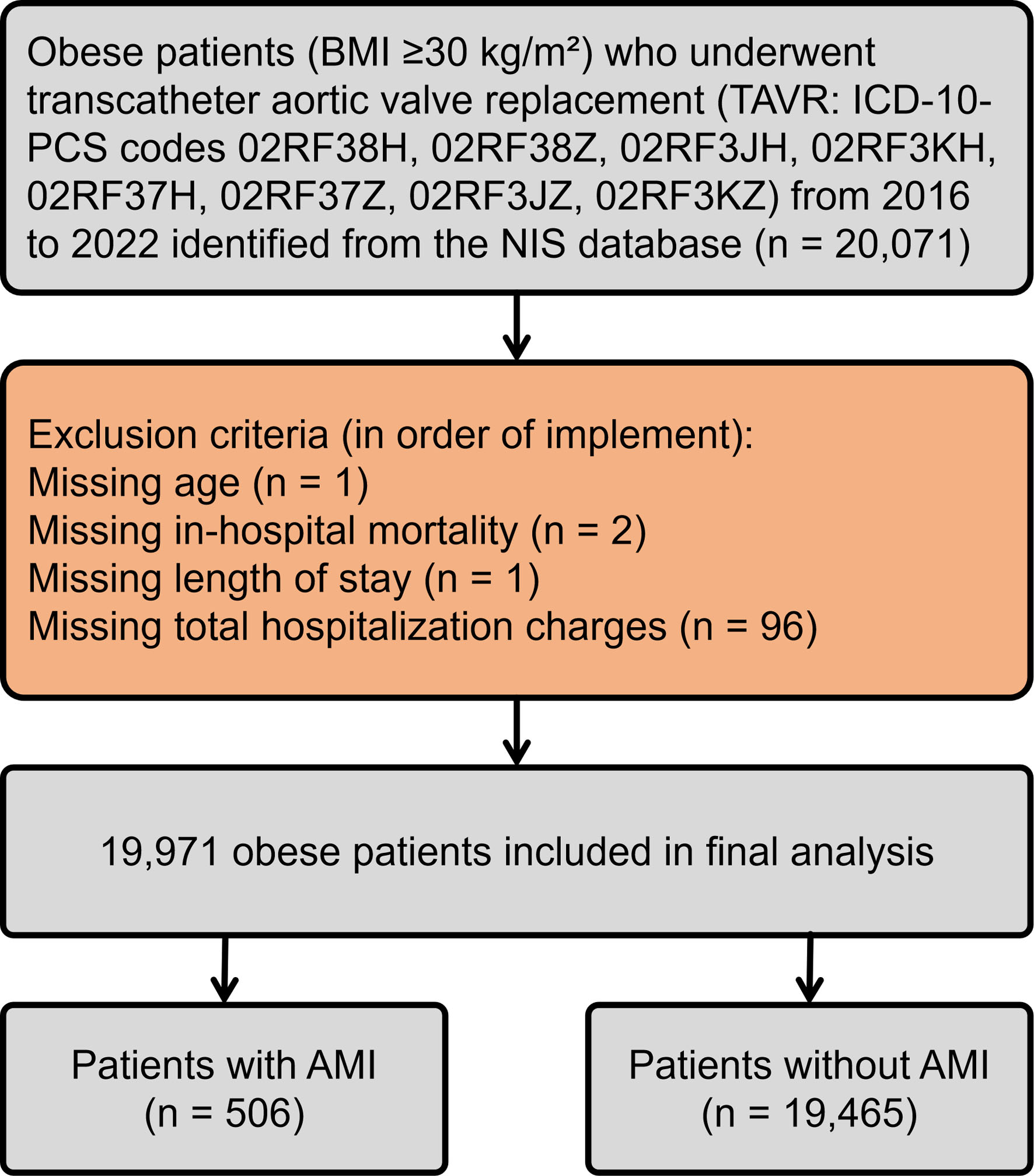 Click for large image | Figure 1. Flowchart of patient selection for in-hospital AMI among patients with obesity undergoing TAVR. AMI: acute myocardial infarction; TAVR: transcatheter aortic valve replacement. |
Variables and outcomes
We extracted comprehensive patient demographic and hospital characteristics as detailed in Table 1. Preoperative comorbidities were identified using ICD-10-CM codes corresponding to the Elixhauser comorbidity measures, defined according to Quan et al 2005 [13], which includes two distinct anemia-related comorbidity measures—deficiency anemia and chronic blood loss anemia—as separate coding categories. These categories were retained as defined to maintain consistency with the validated Elixhauser algorithm. Similarly, the Elixhauser category “pulmonary circulation disorders” encompasses a range of conditions including pulmonary hypertension and pulmonary embolism, and was retained as a standardized coding category without further subclassification. The number of comorbidities was categorized as < 3 and ≥ 3 for analytical purposes. The primary outcome was the incidence of in-hospital AMI among patients with obesity undergoing TAVR, defined as a diagnosis of AMI occurring during the index hospitalization, identified using ICD-10-CM codes (Supplementary Material 1, cr.elmerpub.com). As the NIS database does not provide precise timing of events relative to the procedure, this outcome encompasses AMI events that may have occurred before, during, or after TAVR. Secondary outcomes included in-hospital mortality, length of hospital stay, total hospitalization charges, and postoperative complications (sepsis, blood transfusion, acute respiratory failure, hemorrhage, cardiac arrest, arrhythmia, and pneumonia), all identified using corresponding ICD-10-CM diagnostic codes.
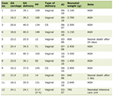 Click to view | Table 1. Variables Used in Binary Logistic Regression Analysis |
Statistical analysis
Continuous variables were presented as median (range) and compared using the Mann–Whitney U test, while categorical variables were expressed as frequencies with percentages and compared using the Chi-square or Fisher’s exact test, as appropriate. The unit of analysis was hospitalization rather than individual patient. Statistical significance was defined as a two-sided P < 0.05. We first calculated the overall AMI incidence among obese TAVR patients and compared baseline characteristics and preoperative comorbidities between patients with and without AMI. Variables with P < 0.05 in univariate analysis were entered into multivariable logistic regression to identify factors independently associated with in-hospital AMI. Clinically relevant variables and variables selected a priori were also included in multivariable models. The models adjusted for age, sex, race, comorbidity burden, insurance type, hospital bed size, admission type, teaching status, hospital region, and individual preoperative comorbidities. Results were reported as adjusted ORs with 95% confidence intervals (CIs). Separate multivariable logistic regression analyses were performed to examine associations between postoperative complications and in-hospital AMI, adjusting for the same confounders. National estimates were generated using NIS discharge weights. All analyses accounted for the complex survey design of the NIS database to ensure nationally representative inferences.
| Results | ▴Top |
Incidence of in-hospital AMI among obese patients undergoing TAVR
From 2016 to 2022, a total of 19,971 (weighted N = 99,855) patients with obesity and 91,850 (weighted N = 459,250) non-obese patients undergoing TAVR were identified in the NIS database. Among patients with obesity, 506 (weighted N = 2,530) developed AMI during the index hospitalization, yielding an overall weighted incidence of 2.5%, compared with 2.7% among non-obese patients (P = 0.295) (Table 2). The annual incidence of AMI is shown in Figure 2.
Click to view | Table 2. Patient Characteristics and Outcomes of In-Hospital AMI Among Patients With Obesity Undergoing TAVR, With Non-Obese Comparison |
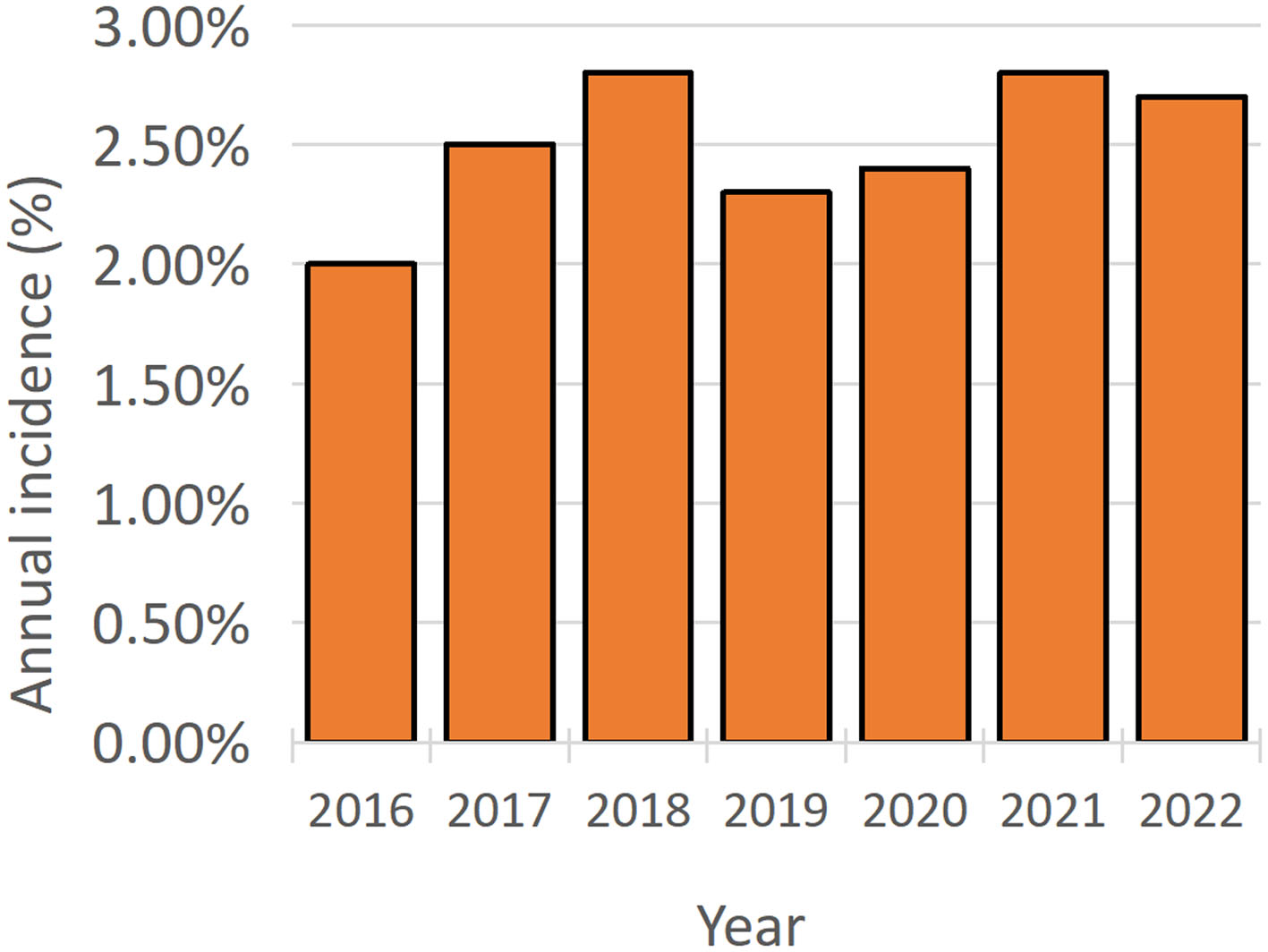 Click for large image | Figure 2. Annual incidence of in-hospital acute myocardial infarction among patients with obesity undergoing TAVR. TAVR: transcatheter aortic valve replacement. |
Comparison between obese and non-obese patients
Compared with patients without obesity, the obesity cohort was significantly younger (median age 75 vs. 81 years, P < 0.001), had a higher proportion of female patients (50.0% vs. 42.2%, P < 0.001), and had a higher comorbidity burden (≥ 3 comorbidities: 95.5% vs. 91.3%, P < 0.001). Despite their higher comorbidity burden, patients with obesity had significantly lower in-hospital mortality (0.8% vs. 1.3%, P = 0.002) but longer hospital stays (3 vs. 2 days, P < 0.001) and higher hospitalization costs ($217,785 vs. $179,887, P < 0.001) compared with non-obese patients. However, the incidence of AMI did not differ significantly between the two groups (2.5% vs. 2.7%, P = 0.295).
Patient demographics between the two groups
Significant differences were observed in baseline characteristics between patients with and without in-hospital AMI (Table 2). Patients who experienced AMI were slightly younger (median age 74 vs. 75 years, P = 0.009). The proportion of patients aged 18–64 years was higher in the AMI group compared to the non-AMI group (13.8% vs. 10.0%, P = 0.005), while those aged ≥ 65 years were less frequent in the AMI group (86.2% vs. 90.0%, P = 0.005). No significant difference in sex distribution was found between the two groups (P = 0.235).
Racial distribution differed significantly (P < 0.001). White patients constituted a lower proportion in the AMI group (79.4% vs. 85.3%), whereas Black (6.5% vs. 4.6%) and Hispanic (9.7% vs. 4.6%) patients were overrepresented in the AMI group. The proportions of Asian or Pacific Islander, Native American, and other races were similar between groups.
Patients with AMI had a higher comorbidity burden: those with ≥ 3 comorbidities accounted for 97.6% of the AMI group compared to 95.4% of the non-AMI group (P = 0.018).
Hospital characteristics between the two groups
Hospital characteristics also differed significantly (Table 2). Patients with AMI were more likely to be treated in large hospitals (75.7% vs. 69.4%) and less likely in small (5.5% vs. 8.5%) or medium (18.8% vs. 22.1%) hospitals (P = 0.005). Elective admission was markedly less frequent in the AMI group (20.8% vs. 85.2%, P < 0.001). Teaching hospital status did not differ between groups (P = 0.658).
Geographic variation was observed (P = 0.001). The proportion of AMI was higher in the Northeast (23.3% vs. 20.9%) and West (23.1% vs. 17.7%) regions, and lower in the Midwest or North Central (20.0% vs. 26.4%) and South (33.6% vs. 35.0%) compared to the non-AMI group. Insurance type did not show significant differences (P = 0.330).
Adverse impact of AMI
As shown in Table 2, in-hospital mortality was significantly higher in patients with AMI (3.8% vs. 0.8%, P < 0.001). The median length of hospital stay was substantially prolonged in the AMI group (11 vs. 3 days, P < 0.001). Consequently, total hospitalization charges were markedly increased, with a median difference of $131,746 ($349,531 vs. $217,785, P < 0.001).
Factors associated with in-hospital AMI among obese patients undergoing TAVR
After multivariable adjustment, the following factors remained significantly associated with AMI (Fig. 3). Compared to small hospitals, medium-sized hospitals (OR = 1.687, 95% CI: 1.086–2.619, P = 0.020) and large hospitals (OR = 1.840, 95% CI: 1.234–2.744, P = 0.003) were associated with significantly increased odds of AMI. Elective admission was associated with significantly lower odds of AMI (OR = 0.046, 95% CI: 0.037–0.058, P < 0.001). Age ≥ 65 years, female sex, race categories, number of comorbidities (≥ 3), insurance types, teaching hospital status, and hospital region were not independently associated with AMI in the multivariable model (all P > 0.05).
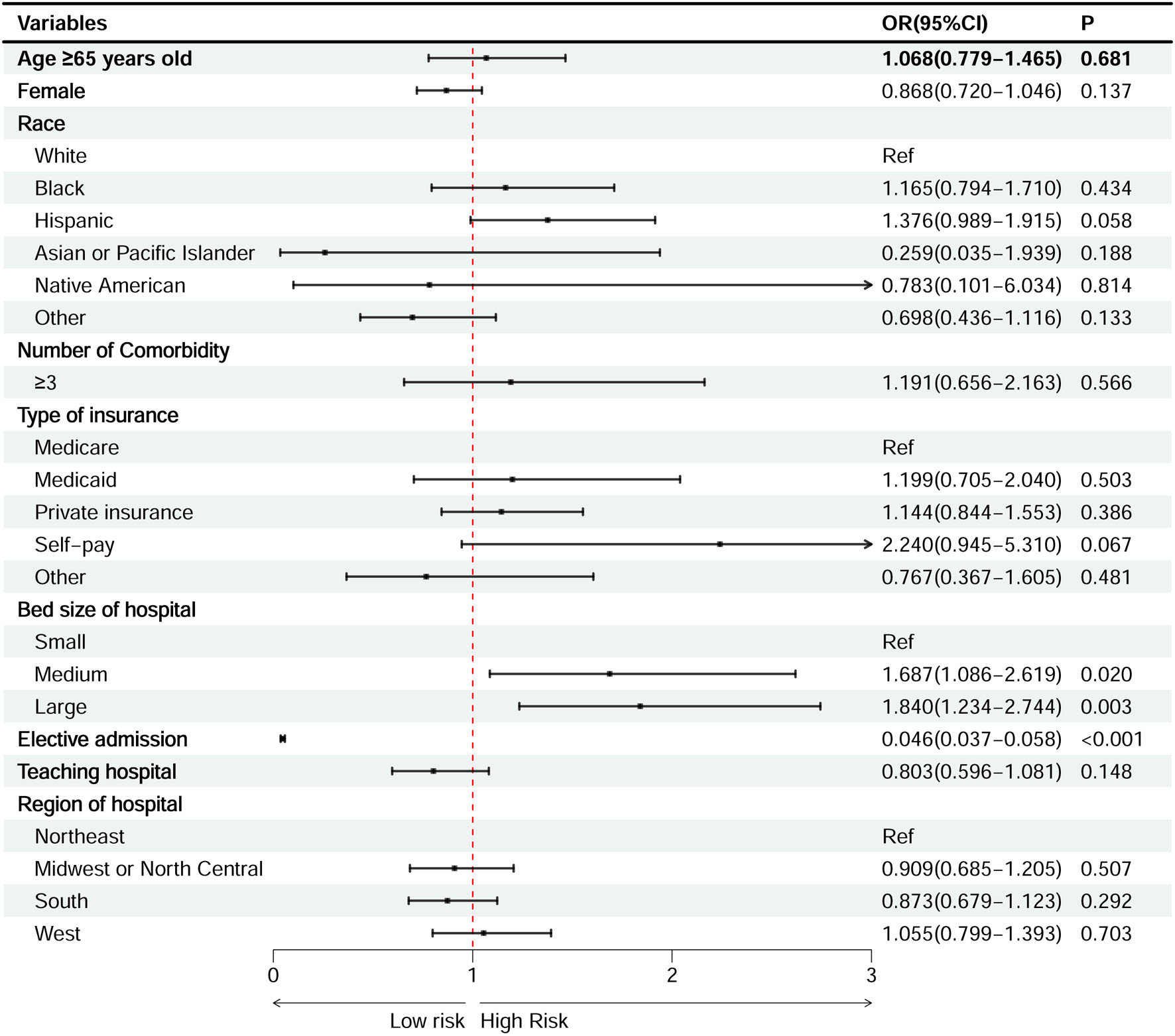 Click for large image | Figure 3. Factors associated with in-hospital AMI among patients with obesity undergoing TAVR. AMI: acute myocardial infarction; TAVR: transcatheter aortic valve replacement. |
Preoperative comorbidities associated with in-hospital AMI among obese patients undergoing TAVR
Univariate analysis revealed multiple preoperative comorbidities significantly associated with AMI (Fig. 4). After multivariable adjustment, the following comorbidities remained significantly associated with AMI: deficiency anemia (OR = 1.466, 95% CI: 1.196–1.796, P < 0.001), chronic blood loss anemia (OR = 2.960, 95% CI: 1.604–5.463, P = 0.001), congestive heart failure (OR = 2.530, 95% CI: 1.871–3.421, P < 0.001), fluid and electrolyte disorders (OR = 2.734, 95% CI: 2.239–3.338, P < 0.001), other neurological disorders (OR = 2.092, 95% CI: 1.453–3.011, P < 0.001), peripheral vascular disorders (OR = 1.260, 95% CI: 1.017–1.561, P = 0.035), pulmonary circulation disorders (OR = 1.297, 95% CI: 1.054–1.595, P = 0.014), and weight loss (OR = 2.156, 95% CI: 1.400–3.319, P < 0.001). Other comorbidities, including acquired immune deficiency syndrome (AIDS), alcohol abuse, rheumatoid arthritis, chronic pulmonary disease, coagulopathy, depression, diabetes, drug abuse, hypertension, liver disease, lymphoma, metastatic cancer, paralysis, psychoses, renal failure, and solid tumor without metastasis, did not retain statistical significance in multivariable analysis (all P > 0.05).
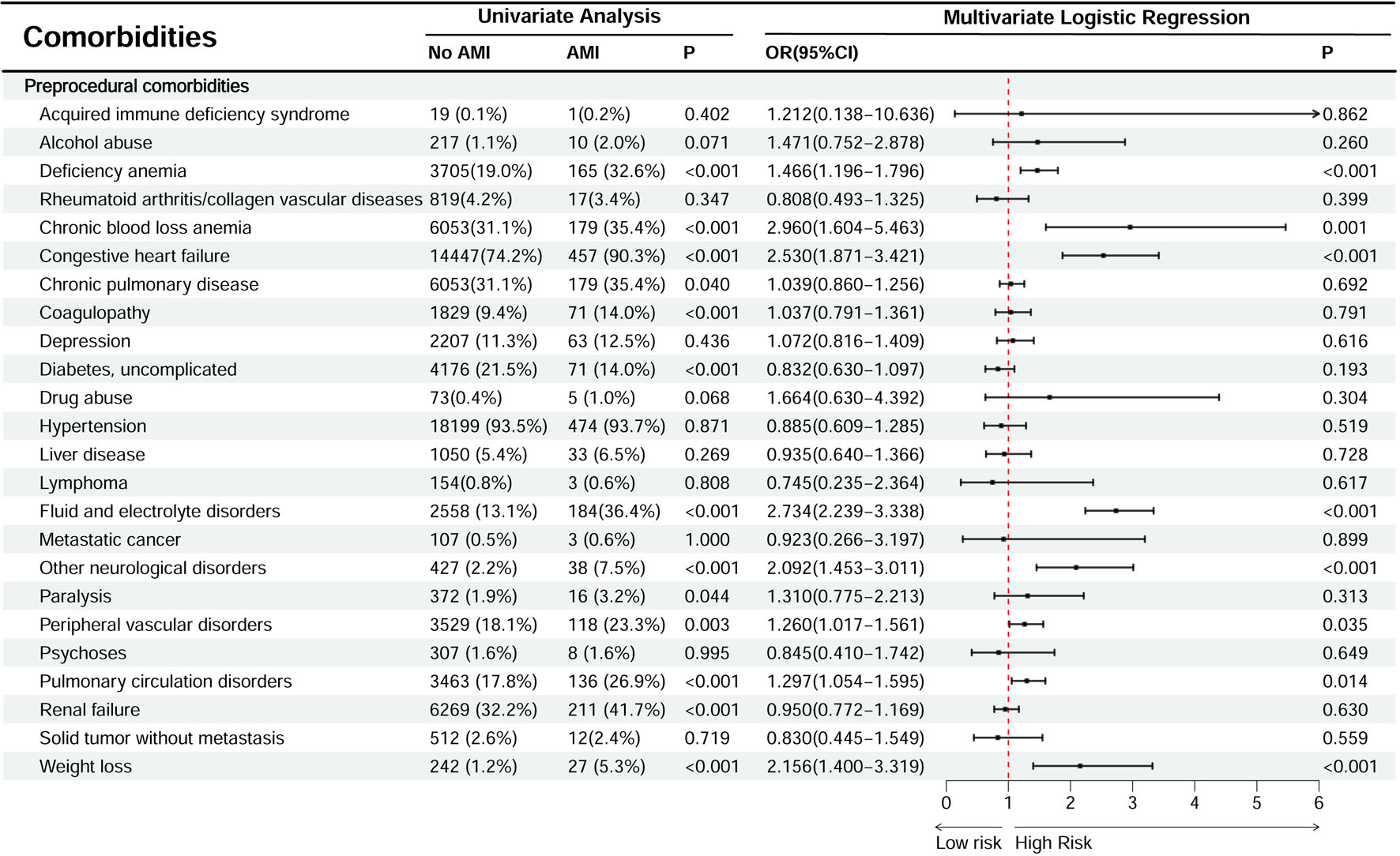 Click for large image | Figure 4. Relationship between in-hospital AMI and preoperative comorbidities among patients with obesity undergoing TAVR. AMI: acute myocardial infarction; TAVR: transcatheter aortic valve replacement. |
Association between in-hospital complications and in-hospital AMI among obese TAVR hospitalizations
Several postoperative complications occurred more frequently in patients with AMI (Fig. 5). In univariate analysis, sepsis, blood transfusion, acute respiratory failure, cardiac arrest, arrhythmia, and pneumonia showed significantly higher incidence in the AMI group (all P < 0.001, except arrhythmia P = 0.006). Hemorrhage did not differ significantly (P = 0.067).
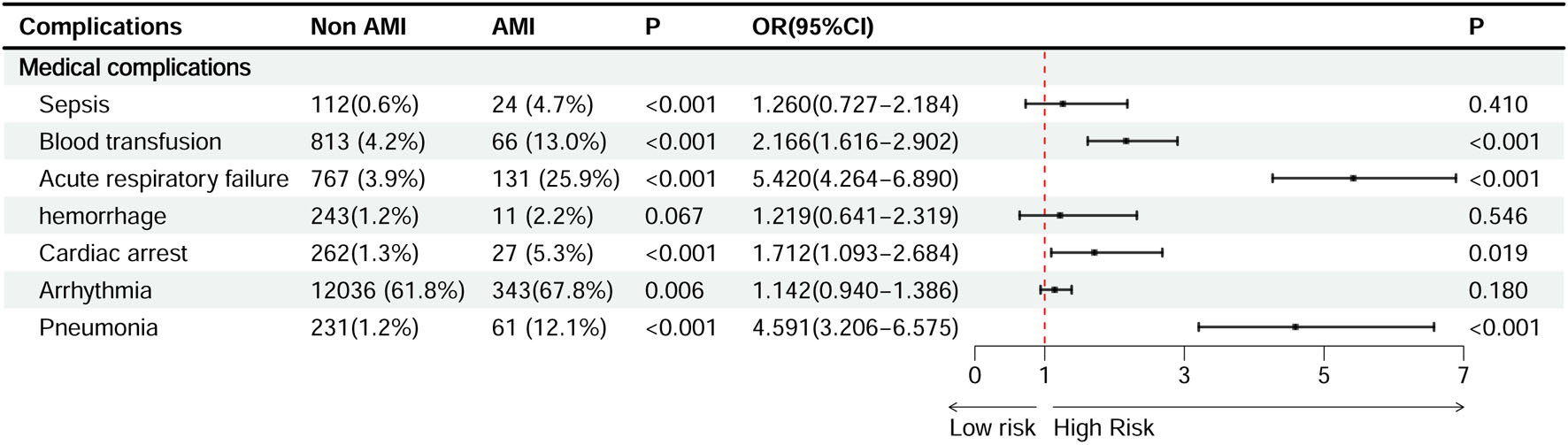 Click for large image | Figure 5. Association between in-hospital complications and AMI among patients with obesity undergoing TAVR. AMI: acute myocardial infarction; TAVR: transcatheter aortic valve replacement. |
After multivariable adjustment, blood transfusion (OR = 2.166, 95% CI: 1.616–2.902, P < 0.001), acute respiratory failure (OR = 5.420, 95% CI: 4.264–6.890, P < 0.001), cardiac arrest (OR = 1.712, 95% CI: 1.093–2.684, P = 0.019), and pneumonia (OR = 4.591, 95% CI: 3.206–6.575, P < 0.001) remained significantly associated with AMI.
| Discussion | ▴Top |
This large-scale retrospective analysis of the NIS database provides contemporary insights into the incidence, associated factors, and clinical implications of in-hospital AMI among patients with obesity undergoing TAVR. Over the 7-year study period, we observed an overall AMI incidence of 2.5% among 19,971 patients with obesity undergoing TAVR, a rate consistent with previous reports [14]. Although obesity has traditionally been associated with a paradoxical protective effect—termed the “obesity paradox”—our findings suggest that this protection does not uniformly extend to all complications. Meta-analyses have demonstrated an obesity paradox in TAVR populations, typically showing lower all-cause mortality in patients with obesity compared with normal-weight counterparts [8]. However, this paradox has been increasingly challenged by evidence suggesting that the apparent survival benefit may reflect residual confounding from frailty and nutritional status rather than a direct protective effect of adiposity [9, 15]. Importantly, the obesity paradox has been primarily described for mortality and heart failure, whereas our study specifically examined AMI—a complication with distinct pathophysiology related to coronary obstruction [5]. Thus, our findings do not contradict the broader paradox literature but suggest that the protective effect, if real, may not uniformly extend to all in-hospital complications [9, 15].
Comparative analysis between patients with obesity and those without obesity
Our comparative analysis revealed that, consistent with the obesity paradox [8, 16], patients with obesity had significantly lower in-hospital mortality (0.8% vs. 1.3%) than their counterparts without obesity, despite having a higher burden of comorbidities. However, despite these favorable overall outcomes, the incidence of AMI was comparable between the two groups (2.5% vs. 2.7%) [17]. This dissociation—obesity conferring a survival benefit but not an AMI benefit—suggests that the protective effect of obesity, if real, is complication-specific rather than universal [18].
Interestingly, patients with obesity had longer hospital stays (3 vs. 2 days) and higher hospitalization costs ($221,000 vs. $179,887) compared with patients without obesity. This may reflect a higher burden of post-procedural complications, including vascular access complications, heart failure exacerbation, and pulmonary complications, which have been shown to be more prevalent in obese patients undergoing TAVR [19]. These findings have important clinical and economic implications: the “obesity paradox” is not a blanket protection but a selective phenomenon—obesity improves survival but prolongs recovery and consumes more healthcare resources [8, 16, 19].
Crucially, the value of our study lies not in documenting an “acceptable” complication rate, but in demonstrating that the obesity paradox—well-described for mortality in TAVR populations—does not extend to AMI. By focusing specifically on patients with obesity and examining AMI as a distinct outcome, our study addresses an important knowledge gap. While prior investigations have predominantly examined composite endpoints or all-cause mortality, our analysis provides a detailed characterization of AMI in this high-risk population and identifies potentially modifiable associated factors—including anemia, electrolyte disorders, and weight loss—that have not been systematically explored in prior TAVR literature. These findings offer clinically actionable insights for preoperative risk stratification beyond the well-recognized association between obesity and cardiovascular risk.
Patient demographics and the evolving understanding of obesity in TAVR
Our univariate analysis revealed a seemingly paradoxical finding: patients experiencing AMI were younger, more frequently belonging to the 18–64 age group in unadjusted analyses. This apparent contradiction may be explained by emerging evidence suggesting that nutritional and frailty status—rather than thinness per se—are the true determinants of adverse outcomes [15, 20]. Consistent with this perspective, the Trans-Pacific TAVR Registry demonstrated that underweight patients, despite being frailer, exhibited greater left ventricular mass regression at 1 year, challenging conventional BMI-centric risk assessment and shifting emphasis toward nutritional and frailty evaluations [9]. The younger age of AMI patients in our cohort may therefore reflect selection bias, wherein younger obese patients undergoing TAVR represent a subgroup with more aggressive disease phenotypes or complex pathology warranting earlier intervention [21]. This hypothesis is further supported by hemodynamic subtype research, which has shown that patients with paradoxical low-flow, low-gradient aortic stenosis—characterized by advanced disease despite preserved ejection fraction—experience the poorest outcomes in patients undergoing TAVR, suggesting that underlying hemodynamic profile, rather than age alone, is associated with post-procedural prognosis [22].
Beyond age-related findings, our unadjusted analysis revealed significant racial disparities, with Black and Hispanic patients disproportionately represented in the AMI group in univariate comparisons. These findings corroborate a comprehensive NIS database analysis documenting increased mortality in Hispanic patients and higher stroke risk in Black patients undergoing TAVR, with Hispanic women facing the highest mortality risk—highlighting the intersectionality of demographic risk factors [23]. The persistent underrepresentation of minority populations in TAVR clinical trials further underscores the need for equitable healthcare delivery [24]. Several interconnected mechanisms may explain these disparities, including differential access to specialized cardiovascular care, variations in comorbidity management, and socioeconomic factors that influence perioperative optimization [25].
Hospital characteristics and system-level factors
The strong association between hospital characteristics and AMI risk warrants careful consideration. Patients treated in large hospitals had significantly higher odds of AMI compared to those in small hospitals. This finding, while counterintuitive at first glance, likely reflects complex case referral patterns to tertiary centers, where patients with severe comorbidities, complex valvular anatomy, or previous cardiac interventions are preferentially managed [26]. Elbadawi et al analyzed 72,123 patients across 400 US hospitals and demonstrated an inverse association between hospital procedural volumes and in-hospital mortality after aortic valve replacement [26]. However, the higher AMI risk observed in large centers may be attributable to their management of more complex cases, which is associated with elevated procedural risk despite superior resources and expertise [26]. Importantly, the NIS database lacks data on annual TAVR case volume at the hospital or operator level, which is a well-established predictor of outcomes [26]. Thus, our reliance on hospital bed size as a proxy for institutional capacity may not fully capture the impact of procedural experience on AMI risk. The observed association between large hospital size and AMI should be interpreted with this limitation in mind. The association between elective admission and lower AMI odds is consistent with evidence highlighting the potential benefits of optimal timing for intervention, which facilitates comprehensive preoperative assessment and optimization before acute decompensation occurs [27, 28].
Preoperative comorbidities independently associated with in-hospital AMI among obese patients undergoing TAVR
Multivariable analysis identified several preoperative comorbidities independently associated with in-hospital AMI. Fluid and electrolyte disorders demonstrated the strongest association, a finding supported by large-scale evidence. A comprehensive NIS database analysis revealed that TAVR patients with concomitant hypo-osmolar hyponatremia had significantly increased risks of in-hospital mortality and adverse events, including AMI and cardiogenic shock [29]. These associations persisted after propensity score matching and sensitivity analysis, underscoring the critical role of electrolyte homeostasis in maintaining myocardial electrical stability and contractile function [29]. The vulnerability of this patient population is further illustrated by case reports of severe electrolyte disturbances—such as osmotic demyelination syndrome resulting from rapid sodium fluctuation—occurring post-procedurally [30]. Electrolyte imbalances may be associated with disruption of the delicate balance between myocardial oxygen demand and supply, which may be associated with ischemic events during the perioperative period characterized by significant fluid shifts and contrast administration [31].
In our analysis, anemia was identified using two distinct Elixhauser comorbidity categories: deficiency anemia and chronic blood loss anemia. Although these categories are derived from standardized ICD-10 coding definitions, we did not interpret them as mutually exclusive etiological subtypes. Rather, both were considered as overall markers of reduced hemoglobin status and comorbidity burden. Anemia emerged as a significant associated factor, with both deficiency anemia and chronic blood loss anemia independently associated with AMI. These findings align with research demonstrating the high prevalence and clinical impact of anemia in TAVR populations. Eitan et al evaluated changes in hemoglobin levels in TAVR patients and reported significant hemoglobin improvement and reduced anemia prevalence 5–12 months post-procedurally [32]. The authors concluded that gastrointestinal blood loss due to angiodysplasia—a feature of Heyde’s syndrome—is significantly reduced following TAVR, suggesting a potential link between correction of aortic stenosis and hemoglobin improvement [32]. This bidirectional relationship—anemia being associated with AMI, and TAVR potentially improving anemia—highlights the importance of considering preoperative hemoglobin status in risk assessment for patients with obesity undergoing TAVR [33].
Congestive heart failure emerged as a potent associated factor, consistent with the understanding that pre-existing myocardial dysfunction may be associated with increased susceptibility to ischemic events. Research on hemodynamic subtypes has demonstrated that patients with paradoxical low-flow, low-gradient aortic stenosis exhibit the highest mortality, poorest symptomatic benefit, and the least degree of reverse cardiac remodeling in patients undergoing TAVR among all subtypes, with this status independently predicting cardiovascular mortality [22]. These findings suggest that the specific hemodynamic profile, rather than simply the presence of heart failure, is a key determinant of post-procedural outcomes.
It is important to distinguish between obesity as a baseline characteristic and weight loss as a comorbidity. In this analysis, “weight loss” was identified using ICD-10-CM diagnosis codes and, consistent with the Elixhauser comorbidity classification [13], represents a marker of malnutrition, cachexia, or frailty rather than intentional weight reduction in patients with obesity. This distinction is critical because other neurological disorders and weight loss emerged as factors independently associated with AMI, likely reflecting overall frailty and comorbidity burden rather than direct mechanistic relationships. This interpretation aligns with the emerging consensus that frailty—not thinness per se—is more closely associated with adverse outcomes [15]. The editorial accompanying the Trans-Pacific TAVR Registry findings emphasizes that BMI is a crude anthropometric proxy that ignores sarcopenia, visceral adiposity, and unintentional weight loss—features that track more closely with resilience or frailty [15]. Thus, while our study used BMI-defined obesity as the inclusion criterion, the observed association between weight loss and AMI should be interpreted as a signal of underlying vulnerability rather than a paradoxical effect of obesity itself, and does not imply a direct causal pathway from weight loss to AMI. Similarly, peripheral vascular disorders and pulmonary circulation disorders reflect systemic atherosclerotic burden and right ventricular afterload, respectively. The Elixhauser category “pulmonary circulation disorders” is a broad administrative coding term that includes pulmonary hypertension and pulmonary embolism, among other conditions [13]. In our analysis, we did not interpret this as a specific pathophysiological diagnosis but rather as a general marker of right heart dysfunction and overall comorbidity burden, consistent with its intended use as an administrative risk-adjustment variable. Research comparing TAVR versus surgical aortic valve replacement (SAVR) in patients with pulmonary hypertension has demonstrated that the presence of pulmonary hypertension significantly impacts outcomes, with TAVR patients showing lower survival compared to SAVR patients in selected populations [34].
Similarly, diabetes mellitus did not retain statistical significance in our multivariable analysis. This lack of association may reflect the complex interplay between obesity, diabetes, and cardiovascular risk, or may be related to differences in diabetic severity and management not captured in administrative data [35, 36].
In-hospital complications associated with AMI among obese TAVR hospitalizations
The strong independent associations between postoperative complications and AMI highlight important considerations for clinical management. Acute respiratory failure demonstrated the strongest association, which may reflect the interplay between respiratory and cardiac function. Hypoxemia from respiratory failure is associated with increased myocardial oxygen demand and reduced oxygen delivery, conditions that can coexist with myocardial ischemia [37]. Similarly, pulmonary edema and respiratory failure often occur together, suggesting a potential cycle of cardiopulmonary deterioration [38, 39].
Pneumonia and blood transfusion were also strongly and independently associated with AMI. Pneumonia is associated with systemic inflammation and increased metabolic demand, which may be linked to myocardial dysfunction and ischemic events [40]. The relationship between blood transfusion and AMI is complex and likely bidirectional. Anemia from procedural blood loss may necessitate transfusion while also reducing myocardial oxygen delivery, and both conditions are associated with ischemic risk [32]. Transfusion itself may be associated with increased blood viscosity and circulatory volume, elevating cardiac workload, and stored blood products can induce inflammatory responses that affect endothelial function and coagulation [32]. The association between anemia and outcomes in patients undergoing TAVR is further supported by evidence of post-procedural hematologic improvement. Studies have demonstrated that patients with baseline anemia show significant hemoglobin increases at 6 and 12 months following the procedure, suggesting a potential association between hemodynamic improvement from valve correction and amelioration of conditions predisposing to both anemia and transfusion need [32]. The reduction in gastrointestinal blood loss from angiodysplasia following valve replacement provides a mechanistic link between aortic stenosis correction and hematologic recovery [41].
Cardiac arrest is closely associated with severe myocardial ischemia, and both conditions often coexist in critically ill patients. Prolonged resuscitation efforts can themselves induce myocardial injury, further complicating the clinical picture [42]. The association between electrolyte disorders and cardiac arrest is supported by research demonstrating that electrolyte imbalances—particularly hypotonic hyponatremia—are associated with increased in-hospital mortality and adverse cardiovascular events [29].
Clinical implications and integration with current evidence
Our findings should be contextualized within the evolving understanding of obesity in TAVR populations. The traditional “obesity paradox”—the notion that higher BMI confers a protective effect—is increasingly challenged by more nuanced analyses incorporating frailty, nutritional status, and body composition [9, 22]. The Trans-Pacific TAVR Registry highlighted that the absence of direct frailty measures leaves the inherent limitations of BMI unaddressed, a caveat that equally applies to our study [9]. As the accompanying editorial emphasized, clinicians should shift focus from BMI-based triage toward actionable parameters—such as albumin, hemoglobin, and quadriceps circumference—that more directly correlate with functional recovery [15].
These findings carry several clinical implications. First, the identification of multiple preoperative factors associated with AMI presents opportunities for targeted optimization. Given that anemia affects up to 67.5% of TAVR candidates and demonstrates significant post-procedural improvement [32], its role as a marker of increased risk warrants attention in preoperative assessment. Second, the strong association between elective admission underscores the importance of timely TAVR referral—before acute decompensation occurs—to allow for comprehensive preoperative assessment and optimization of the patient’s condition. Third, the observed racial disparities highlight the need for targeted interventions to ensure equitable access to high-quality cardiovascular care, particularly in light of well-documented outcome disparities among minority populations undergoing TAVR [23]. Fourth, clinicians should move beyond simplistic BMI-based risk stratification toward a more comprehensive evaluation of modifiable resilience markers, including nutritional status, hemoglobin levels, and functional capacity [9, 15, 22].
Limitations
This study has several limitations inherent to its retrospective design and administrative database source. First, the NIS database captures only in-hospital events, precluding assessment of post-discharge AMI occurrences and long-term outcomes. Second, coding inaccuracies in ICD-10-CM diagnoses may lead to misclassification bias, although previous validation studies have demonstrated reasonable accuracy for major cardiovascular events. Our definition of AMI relied exclusively on ICD-10-CM diagnostic codes, without clinical adjudication or differentiation between ST-segment elevation myocardial infarction (STEMI) and non-ST-segment elevation myocardial infarction (NSTEMI). This approach captures all AMI types (STEMI, NSTEMI, and unspecified) as a composite outcome, which may introduce heterogeneity and limit the granularity of our findings, as STEMI and NSTEMI differ in their pathophysiology, management, and prognostic implications. The absence of electrocardiographic, biomarker, and angiographic data precludes further subclassification and assessment of AMI severity or mechanism. Additionally, the NIS database does not provide the exact timing of AMI relative to the TAVR procedure, and administrative coding does not reliably establish event chronology. Consequently, AMI was defined as an in-hospital diagnosis during the index hospitalization and may include events occurring before, during, or after the TAVR procedure, precluding distinction between periprocedural and spontaneous AMI. Third, the database lacks granular clinical information including angiographic data, details of the culprit vessel, coronary anatomy, specific TAVR procedural details (e.g., valve type/platform, approach, concomitant procedures), perioperative medications (antiplatelet therapy, anticoagulation), surgical risk scores (e.g., STS-PROM, EuroSCORE II) and laboratory values (troponin levels, hemoglobin, electrolytes), as well as annual hospital and operator TAVR procedure volume, and patient-level cardiovascular risk factors such as smoking status and family history of cardiovascular disease, limiting our ability to adjust for these potential confounders. The absence of valve-specific data precludes comparative analysis of outcomes across different transcatheter heart valve platforms, which may have varying profiles for coronary obstruction and other procedural complications. The absence of procedure volume data is particularly relevant given the established volume-outcome relationship in TAVR. Additionally, the lack of angiographic and coronary anatomical data precludes assessment of the relationship between pre-existing coronary artery disease, the mechanism of AMI (e.g., coronary obstruction vs. embolic events), and post-procedural outcomes. Fourth, the observational design precludes causal inference; the associations identified between comorbidities, complications, and AMI should be interpreted as associations rather than causal relationships. Fifth, unmeasured confounding—including frailty measures (grip strength, gait speed), socioeconomic factors, and institutional protocols—may influence the observed relationships. The Trans-Pacific TAVR Registry’s finding that lack of direct frailty measures leaves BMI’s known limitations unaddressed applies equally to our study [9]. Sixth, our study focused exclusively on obese patients, limiting generalizability to normal-weight TAVR populations, although this specificity was intentional to address the unique considerations in this growing patient population. Finally, the lack of echocardiographic follow-up data, as noted in other studies, limits our ability to assess cardiac remodeling and its relationship to outcomes.
Conclusions
In this national analysis of patients with obesity undergoing TAVR, in-hospital AMI occurred in 2.5%, a rate comparable to that observed in patients without obesity (2.7%, P = 0.295). Despite lower overall mortality in the obesity cohort (0.8% vs. 1.3%, P = 0.002)—consistent with the obesity paradox—AMI risk was not similarly attenuated, suggesting that the protective effect of obesity does not uniformly extend to all periprocedural complications. Rather than simply documenting an expected complication rate, the clinical value of our study lies in identifying potentially modifiable factors associated with AMI specifically in the obesity cohort—including anemia, fluid and electrolyte disorders, and weight loss—that may inform targeted preoperative optimization. These findings may help refine perioperative risk assessment, although prospective studies with more granular clinical data are needed to validate these associations and clarify event chronology.
| Supplementary Material | ▴Top |
Suppl 1. ICD-10 codes used for patient identification.
Acknowledgments
The authors would like to thank all the participants and researchers who contributed to this study.
Financial Disclosure
This research did not receive any specific grant from funding agencies in the public, commercial, or not-for-profit sectors.
Conflict of Interest
The authors have no conflict of interest to declare.
Informed Consent
Not applicable.
Author Contributions
Li Li Zheng, Gui Zhen Xu, Xiao Jun Zeng, and Zi Hao Zhou: conceptualization, data curation, formal analysis, methodology, writing – original draft. Hao Xie and Tao Shi: methodology, data curation, writing – review & editing. Long Hua Liu: conceptualization, formal analysis, writing – review & editing. Yan Zhu: conceptualization, methodology, writing – review & editing. Xiang Hua Cao: investigation, data curation, writing – review & editing. Wen Gui Liu and Sheng Qi Xie: supervision, project administration, writing – review & editing.
Data Availability
The data that support the findings of this study are publicly available from the Healthcare Cost and Utilization Project (HCUP) Central Distributor. The National Inpatient Sample (NIS) database official information page is: https://hcup-us.ahrq.gov/nisoverview.jsp. The dataset can be accessed via the AHRQ HCUP Central Distributor: https://hcup-us.ahrq.gov/tech_assist/centdist.jsp. Researchers must complete a data use agreement to obtain the data. The authors did not have any special access privileges.
Abbreviations
AHRQ: Agency for Healthcare Research and Quality; AIDS: acquired immunodeficiency syndrome; AMI: acute myocardial infarction; BMI: body mass index; CI: confidence interval; HCUP: Healthcare Cost and Utilization Project; ICD-10-CM: International Classification of Diseases, Tenth Revision, Clinical Modification; ICD-10-PCS: International Classification of Diseases, Tenth Revision, Procedure Coding System; ICD-CM: International Classification of Diseases, Clinical Modification; IRB: Institutional Review Board; LOS: length of stay; NIS: National Inpatient Sample; OR: odds ratio; SAVR: surgical aortic valve replacement; TAVR: transcatheter aortic valve replacement; TOTCHG: Total Charges; VARC: Valve Academic Research Consortium
| References | ▴Top |
- Leon MB, Smith CR, Mack MJ, Makkar RR, Svensson LG, Kodali SK, Thourani VH, et al. Transcatheter or surgical aortic-valve replacement in intermediate-risk patients. N Engl J Med. 2016;374(17):1609-1620.
doi pubmed - Mack MJ, Leon MB, Thourani VH, Makkar R, Kodali SK, Russo M, Kapadia SR, et al. Transcatheter aortic-valve replacement with a balloon-expandable valve in low-risk patients. N Engl J Med. 2019;380(18):1695-1705.
doi pubmed - Smith CR, Leon MB, Mack MJ, Miller DC, Moses JW, Svensson LG, Tuzcu EM, et al. Transcatheter versus surgical aortic-valve replacement in high-risk patients. N Engl J Med. 2011;364(23):2187-2198.
doi pubmed - Chiu HAC, Lam SC, Tang GHL. Valve-in-valve transcatheter aortic valve replacement (ViV-TAVR): the past, present, and future. JACC Asia. 2025;5(10):1298-1301.
doi pubmed - Nikas DN, Lakkas L, Nikopoulos S, Tsamis K, Sakellariou X, Florentin M, Papanagiotou P, et al. Stroke in transcatheter aortic valve implantation (TAVI): a comprehensive review. J Clin Med. 2025;14(19).
doi pubmed - Giordana F, D'Ascenzo F, Nijhoff F, Moretti C, D'Amico M, Biondi Zoccai G, Sinning JM, et al. Meta-analysis of predictors of all-cause mortality after transcatheter aortic valve implantation. Am J Cardiol. 2014;114(9):1447-1455.
doi pubmed - Hu X, Zhao Z, Wang C, Feng D, Chen Y, Niu G, Zhou Z, et al. Predictors and prognostic effects of perioperative myocardial injury after transcatheter aortic valve replacement according to VARC-3 criteria. Clin Interv Aging. 2025;20:125-135.
doi pubmed - Madanat L, Jabri A, Hanson ID, Khalili H, Rodes-Cabau J, Pilgrim T, Okuno T, et al. Obesity paradox in transcatheter aortic valve replacement. Curr Cardiol Rep. 2024;26(9):1005-1009.
doi pubmed - Cantey EP, Samhan A, Baldridge AS, Malaisrie SC, Davidson CJ, Kim JB, Yeung AC, et al. Body mass index and outcomes after transcatheter aortic valve replacement: insights from the transpacific-TAVR registry. JACC Asia. 2025;5(9):1124-1133.
doi pubmed - Bahar AR, Ullah W, Bahar Y, Roomi S, Ashraf S, Alraies MC. Transcatheter aortic valve implantation in patients with super obesity: defining a high-risk phenotype. Crit Pathw Cardiol. 2026;25(1):e0410.
doi pubmed - Stulberg JJ, Haut ER. Practical guide to surgical data sets: healthcare cost and utilization project national inpatient sample (NIS). JAMA Surg. 2018;153(6):586-587.
doi pubmed - Ammann EM, Kalsekar I, Yoo A, Johnston SS. Validation of body mass index (BMI)-related ICD-9-CM and ICD-10-CM administrative diagnosis codes recorded in US claims data. Pharmacoepidemiol Drug Saf. 2018;27(10):1092-1100.
doi pubmed - Quan H, Sundararajan V, Halfon P, Fong A, Burnand B, Luthi JC, Saunders LD, et al. Coding algorithms for defining comorbidities in ICD-9-CM and ICD-10 administrative data. Med Care. 2005;43(11):1130-1139.
doi pubmed - Koren O, Patel V, Naami R, Naami E, Nagasaka T, Shechter A, Natanzon SS, et al. New adverse coronary events in valve-in-valve TAVR and native TAVR-A 2-year matched cohort. Front Cardiovasc Med. 2022;9:1004103.
doi pubmed - Arshad HB, Bittenbender P. Body Mass Index in TAVR: looking beyond the scale to what truly matters. JACC Asia. 2025;5(9):1134-1136.
doi pubmed - Gupta R, Mahmoudi E, Behnoush AH, Khalaji A, Malik AH, Sood A, Bandyopadhyay D, et al. Effect of BMI on patients undergoing transcatheter aortic valve implantation: A systematic review and meta-analysis. Prog Cardiovasc Dis. 2023;78:58-66.
doi pubmed - Yasmin F, Moeed A, Zaidi F, Adil M, Surani S, Alraies MC. Impact of obesity on outcomes of transcatheter aortic valve implantation in patients with aortic stenosis: a systematic review and meta-analysis of real-world data. Am J Cardiovasc Dis. 2025;15(2):85-99.
doi pubmed - Seo J, Li W, Safiriyu I, Kharawala A, Nagraj S, Tahir A, Doundoulakis I, et al. A meta-analysis on the impact of high BMI in patients undergoing transcatheter aortic valve replacement. J Cardiovasc Dev Dis. 2022;9(11).
doi pubmed - Wahadneh OA, Rahman SU, Alziadin N, Maraey A, Raju A, Al-Khalaileh A, Albarakat MM, et al. Inpatient outcomes of transcatheter aortic valve replacement based on class of obesity. Curr Probl Cardiol. 2024;49(3):102407.
doi pubmed - Doi S, Funamizu T, Iwata H, Naito R, Moriya S, Koike T, Nishio R, et al. The Triglycerides, total Cholesterol, and Body weight Index associating with frailty and predicting poor outcome after transcatheter aortic valve implantation: insights from LAPLACE-TAVI registry. Eur Heart J Open. 2025;5(1):oeaf008.
doi pubmed - Mot IDD, Serban AM, Achim A, Mot SDC, Pop D. Transcatheter aortic valve implantation in young patients: challenges and perspectives-a narrative review. J Clin Med. 2025;14(19).
doi pubmed - Puls M, Beuthner BE, Topci R, Jacob CF, Steinhaus KE, Paul N, Beissbarth T, et al. Patients with paradoxical low-flow, low-gradient aortic stenosis gain the least benefit from TAVI among all hemodynamic subtypes. Clin Res Cardiol. 2025;114(11):1479-1490.
doi pubmed - Diaz-Arocutipa C, Salguero R, Puerto E, Martin-Asenjo R, Vicent L. Sex and race/ethnicity disparities on in-hospital outcomes in patients with severe aortic stenosis undergoing TAVR. Expert Rev Cardiovasc Ther. 2025;23(7):357-366.
doi pubmed - Alkhouli M, Holmes DR, Jr., Carroll JD, Li Z, Inohara T, Kosinski AS, Szerlip M, et al. Racial disparities in the utilization and outcomes of TAVR: TVT registry report. JACC Cardiovasc Interv. 2019;12(10):936-948.
doi pubmed - Nathan AS, Yang L, Yang N, Eberly LA, Khatana SAM, Dayoub EJ, Vemulapalli S, et al. Racial, ethnic, and socioeconomic disparities in access to transcatheter aortic valve replacement within major metropolitan areas. JAMA Cardiol. 2022;7(2):150-157.
doi pubmed - Elbadawi A, Mohamed A, Sedhom R, Garcia L, Pandey A, Girotra S, Bavry A, et al. Clinical Outcomes in Relation to Total Hospital Surgical and Transcatheter Aortic Valve Replacement Volumes. J Am Heart Assoc. 2024;13(19):e035719.
doi pubmed - Zhou JY, Nanayakkara S, Johnston R, Gardner E, Gartner E, Fernando R, Htun NM, et al. Urgent vs Elective Transcatheter Aortic Valve Replacement in Patients With Severe Aortic Stenosis. JACC Adv. 2025;4(8):102039.
doi pubmed - Babaei M, Fallahtafti P, Mohammadi NSH, Azarboo A, Habibzadeh A, Azizpour A, Rashedi S, et al. Mortality after urgent versus elective transcatheter aortic valve replacement: a systematic review and meta-analysis using reconstructed individual patient data from Kaplan-Meier curves. BMC Cardiovasc Disord. 2025;26(1).
doi pubmed - Fu S, Wang K, Ma X, Shi B, Ye C, Yan R, Yan R, et al. Impact of hypotonic hyponatremia on outcomes in patients undergoing transcatheter aortic valve replacement: a national inpatient sample. BMC Cardiovasc Disord. 2025;25(1):168.
doi pubmed - Jin X, Wang Y. Case report: osmotic demyelination syndrome after transcatheter aortic valve replacement: case report and review of current literature. Front Med (Lausanne). 2022;9:915981.
doi pubmed - Tsuchida H, Amano S, Sano C, Ohta R. Type 2 myocardial infarction caused by orthostatic hypotension with post-transcatheter aortic valve implantation: a case report. Cureus. 2024;16(2):e53921.
doi pubmed - Eitan A, Sliman H, Zafrir B, Zissman K, Flugelman MY, Jaffe R. Reduced rate of anemia after transcatheter aortic valve replacement. J Clin Med. 2024;13(18).
doi pubmed - Jimenez-Xarrie E, Asmarats L, Roque-Figuls M, Millan X, Li CHP, Fernandez-Peregrina E, Sanchez-Cena J, et al. Impact of baseline anemia in patients undergoing transcatheter aortic valve replacement: a prognostic systematic review and meta-analysis. J Clin Med. 2023;12(18).
doi pubmed - Satija D, Gouchoe DA, Monasterio J, Cui EY, Lilly S, Boudoulas KD, Matre N, et al. Transcatheter versus surgical aortic valve replacement for patients with pulmonary hypertension. J Surg Res. 2025;305:222-230.
doi pubmed - Gomes RAP, Suruagy Motta RFO, Filho EM, Cheidde L, Dos Santos KDA, Assumpcao JVA, Anselmi LF, et al. Effect of diabetes mellitus on clinical outcomes after transcatheter aortic valve implantation: an updated systematic review and meta-analysis. Catheter Cardiovasc Interv. 2025;106(7):3444-3455.
doi pubmed - Sun Y, Liu X, He Y, Tang M, Zhu Q, Xu X, Guo D, et al. Meta-analysis of impact of diabetes mellitus on outcomes after transcatheter aortic valve implantation. Am J Cardiol. 2017;119(4):623-629.
doi pubmed - Liang Y, Ruan W, Jiang Y, Smalling R, Yuan X, Eltzschig HK. Interplay of hypoxia-inducible factors and oxygen therapy in cardiovascular medicine. Nat Rev Cardiol. 2023;20(11):723-737.
doi pubmed - Fatuyi M, Akinti S, Rukayat O, Md NA, Ansari A, Al-Amoodi M, Chung ES, et al. Systolic heart failure is associated with higher mortality among patients undergoing transcatheter aortic valve replacement: a nationwide analysis. Curr Probl Cardiol. 2023;48(12):101936.
doi pubmed - Ando T, Adegbala O, Akintoye E, Ashraf S, Pahuja M, Briasoulis A, Takagi H, et al. Is transcatheter aortic valve replacement better than surgical aortic valve replacement in patients with chronic obstructive pulmonary disease? A nationwide inpatient sample analysis. J Am Heart Assoc. 2018;7(7).
doi pubmed - Musher DM, Abers MS, Corrales-Medina VF. Acute infection and myocardial infarction. N Engl J Med. 2019;380(2):171-176.
doi pubmed - Goltstein L, Rooijakkers MJP, Thierens NDE, Schoormans SCM, van Herwaarden AE, Beaumont H, Houdeville C, et al. Gastrointestinal angiodysplasia resolution after transcatheter aortic valve implantation. JAMA Netw Open. 2024;7(10):e2442324.
doi pubmed - Tsao CW, Aday AW, Almarzooq ZI, Anderson CAM, Arora P, Avery CL, Baker-Smith CM, et al. Heart disease and stroke statistics-2023 update: a report from the American Heart Association. Circulation. 2023;147(8):e93-e621.
doi pubmed
This article is distributed under the terms of the Creative Commons Attribution 4.0 International License (CC BY 4.0), which permits unrestricted use, distribution, and reproduction in any medium, including commercial use, provided the original work is properly cited.
Cardiology Research is published by Elmer Press Inc.