

Watching the Game, Skipping the Hospital: World Cup Matches and Cardiovascular Hospitalizations
DOI:
https://doi.org/10.14740/cr2271Keywords:
World Cup, Myocardial infarction, Heart failure, Healthcare utilization, Public healthAbstract
Background: Major sporting events may acutely alter patterns of cardiovascular hospitalization through changes in healthcare-seeking behavior, hospital utilization, and emotional or behavioral triggers. Brazil participated in the FIFA World Cup in 2014 (as host), 2018, and 2022, providing a unique natural experiment.
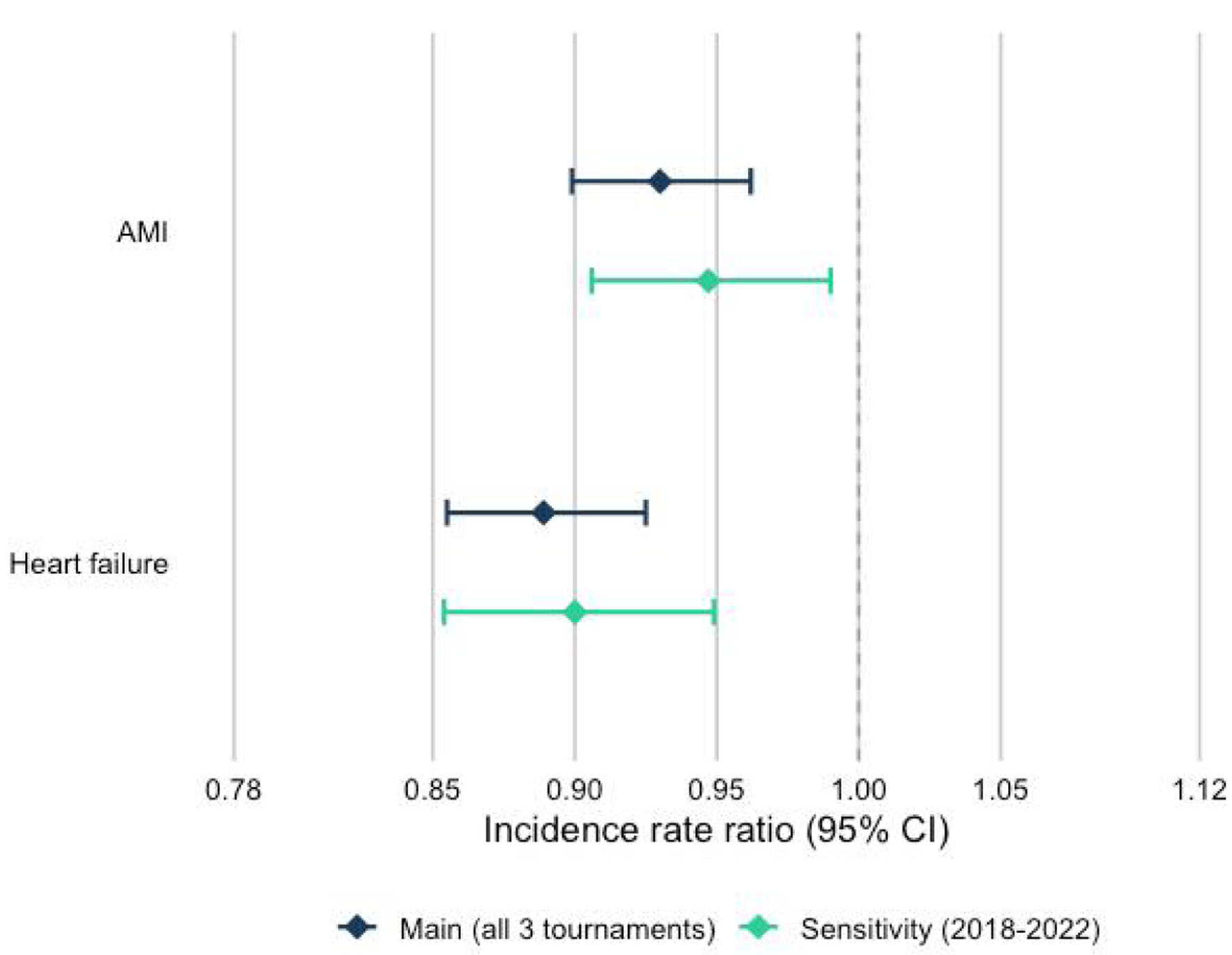
Methods: We analyzed daily counts of acute myocardial infarction (AMI, ICD-10 I21) and heart failure (HF, ICD-10 I50) hospitalizations from the Brazilian national hospital information system (SIH-SUS) during three ± 30-day windows around each World Cup tournament (2014, 2018, 2022). Negative binomial regression models estimated incidence rate ratios (IRRs) for Brazil match days versus non-match days, controlling for day of week, month, and year fixed effects.
Results: On Brazil match days, AMI admissions were 7.0% lower than non-match days (IRR 0.930, 95% confidence interval (CI) 0.898–0.962, P < 0.001) and HF admissions were 11.1% lower (IRR 0.889, 95% CI 0.855–0.925, P < 0.001).
Conclusions: Brazil World Cup matches were associated with significant reductions in same-day AMI and HF hospitalizations. These findings highlight the potential impact of major sporting events on hospital utilization and cardiovascular care access.
Published
Issue
Section
License
Copyright (c) 2026 The authors

This work is licensed under a Creative Commons Attribution 4.0 International License.