


Racial Disparities in Transcatheter Edge-to-Edge Repair Versus Open Mitral Valve Surgery: A Nationwide Analysis
DOI:
https://doi.org/10.14740/cr2226Keywords:
Racial differences, Procedural selection, Outcomes, TEER, Open mitral valve surgeryAbstract
Background: Racial disparities have been documented across multiple domains of cardiovascular care, yet data on mitral valve intervention remain limited. We examined racial differences in procedural selection and outcomes following transcatheter edge-to-edge repair (TEER) and open mitral valve surgery.
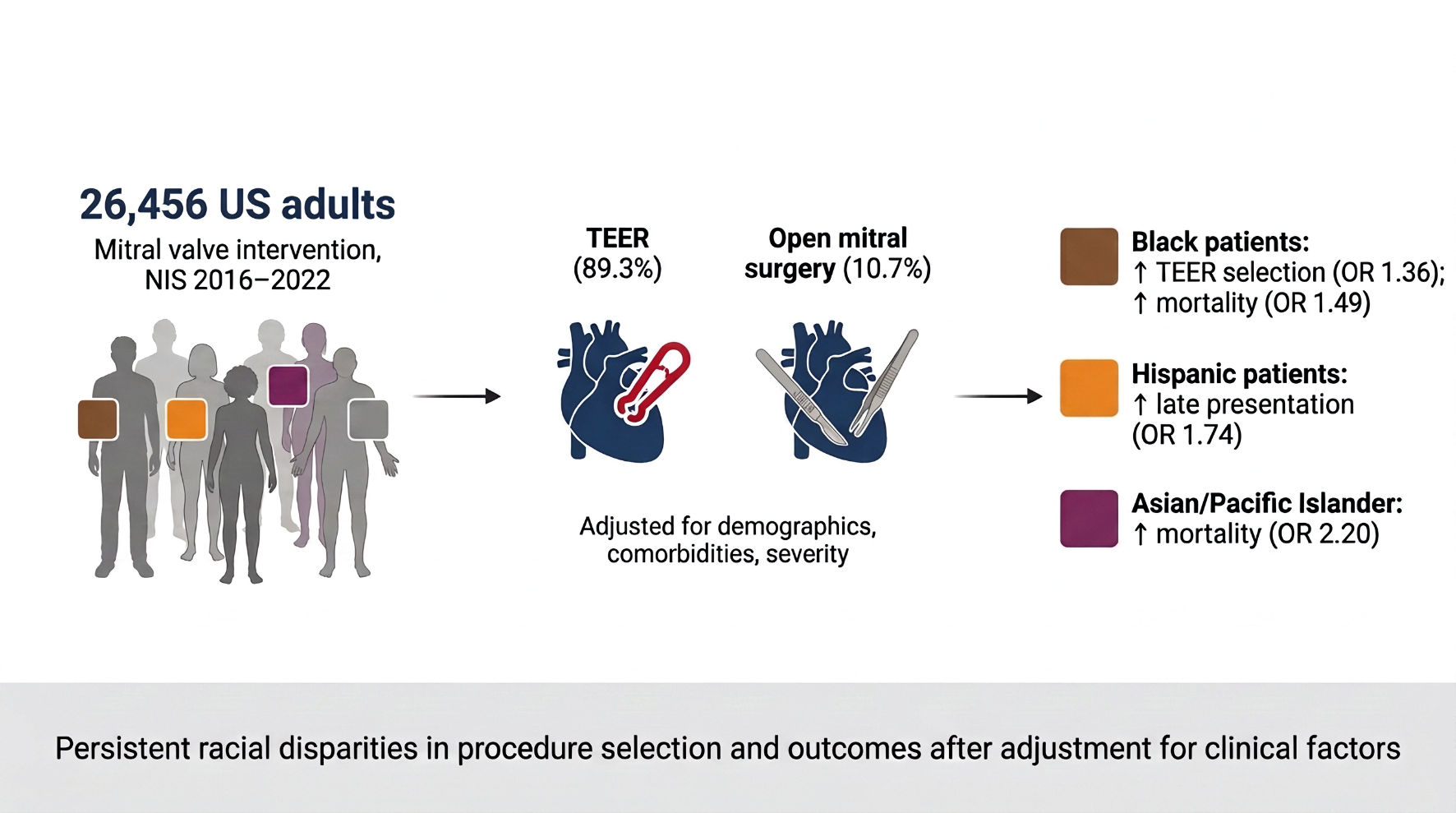
Methods: Using the National Inpatient Sample (NIS, 2016–2022), we identified 26,456 adults undergoing mitral valve intervention. Multivariable regression models were used to assess racial differences in mortality, procedure type, length of stay, and charges, adjusting for demographics, comorbidities, hospital characteristics, and illness severity.
Results: TEER comprised 89% of procedures. Black patients were younger (mean 62 vs 70 years) but presented with higher illness severity. After adjustment, Black patients had greater odds of receiving TEER (odds ratio (OR) = 1.36; 95% confidence interval (CI), 1.15–1.61). Mortality disparities persisted after adjustment: Black patients (OR = 1.49; 95% CI, 1.01–2.19; P = 0.045) and Asian/Pacific Islander patients OR = 2.20; 95% CI, 1.30–3.72; P = 0.003). Late presentation was more common among Black (24%) and Hispanic (27%) compared with White patients (13%).
Conclusions: Black and Asian/Pacific Islander patients experience elevated inpatient mortality following mitral valve intervention that is not fully explained by covariates available in NIS. Late referral patterns are consistent with barriers to timely specialized care in minority populations.
Published
Issue
Section
License
Copyright (c) 2026 The authors

This work is licensed under a Creative Commons Attribution 4.0 International License.