


Global Burden, Temporal Trends, Inequalities, and Future Projections of Aortic Aneurysm Attributable to Smoking, Dietary, and Environmental Risks: Findings From the Global Burden of Disease Study 2021
DOI:
https://doi.org/10.14740/cr2302Keywords:
Global Burden of Disease Study, Aortic aneurysm, Risk factors, Smoking, Dietary risks, Environmental risks, Disease burdenAbstract
Background: Aortic aneurysm (AA) remains a major vascular disease associated with substantial mortality worldwide. Although smoking, dietary factors, and selected environmental exposures are included in model-based assessments of AA-attributable burden, their long-term global patterns and socioeconomic disparities have not been comprehensively characterized. This study aimed to evaluate the global, regional, and national burden of AA attributable to these risk factors and to assess temporal trends, inequalities, and future trajectories from 1990 to 2021.
Methods: Model-based estimates of AA burden attributable to smoking, dietary risks, and environmental risks were obtained from the Global Burden of Disease Study 2021. Deaths, disability-adjusted life years (DALYs), and age-standardized rates (ASRs) were analyzed across 204 countries and territories from 1990 to 2021. Temporal trends were assessed using estimated annual percentage changes (EAPCs). Burden differences according to socio-demographic index (SDI), sex, age, and geographic location were evaluated. Decomposition analysis was performed to quantify contributions from population growth, aging, and epidemiological changes. Future trends through 2050 were predicted using autoregressive integrated moving average and exponential smoothing models.
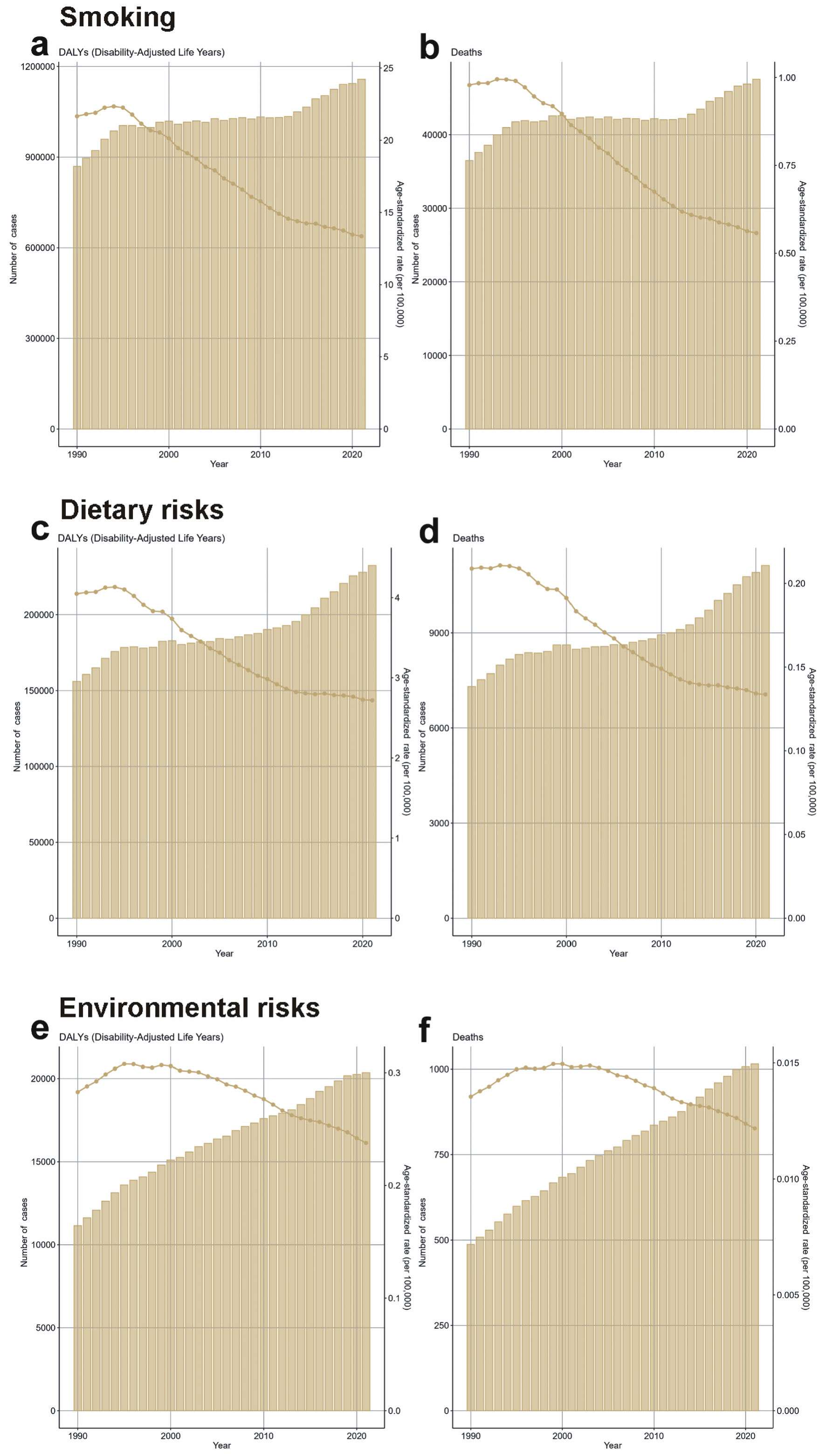
Results: From 1990 to 2021, absolute numbers of AA deaths and DALYs attributable to smoking, dietary risks, and environmental risks increased globally, whereas ASRs generally declined. Among the three risk categories examined, smoking accounted for the largest estimated AA-attributable burden. These comparisons do not establish the relative importance of all AA etiologies. High-SDI regions experienced substantial reductions in smoking- and dietary-related age-standardized burden, while low-middle and low-SDI regions showed increasing trends for several risk factors. Eastern Europe exhibited the highest burden associated with smoking and dietary risks, whereas Australasia showed the greatest reductions. Men consistently experienced higher burdens than women across risk categories. Decomposition analysis indicated that population aging and growth were major contributors to increasing absolute burden. Future projections suggested continued increases in absolute deaths and DALYs despite declining ASRs.
Conclusions: The global burden of AA attributable to the three selected risk categories remains substantial, with pronounced socioeconomic and geographic inequalities. Declining age-standardized burden coexists with demographic pressures that may increase absolute burden. These findings can inform region-specific prevention priorities, but they do not quantify the independent contribution of atherosclerosis or establish a hierarchy of all AA causes.
Published
Issue
Section
License
Copyright (c) 2026 The authors

This work is licensed under a Creative Commons Attribution 4.0 International License.