

Warfarin After Seven Decades: Persistent Value and the Contemporary Role of Vitamin K Antagonism
DOI:
https://doi.org/10.14740/cr2322Keywords:
Warfarin, Vitamin K antagonist, Direct oral anticoagulants, Mechanical heart valve, Rheumatic heart disease, Antiphospholipid syndrome, Left ventricular thrombus, Atrial fibrillation, Global health, AnticoagulationAbstract
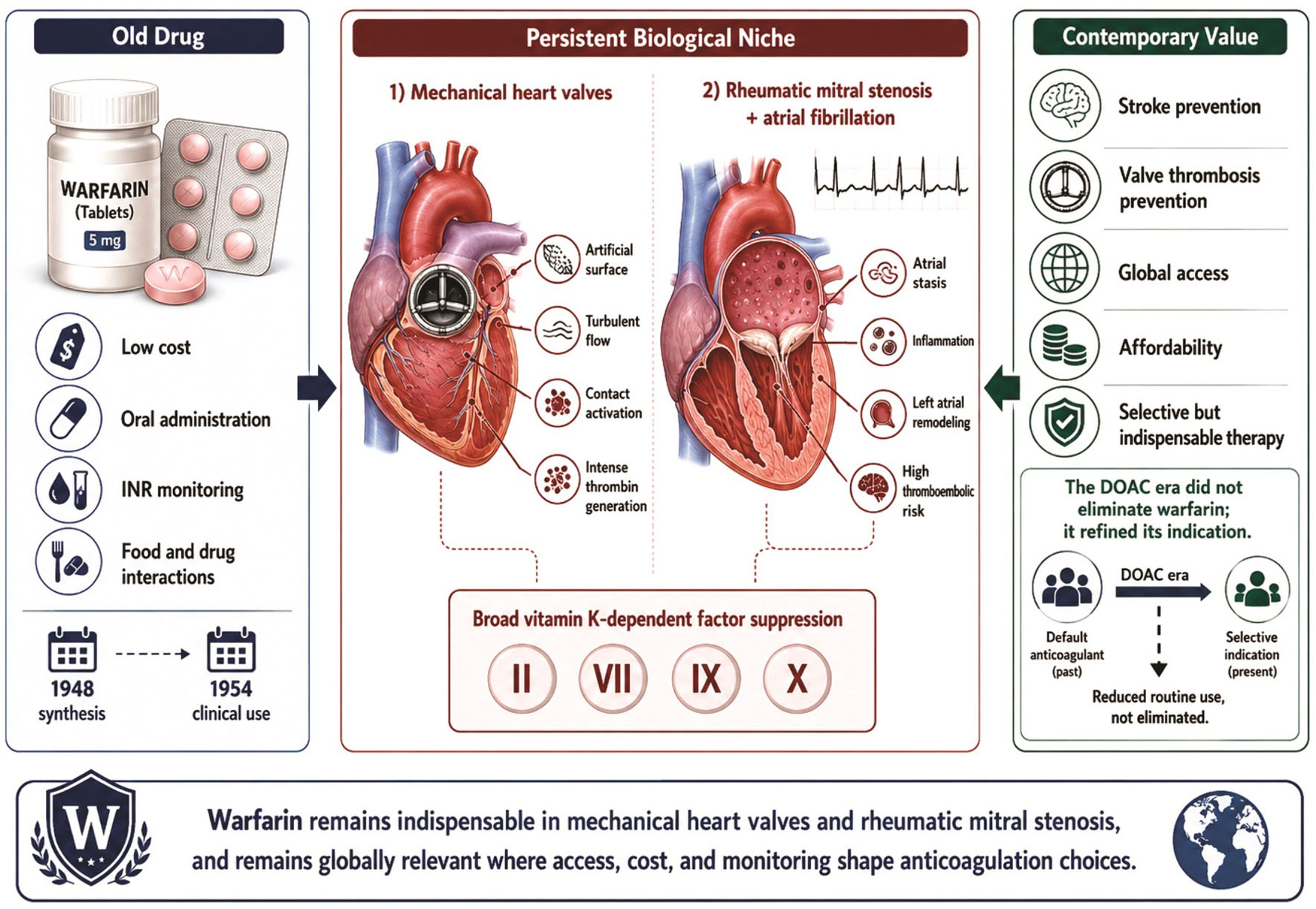
Warfarin is one of the most enduring drugs in cardiovascular medicine. Although direct oral anticoagulants (DOACs) have transformed anticoagulation, especially in atrial fibrillation (AF) eligible for DOAC therapy, their success cannot be extrapolated to every thrombotic substrate. This review examines the contemporary boundaries of warfarin and vitamin K antagonist (VKA) therapy. Mechanical heart valves remain the clearest setting in which lifelong international normalized ratio (INR)-guided VKA therapy is required; randomized attempts to substitute dabigatran or apixaban have failed. In rheumatic heart disease-associated AF, INVICTUS favored VKA therapy over rivaroxaban, supporting the VKA class rather than warfarin specifically. High-risk thrombotic antiphospholipid syndrome, particularly triple-positive disease, is another VKA-preferred setting. Left ventricular thrombus (LVT) occupies an evolving position in which warfarin remains established, while randomized evidence supports rivaroxaban as a potential alternative in selected acute post-myocardial infarction LVT. Pregnancy with mechanical valves requires dynamic maternal–fetal risk balancing, whereas advanced chronic kidney disease and dialysis represent areas of uncertainty rather than intrinsic indications for warfarin. The global relevance of warfarin also depends on total anticoagulation burden, including INR monitoring, travel, treatment continuity, quality of anticoagulation, and reversal capacity. The persistence of VKA efficacy in selected highly thrombogenic environments raises a biologically plausible hypothesis that broader suppression of vitamin K-dependent factors may matter, but this mechanism is not established by clinical trials. Contemporary anticoagulation should therefore be substrate-centered: VKA therapy remains necessary in some conditions, preferred in others, increasingly replaceable in several, and uncertain in a few.
Published
Issue
Section
License
Copyright (c) 2026 The authors

This work is licensed under a Creative Commons Attribution 4.0 International License.