

Association Between Insulin Resistance Marker Estimated Glucose Disposal Rate and Cardiovascular Risk in Obesity: Insights From the National Health and Nutrition Examination Survey 1999 to 2018
DOI:
https://doi.org/10.14740/cr2136Keywords:
Obesity, eGDR, NHANES, CVD, Insulin resistanceAbstract
Background: This study evaluated the effectiveness of the estimated glucose disposal rate (eGDR), an indicator of insulin resistance, as a screening tool for cardiovascular disease (CVD) in individuals with obesity.
Methods: A cross-sectional analysis was conducted using data from the US National Health and Nutrition Examination Survey (NHANES) covering the years 1999 to 2018. The study included 20,521 participants with a waist-to-height ratio (WHtR) of 0.6 or higher, indicating obesity. Participants were divided into quartiles based on their eGDR levels: Q1 (> 8 mg/kg/min), Q2 (6 - 8 mg/kg/min), Q3 (4 - 6 mg/kg/min), and Q4 (≤ 4 mg/kg/min). Multivariable logistic regression models, adjusted for various demographic, lifestyle, and metabolic confounders, were used to analyze the relationship between eGDR and CVD. The predictive capability of eGDR was assessed using the area under the receiver operating characteristic curve (AUC), restricted cubic splines (RCS) for capturing non-linear relationships, and stratified subgroup analyses.
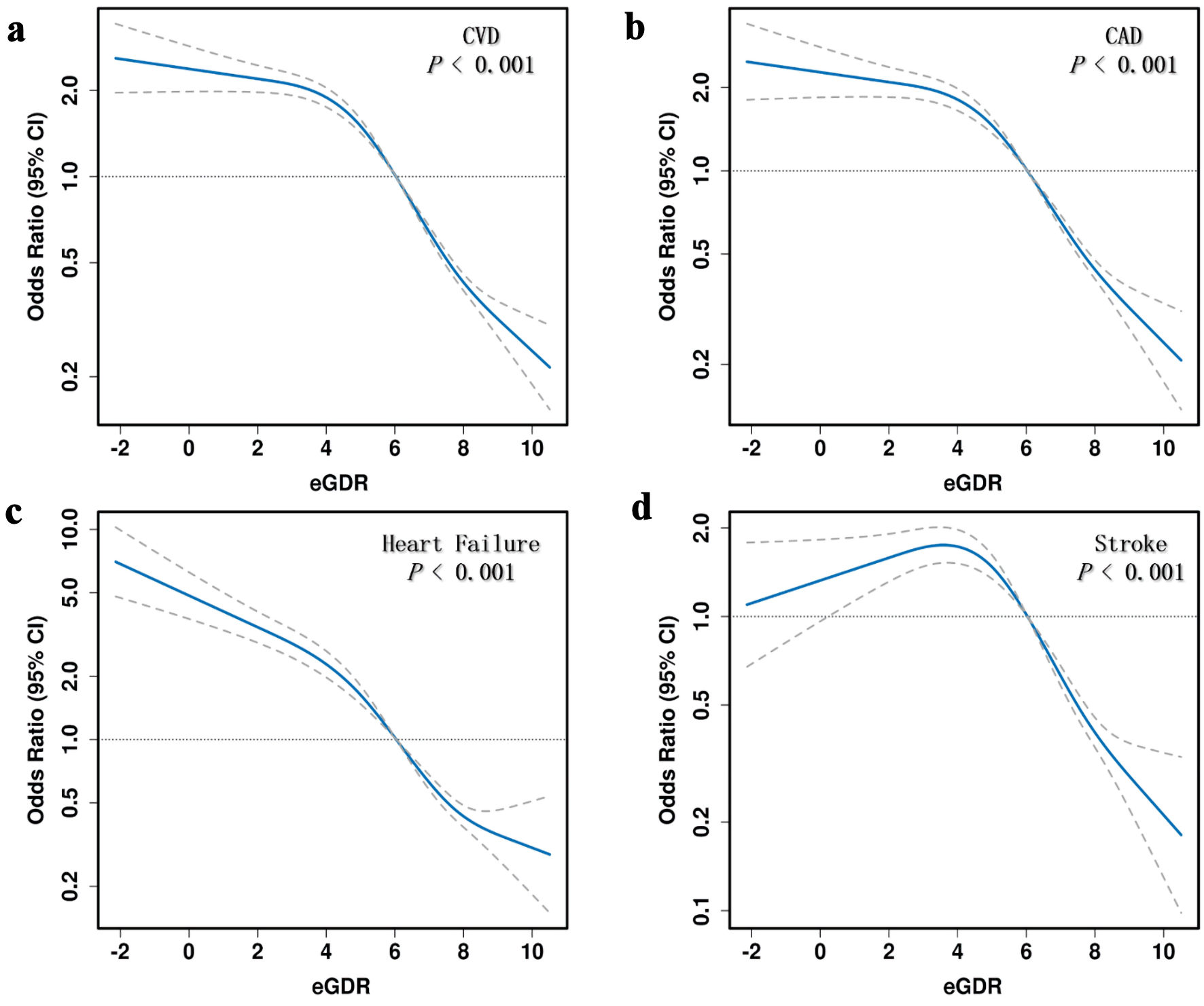
Results: CVD prevalence significantly increased with decreasing eGDR levels (Q1: 5.3% vs. Q4: 26.2%). After full adjustment for covariates, multivariable regression confirmed that the lowest eGDR quartile (Q4) was strongly and independently associated with a substantially elevated risk of CVD compared to the highest quartile (adjusted odds ratio (OR) = 6.3; 95% confidence interval (CI): 5.53 - 7.17; P < 0.001). eGDR also demonstrated good predictive performance for specific CVD subtypes, with the highest AUC for heart failure (0.715, 95% CI: 0.699 - 0.730). RCS analysis validated a significant non-linear, inverse dose-response relationship between eGDR and overall CVD risk. Subgroup analyses, stratified by age, sex, and glycemic status, consistently demonstrated a significant association between low eGDR and increased CVD risk across all categories (P < 0.001).
Conclusions: Lower eGDR independently and strongly indicated a heightened risk of CVD in individuals with obesity.
Published
Issue
Section
License
Copyright (c) 2026 The authors

This work is licensed under a Creative Commons Attribution 4.0 International License.