

Clinical and Metabolic Factors as Predictors of Thirty-Day Readmission in Patients With Acute Decompensated Heart Failure With Reduced Ejection Fraction and Type 2 Diabetes Mellitus
DOI:
https://doi.org/10.14740/cr2206Keywords:
Heart failure, Ejection fraction, Type-2 diabetes mellitus, 30-day readmissionAbstract
Background: Patients with heart failure with reduced ejection fraction (HFrEF) had higher readmission rates than those with normal ejection fractions, and readmission rates were highest in the first 30-days post-admission. About 30% of patients with decompensated heart failure also have type 2 diabetes mellitus (T2DM). The aim of the study was to determine the clinical and metabolic predictors of 30-day readmission in patients with acute decompensated heart failure (ADHF) with reduced ejection fraction and type-2 DM.
Methods: The study was conducted in a retrospective-cohort design, and data were taken from medical records based on the admissions of patients. The clinical outcomes were divided into readmission and non-readmission groups. The clinical outcome assessed was the incidence of readmission due to worsening of the condition of heart failure at 30 days after the last admission at the National Cardiovascular Center Harapan Kita (NCCHK), based on clinical encounters/readmission of patients. Logistic regression multivariate analysis was performed to determine significant predictors for 30-day readmission. Bootstrapping was performed to ensure robustness of the multivariate logistic regression analysis.
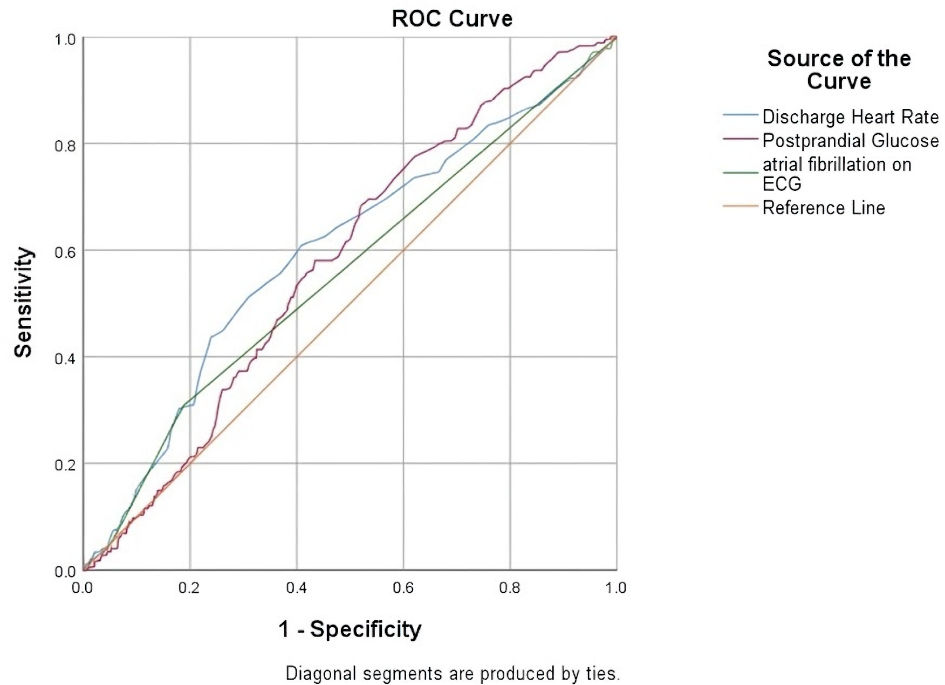
Results: There were 747 clinical encounters, consisting of 179 readmission events, and 568 were non-readmission events (readmission rate 24%). Atrial fibrillation (AF) was found in 15.7% of clinical encounters. The median ejection fraction (EF) was 23% during admission. median fasting blood sugar and postprandial blood sugar of study subjects were 107(34–324) and 145 (51–409) mg/dL. Multivariate logistic regression analysis showed that the factors associated at 30-days readmission were: AF rhythm (odds ratio (OR) = 2.616; 95% confidence interval (CI), 1.604–4,267; P = 0.000), heart rate at discharge (area under the receiver operating characteristic (ROC) curve (AUC) 0.650 (95% CI, 0.545–0.756) P = 0.007) (OR = 1.022; 95% CI, 1.005–1.039; P = 0.010). Postprandial blood glucose level ≤ 140 mg/dL was a protective predictor for 30-day readmission (OR = 0.528; 95% CI, 0.348–0.802; P = 0.003).
Conclusions: This study showed that clinical factors such as AF and increased heart rate at discharge were associated with rehospitalization risk in 30 days in patients with HFrEF and T2DM, while a metabolic factor of postprandial blood sugar ≤ 140 mg/dL was observed to have protective effects against rehospitalization in 30 days in patients with HFrEF and T2DM. ROC analysis showed that reducing discharge heart rate to below 78 beats per minute (bpm) might be beneficial in diabetic patients with HFrEF and AF.
Published
Issue
Section
License
Copyright (c) 2026 The authors

This work is licensed under a Creative Commons Attribution 4.0 International License.