

Incidence and Factors Associated With In-Hospital Acute Myocardial Infarction in Patients With Obesity Undergoing Transcatheter Aortic Valve Replacement: A National Inpatient Sample Analysis
DOI:
https://doi.org/10.14740/cr2257Keywords:
Transcatheter aortic valve replacement, Acute myocardial infarction, Patients with obesity, Risk factors, In-hospital outcomesAbstract
Background: The impact of obesity on acute myocardial infarction (AMI) risk in patients undergoing transcatheter aortic valve replacement (TAVR) remains poorly characterized, particularly with respect to the incidence and specific factors associated with this complication. This study aimed to determine the incidence, associated factors, and clinical implications of in-hospital AMI among patients with obesity undergoing TAVR.
Methods: We analyzed the National Inpatient Sample (2016–2022) to identify adult patients with obesity (body mass index (BMI) ≥ 30 kg/m2) undergoing TAVR, with non-obese patients as a comparative cohort. Multivariable logistic regression identified factors associated with in-hospital AMI.
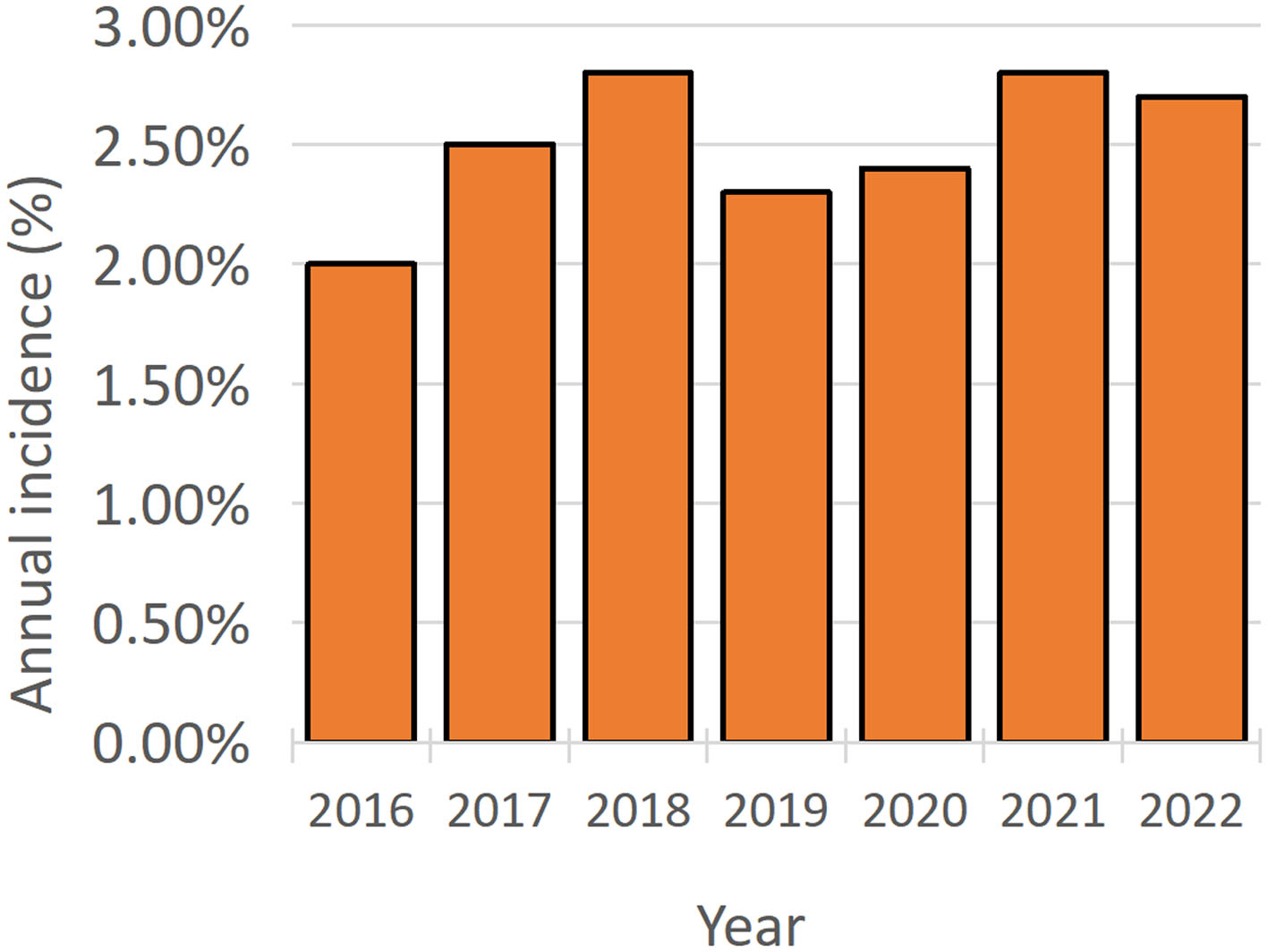
Results: Among 19,971 patients with obesity undergoing TAVR, 506 (2.5%) experienced in-hospital AMI, compared with 2.7% among non-obese patients (P = 0.295). Patients with obesity were younger (median age 75 vs. 81 years, P < 0.001) and had lower in-hospital mortality (0.8% vs. 1.3%, P = 0.002) but longer hospital stays (3 vs. 2 days, P < 0.001) and higher hospitalization costs ($217,785 vs. $179,887, P < 0.001) compared with patients without obesity. Factors associated with higher AMI odds in the obesity cohort included medium hospital size (odds ratio (OR) 1.687, 95% confidence interval (CI) 1.086–2.619), large hospital size (OR 1.840, 95% CI 1.234–2.744), deficiency anemia (OR 1.466, 95% CI 1.196–1.796), chronic blood loss anemia (OR 2.960, 95% CI 1.604–5.463), congestive heart failure (OR 2.530, 95% CI 1.871–3.421), fluid and electrolyte disorders (OR 2.734, 95% CI 2.239–3.338), other neurological disorders (OR 2.092, 95% CI 1.453–3.011), peripheral vascular disorders (OR 1.260, 95% CI 1.017–1.561), pulmonary circulation disorders (OR 1.297, 95% CI 1.054–1.595), and weight loss (OR 2.156, 95% CI 1.400–3.319). Conversely, elective admission (OR 0.046, 95% CI 0.037–0.058) was associated with lower AMI odds. AMI was associated with higher mortality (3.8% vs. 0.8%), prolonged hospitalization (11 vs. 3 days), and increased costs ($349,531 vs. $217,785) (all P < 0.001).
Conclusions: In-hospital AMI occurs in 2.5% of patients with obesity undergoing TAVR—a rate comparable to that of patients without obesity (2.7%, P = 0.295)—and is associated with worse outcomes. Despite lower overall mortality in the obesity cohort—consistent with the obesity paradox—AMI risk was not similarly attenuated, suggesting that the protective effect of obesity does not uniformly extend to all periprocedural complications. Rather than simply documenting an expected complication rate, the clinical value of our study lies in identifying potentially modifiable factors associated with AMI specifically in the obesity cohort—including anemia, fluid and electrolyte disorders, and weight loss—that may inform targeted preoperative optimization.
Published
Issue
Section
License
Copyright (c) 2026 The authors

This work is licensed under a Creative Commons Attribution 4.0 International License.