

Renal Denervation: A Multicenter, Real-World Experience

Authors

  • Sarita Rao
  • Kamarishi Roshan Rao
  • Ajith Pillai
  • Amit Patil
  • Anuj Kapadiya
  • Arun Gopi
  • Gautam Swaroop
  • Harshal Ingle
  • Keyur Parikh
  • Nalin Kumar Mahesh
  • Nimit Shah
  • Praveen Chandra
  • Raj Pratap Singh
  • Ramesh Natarajan
  • Ravinder Singh Rao
  • Refai Showkathali
  • Shashi Mohan Sharma
  • Sunil Sathe
  • Sunip Banerjee
  • Varada Rajasekhar
  • Vithala Surya Prakasa Rao
  • Viveka Kumar
  • Yerramareddy Vijaychandra Reddy

DOI:

https://doi.org/10.14740/cr2268

Keywords:

Renal denervation, Resistant hypertension, Blood pressure, India

Abstract

Background: Renal denervation (RDN) has emerged as a promising device-based therapy for the management of resistant hypertension (RH). However, real-world evidence of effectiveness and safety in the Indian population remains limited. This study aimed to evaluate the efficacy and safety of catheter-based RDN in reducing blood pressure (BP) and antihypertensive medication burden among Indian patients with RH.

Methods: This retrospective, multicenter, real-world study included 26 consecutive patients who underwent RDN across 21 tertiary care centers in India. Patients were followed at discharge and at 1, 3, 6, and 12 months after the procedure. The primary endpoint was the change in office BP at 12 months. Secondary endpoints included changes in antihypertensive medication burden and procedure-related safety outcomes.

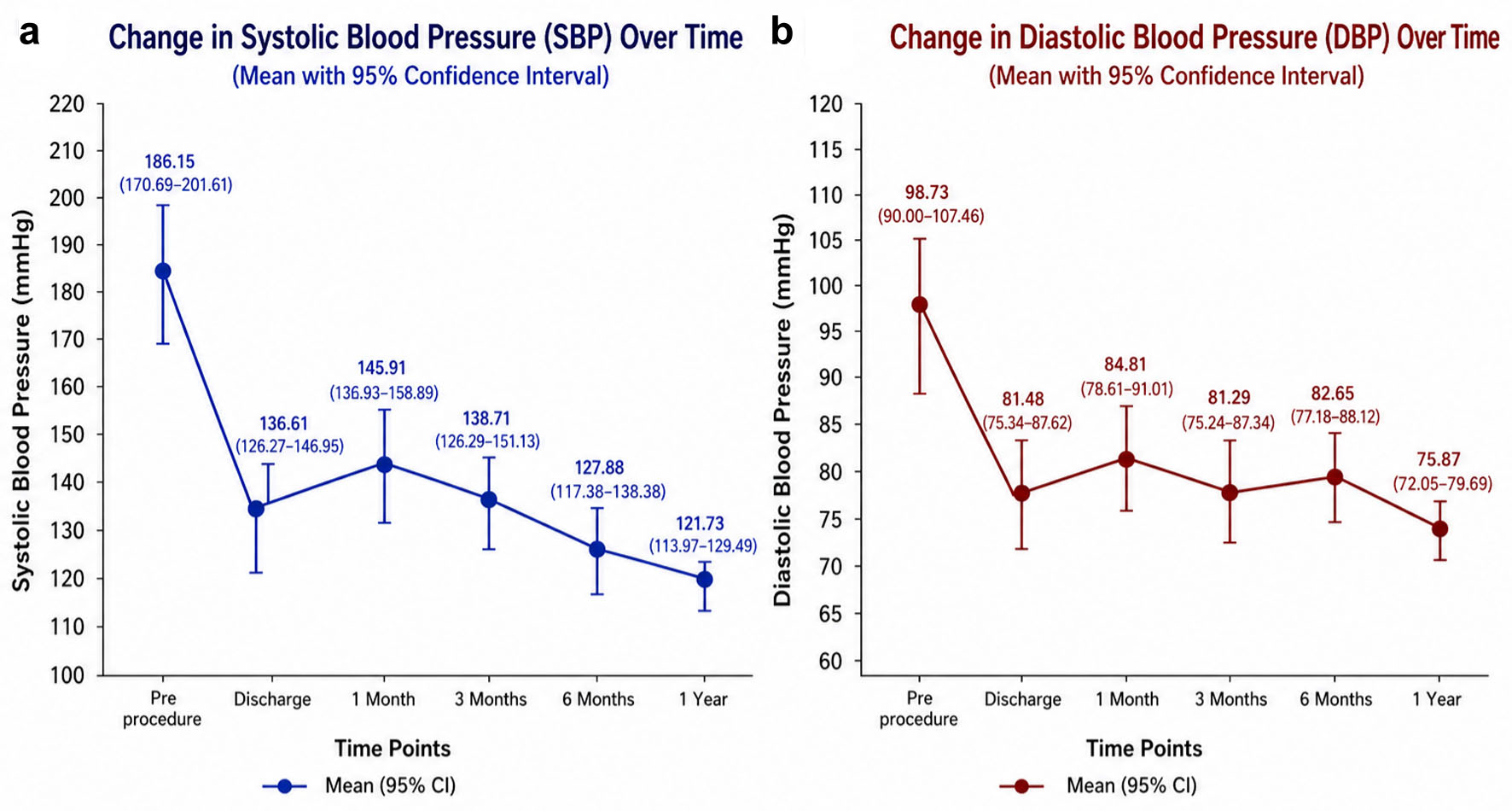
Results: The mean age of the study population was 60.7 ± 13.8 years, and 61.5% were male. Baseline systolic blood pressure (SBP) and diastolic blood pressure (DBP) were 186.2 ± 18.8 and 98.7 ± 25.3 mm Hg, respectively. Significant reductions in BP were observed at all follow-up time points. At 12 months, mean SBP and DBP decreased to 121.7 ± 10.5 and 75.9 ± 4.7 mm Hg, corresponding to reductions of 63.4 and 24.7 mm Hg, respectively (both P < 0.001). The mean number of antihypertensive medication classes was significantly reduced from 5.12 ± 1.70 at baseline to 2.00 ± 0.80 at 1 year (P < 0.001). No major periprocedural complications or adverse events were reported. One patient experienced an access-site vascular complication involving the superficial femoral artery, which was successfully managed with covered stent implantation without further sequelae.

Conclusions: RDN was associated with significant and sustained reductions in BP and antihypertensive medication burden over 12 months. The procedure demonstrated a favorable safety profile, supporting its role as an as a safe and effective adjunctive treatment option for patients with RH.
Author Biographies

  • Sarita Rao, Apollo Hospitals Indore

    Senior Interventional Cardiologist and Director Cath Lab, Apollo Hospitals, Indore, Madhya Pradesh, India

  • Kamarishi Roshan Rao, Apollo Hospitals Indore

    Senior Interventional Cardiologist and Head, Department of Cardiology

  • Ajith Pillai, Kauvery Hospital, Chennai

    Chief Cardiologist and HOD

  • Amit Patil, Surana Sethia Hospital, Mumbai

    Interventional Cardiologist

  • Anuj Kapadiya, AIG Hospitals, Hyderabad

    Senior Consultant Cardiologist and Cath Lab Director

  • Arun Gopi, Metromed International Cardiac Centre Calicut

    Senior Consultant Cardiology and Electrophysiologist

  • Gautam Swaroop, Tender Palm Hospital, Lucknow

    Senior Interventional Cardiologist and Director Cardiac Sciences

  • Harshal Ingle, Ruby Hall Clinic, Pune

    Interventional Cardiologist

  • Keyur Parikh, Marengo CIMS Hospital, Ahmedabad

    Interventional Cardiologist

  • Nalin Kumar Mahesh, St. Gregorios Medical Mission Hospital, Parumala

    HOD, Senior Consultant Cardiologist

  • Nimit Shah, Breach Candy Hospital, Mumbai

    Consultant Interventional Cardiologist

  • Praveen Chandra, Medanta Hospital, Gurgaon

    Chairman, Interventional and Structural Heart Cardiology

  • Raj Pratap Singh, Graphic Era Institute of Medical Sciences, Dehradun

    Director Cath Lab and HOD

  • Ramesh Natarajan, KIIMS Health, Thiruvananthapuram

    Chief Coordinator and Senior Consultant Cardiology

  • Ravinder Singh Rao, RHL Heart Centre, Jaipur

    Chief Interventional Cardiologist

  • Refai Showkathali, Apollo Main Hospital, Chennai

    Senior Consultant Interventional Cardiologist

  • Shashi Mohan Sharma, SMS Medical College, Jaipur

    Professor and Head, Cardiology

  • Sunil Sathe, Poona Hospital, Pune

    Senior Interventional Cardiologist, Cardiology

  • Sunip Banerjee, Kolkata Heart Lung Center, Kolkata

    Senior Interventional Cardiologist

  • Varada Rajasekhar, Yashoda Hospitals, Hyderabad

    Senior Consultant Interventional Cardiology and Electrophysiology

  • Vithala Surya Prakasa Rao, CARE Hospital, Hyderabad

    HOD, Department of Cardiology

  • Viveka Kumar, Max Super Speciality Hospital, Delhi

    Vice Chairman and Chief of Cath Labs

  • Yerramareddy Vijaychandra Reddy, Apollo Main Hospitals, Chennai

    Senior Consultant and Interventional Cardiologist

Downloads

Published

2026-08-31

Issue

Section

Original Article

How to Cite

1.
Rao S, Rao KR, Pillai A, et al. Renal Denervation: A Multicenter, Real-World Experience. Cardiol Res. 2026;17(5):509-518. doi:10.14740/cr2268

Similar Articles

81-90 of 114

You may also start an advanced similarity search for this article.