

K-CVD as the Best-Calibrated ASCVD Risk Equation Among Three Country-Specific Equations in 9,532 Chinese Adults: A 9-Year Real-World Validation From CHARLS With Decision Curve Analysis
DOI:
https://doi.org/10.14740/cr2315Keywords:
ASCVD risk prediction, PCE, China-PAR, K-CVD, CHARLS, Decision curve analysis, Cystatin C, East Asian cardiovascular riskAbstract
Background: Precise 10-year atherosclerotic cardiovascular disease (ASCVD) risk prediction matters for Chinese primary prevention, while domestic risk equations have not been validated in 9-year real-world cohorts, and the Korean K-CVD model has never been validated locally.
Methods: This study enrolled 9,532 ASCVD-free Chinese adults aged 45–79 years from the China Health and Retirement Longitudinal Study (CHARLS, 2011–2020) with a 9-year follow-up (114 ASCVD events, incidence 1.20%). Three risk tools (pooled cohort equation (PCE)-US, China-PAR, and K-CVD-Korea) were compared regarding discrimination (area under the receiver operating characteristic (ROC) curve (AUC)), calibration, and clinical utility via decision curve analysis (DCA); MICE was adopted to impute missing systolic blood pressure data.
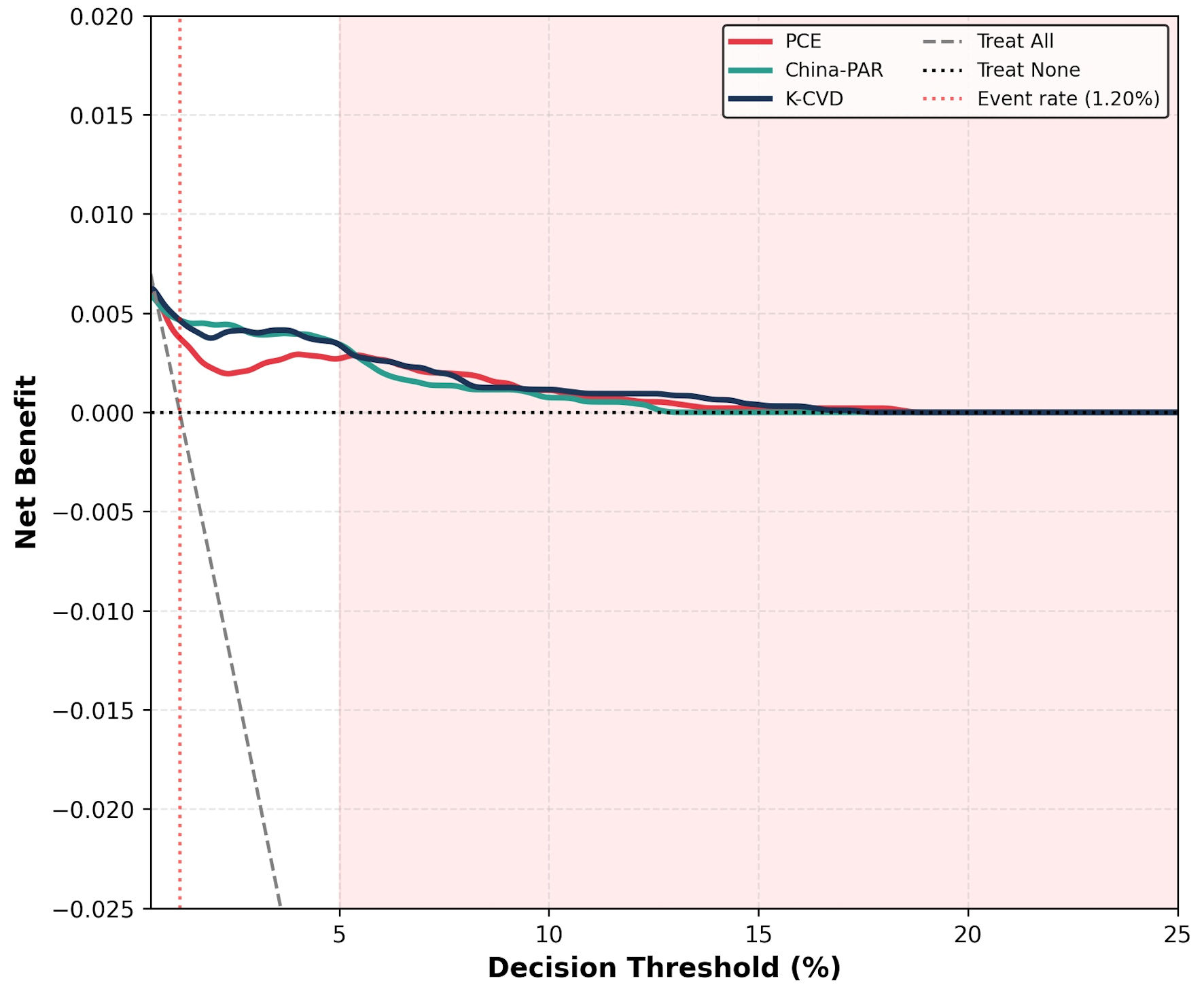
Results: K-CVD presented optimal calibration (predicted/observed ratio = 0.97). PCE overestimated risk by 17%, and China-PAR underestimated risk by 10%. The three models had comparable AUCs (0.775–0.777, P > 0.05). Post logit recalibration yielded identical Brier score (0.0116) for all models. DCA showed negative net benefit at thresholds ≥ 5%; PCE and K-CVD gained slight superiority over China-PAR at 1–2% thresholds matching the low actual event rate.
Conclusions: K-CVD has the best native calibration in this Chinese cohort. All three equations need formal recalibration for clinical use, and low cut-offs (1–2%) are more suitable for low-risk Chinese adults instead of Western standard thresholds.
Published
Issue
Section
License
Copyright (c) 2026 The authors

This work is licensed under a Creative Commons Attribution 4.0 International License.