

Development and Validation of a Prognostic Model to Predict Mortality in Patients With Heart Failure With Mildly Reduced Ejection Fraction After Acute Myocardial Infarction
DOI:
https://doi.org/10.14740/cr2096Keywords:
Acute myocardial infarction, Heart failure with mildly reduced ejection fraction, All-cause mortality risk, Predictive model, Least absolute shrinkage and selection operator, Decision curve analysisAbstract
Background: Accurately assessing mortality risk in patients with heart failure with mildly reduced ejection fraction (HFmrEF) after acute myocardial infarction (AMI) remains challenging. This study developed and validated a mortality risk predictive model for such patients.
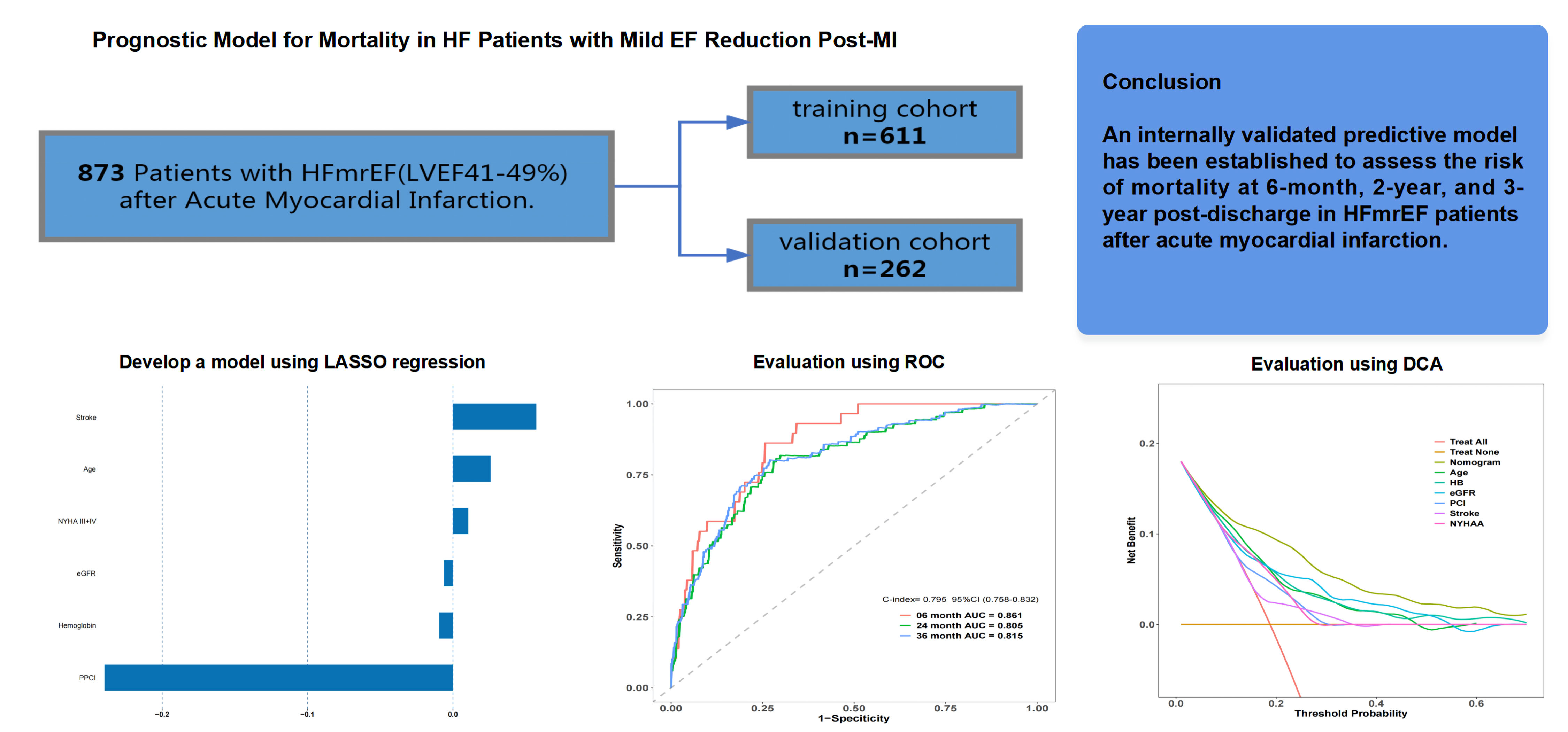
Methods: In this single-center retrospective study of 873 hospitalized patients with HFmrEF after AMI, 611 patients were included in the training cohort and 262 in the validation cohort. The primary outcome was all-cause mortality over an average 33-month follow-up. Least absolute shrinkage and selection operator (LASSO) regression identified predictive variables for post-discharge mortality, with model performance assessed via receiver operating characteristic (ROC) analysis and decision curve analysis (DCA).
Results: Six mortality risk predictors were identified: age, stroke history, New York Heart Association (NYHA) classification, hemoglobin (Hb) levels, estimated glomerular filtration rate (eGFR), and primary percutaneous coronary intervention (PPCI) implementation. The C-index for training and validation cohorts was 0.795 (95% confidence interval (CI), 0.758–0.832) and 0.741 (95% CI, 0.672–0.81), respectively. Training cohort area under the curve (AUC) metrics for 6-month, 2-year, and 3-year survival were 0.861, 0.805, and 0.815; for the validation cohort, they were 0.722, 0.742, and 0.736.
Conclusions: A validated predictive model assessing mortality risk in HFmrEF patients post-AMI was established. External validation in future studies is recommended.
Published
Issue
Section
License
Copyright (c) 2026 The authors

This work is licensed under a Creative Commons Attribution 4.0 International License.