

Left Atrial Deformation Parameters After Myocardial Infarction With Low Triiodothyronine Syndrome and Their Prognostic Value
DOI:
https://doi.org/10.14740/cr2166Keywords:
Speckle-tracking echocardiography, Left atrial deformation, Low T3 syndrome, ST-segment elevation myocardial infarctionAbstract
Background: Acute myocardial infarction (AMI) management has reduced in-hospital mortality, yet heart failure (HF) and atrial fibrillation (AF) remain common long-term complications. Left atrial (LA) function, assessed via speckle-tracking echocardiography (STE), provides sensitive markers of cardiac remodeling. This study aims to investigate the prognostic value of LA deformation parameters and their significance for long-term outcomes in patients with ST-segment elevation myocardial infarction (STEMI), particularly in relation to low triiodothyronine (T3) syndrome.
Methods: A retrospective study enrolled 140 first-onset STEMI patients treated with primary percutaneous coronary intervention. Thyroid hormone concentrations were measured within 24 h of admission, and patients were classified into low T3 (free triiodothyronine (fT3) < 3.2 pmol/L, n = 44) and control groups (n = 96). Echocardiography and STE were performed within 72 h and repeated after 6 months. LA reservoir strain and conduit and contractile strain rate parameters were analyzed. Long-term outcomes, including AF, rehospitalization, HF, major adverse cardiac events (MACEs), and all-cause death, were assessed after 10 years.
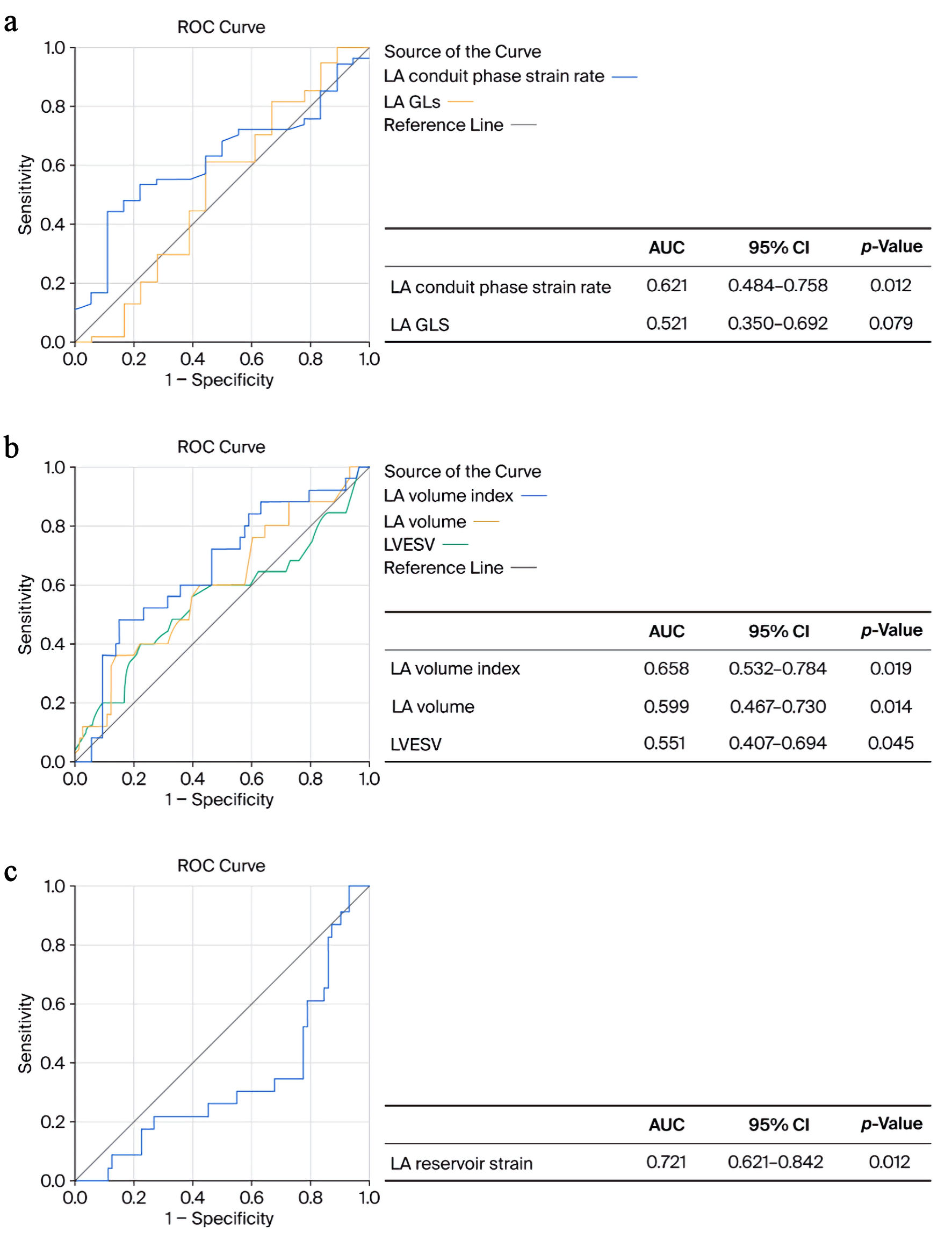
Results: Patients with low T3 syndrome were older, with higher inflammatory markers (P = 0.03) and reduced LA conduit strain rates during the acute phase (P = 0.04). After 6 months, LA volume increased significantly in both groups, but more prominently in low T3 patients (P = 0.03). Reduced LA reservoir strain (area under the curve (AUC), 0.721; P = 0.012) and conduit strain rate (AUC, 0.621; P = 0.012) were strong predictors of MACEs and AF, respectively. Logistic regression identified the LA conduit strain rate, LA reservoir strain, LA volume index, and left ventricular ejection fraction as independent predictors of adverse outcomes.
Conclusions: STE-derived LA deformation parameters provide valuable prognostic information in post-STEMI patients. The LA reservoir strain and LA conduit strain rate are significant predictors of MACEs, while LA global longitudinal strain identifies patients at risk of HF. Early STE evaluation can enhance risk stratification and guide management.
Published
Issue
Section
License
Copyright (c) 2026 The authors

This work is licensed under a Creative Commons Attribution 4.0 International License.