

Role of Intracoronary Imaging in Percutaneous Coronary Intervention for In-Stent Restenosis: A Prospective Observational Study
DOI:
https://doi.org/10.14740/cr2224Keywords:
In-stent restenosis, Intracoronary imaging, Intravascular ultrasound, Optical coherence tomography, Drug-eluting balloon, Drug-eluting stentAbstract
Background: Despite advances in contemporary stent technology and procedural techniques, in-stent restenosis (ISR) remains a clinically significant cause of repeat revascularization. Coronary angiography, although the standard diagnostic modality, has limited ability to identify the underlying mechanism of ISR. Intravascular ultrasound (IVUS) and optical coherence tomography (OCT) may improve mechanism-based decision-making and procedural optimization. This study aimed to evaluate the impact of intracoronary imaging on ISR mechanism identification and treatment strategy during ISR percutaneous coronary intervention (PCI).
Methods: This prospective observational study included 34 patients with 40 ISR lesions (60 previously implanted stents) undergoing IVUS- or OCT-guided PCI at a tertiary care center. Patients underwent detailed assessment of cardiovascular risk factors, angiographic classification of ISR, and systematic intracoronary imaging analysis. ISR lesions were classified as mechanically driven or tissue-proliferative based on imaging findings. The primary objective was to assess the impact of imaging on lesion preparation and definitive treatment strategy.
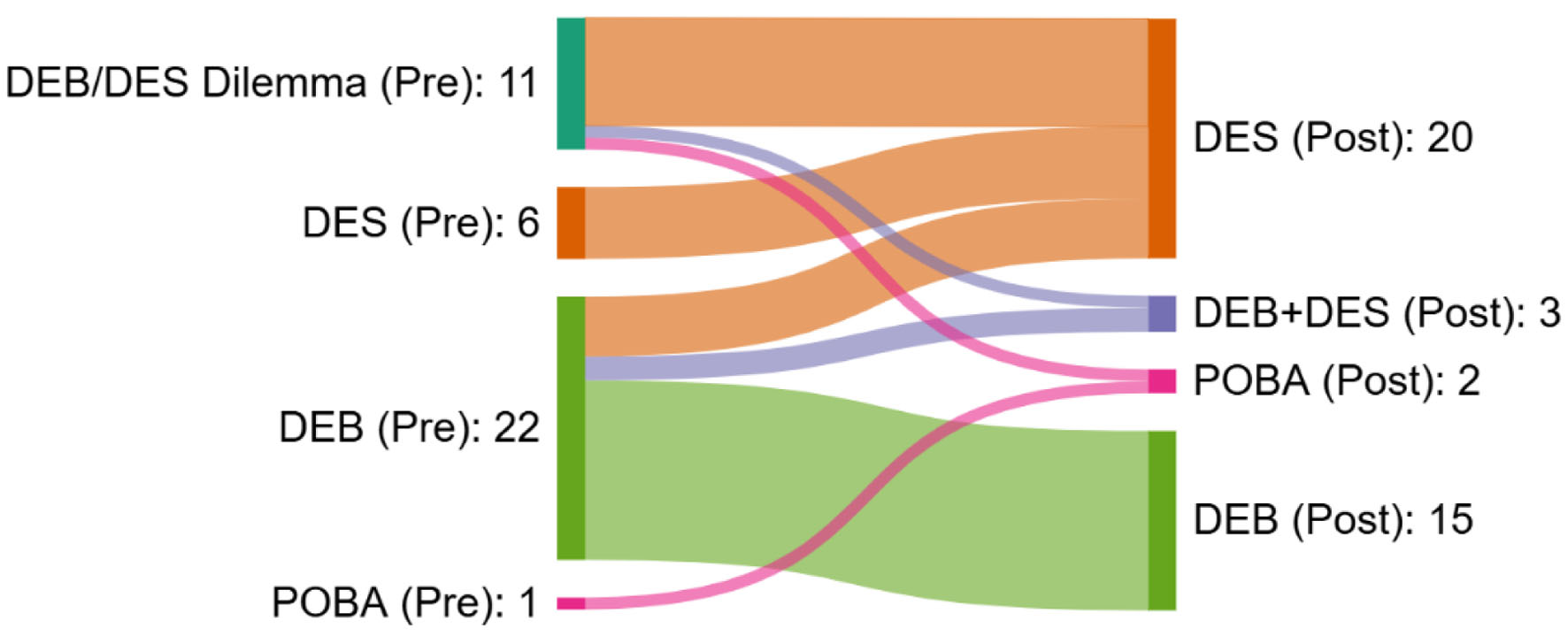
Results: The mean age was 63 years, and 82.4% were male. Diffuse ISR was present in 57.5% of lesions. Intracoronary imaging identified mechanical and tissue-proliferative ISR in equal proportions (50% each). Mechanical ISR was more frequently associated with earlier presentation and structural complexity, including multisegment involvement and stent overlap zones. Intravascular imaging led to escalation of lesion modification strategies in 50% of lesions. Before imaging, drug-eluting balloon (DEB) therapy was planned in 55% and drug-eluting stent (DES) implantation in 15% of cases. Following imaging, DES implantation was performed in 50% of lesions, representing a significant shift in treatment strategy (McNemar test, P = 0.021).
Conclusion: Both mechanical and tissue-proliferative mechanisms contributed substantially to ISR. Intracoronary imaging clarified the dominant ISR mechanism, guided lesion preparation, and modified definitive treatment strategy. These findings suggest a mechanism-based role for IVUS/OCT in lesion assessment and procedural planning during ISR PCI. Larger comparative studies with longer follow-up are required to determine whether imaging-guided ISR PCI improves clinical outcomes.
Published
Issue
Section
License
Copyright (c) 2026 The authors

This work is licensed under a Creative Commons Attribution 4.0 International License.