


Conventional and Emerging Biomarkers for Predicting Post-Ablation Atrial Fibrillation Recurrence: An Updated Systematic Review
DOI:
https://doi.org/10.14740/cr2231Keywords:
Biomarkers, Atrial fibrillation recurrence, Catheter ablationAbstract
Background: Atrial fibrillation (AF) recurrence after catheter ablation remains common and difficult to predict using conventional clinical risk models. Circulating biomarkers reflecting inflammation, myocardial remodeling, metabolic dysfunction, and neurohormonal activation may improve risk stratification. This systematic review provides an updated synthesis of conventional and emerging biomarkers associated with post-ablation AF recurrence.
Methods: This systematic review was conducted in accordance with PRISMA 2020 guidelines. A comprehensive search of databases (PubMed/Medline, Cochrane Library, ScienceDirect, Europe PubMed Central, and Google Scholar) was performed for studies published between January 2020 and March 2025. Eligible studies included observational cohorts, systematic reviews and meta-analyses evaluating biomarkers associated with AF recurrence after catheter ablation with ≥ 12 months follow-up. Eligible studies were critically appraised using appropriate quality assessment tools. Due to heterogeneity in study design, biomarker measurement, and effect reporting, a qualitative synthesis was performed.
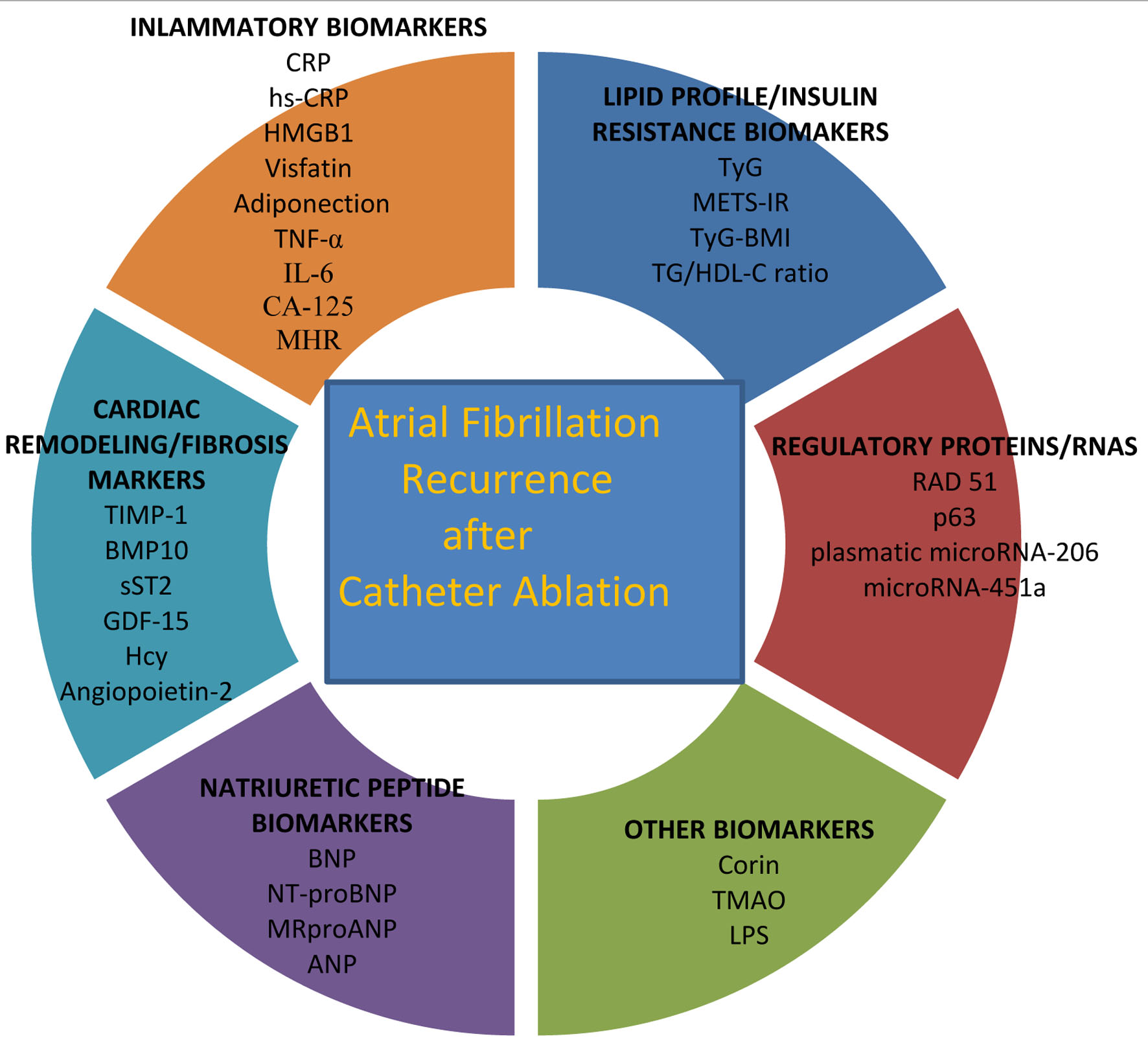
Results: A total of 27 studies encompassing 26,702 participants and 30 biomarkers were included. AF recurrence rates ranged from 15.7% to 51% over follow-up periods of 12–36 months. Stronger predictors identified in larger cohorts included bone morphogenetic protein-10 (BMP-10), homocysteine, triglyceride glucose index, and plasma carbohydrate antigen-125. Among natriuretic peptides, N-terminal pro-B-type natriuretic peptide and mid-regional pro-atrial natriuretic peptide demonstrated strong associations. Emerging biomarkers such as high mobility group box 1, trimethylamine-N-oxide, and lipopolysaccharide showed high predictive potential but were supported by smaller cohorts. Conventional inflammatory markers, including C-reactive protein (CRP), high-sensitivity CRP, and interleukin, demonstrated weaker or inconsistent associations. Overall, biomarker performance varied by mechanistic category, study size, and timing of measurement.
Conclusions: Multiple conventional and emerging biomarkers are associated with AF recurrence following catheter ablation with metabolic, remodeling, and natriuretic biomarkers demonstrating the strongest and more consistent predictive value. Integration of these biomarkers into clinical risk models may enhance prognostication. Further large-scale, standardized studies are required to validate their clinical utility and facilitate translation into routine practice.
Published
Issue
Section
License
Copyright (c) 2026 The authors

This work is licensed under a Creative Commons Attribution 4.0 International License.