

Relationship Between the Systemic Coagulation–Inflammation Index and Radial Artery Occlusion After Transradial Coronary Angiography
DOI:
https://doi.org/10.14740/cr2275Keywords:
Radial artery occlusion, Transradial access, Systemic Coagulation–Inflammation Index, Coronary angiography, InflammationAbstract
Background: Radial artery occlusion (RAO) is the most common vascular complication of transradial coronary procedures. The Systemic Coagulation–Inflammation Index (SCII), which integrates platelet count, fibrinogen, and white blood cell count, jointly reflects coagulation activation and systemic inflammation, two central mechanisms in RAO. We aimed to evaluate the association between SCII and RAO and its predictive value.
Methods: This single-center, retrospective cohort study included 2,055 patients who underwent elective transradial coronary angiography or percutaneous coronary intervention between January 2021 and December 2025. Radial artery patency was assessed by Doppler ultrasonography before discharge, and RAO was defined as the absence of antegrade flow. SCII was calculated as (platelet count × fibrinogen)/(white blood cell count × 100). Predictors of RAO were identified using logistic regression, and the discriminative performance of SCII was assessed by receiver operating characteristic (ROC) analysis.
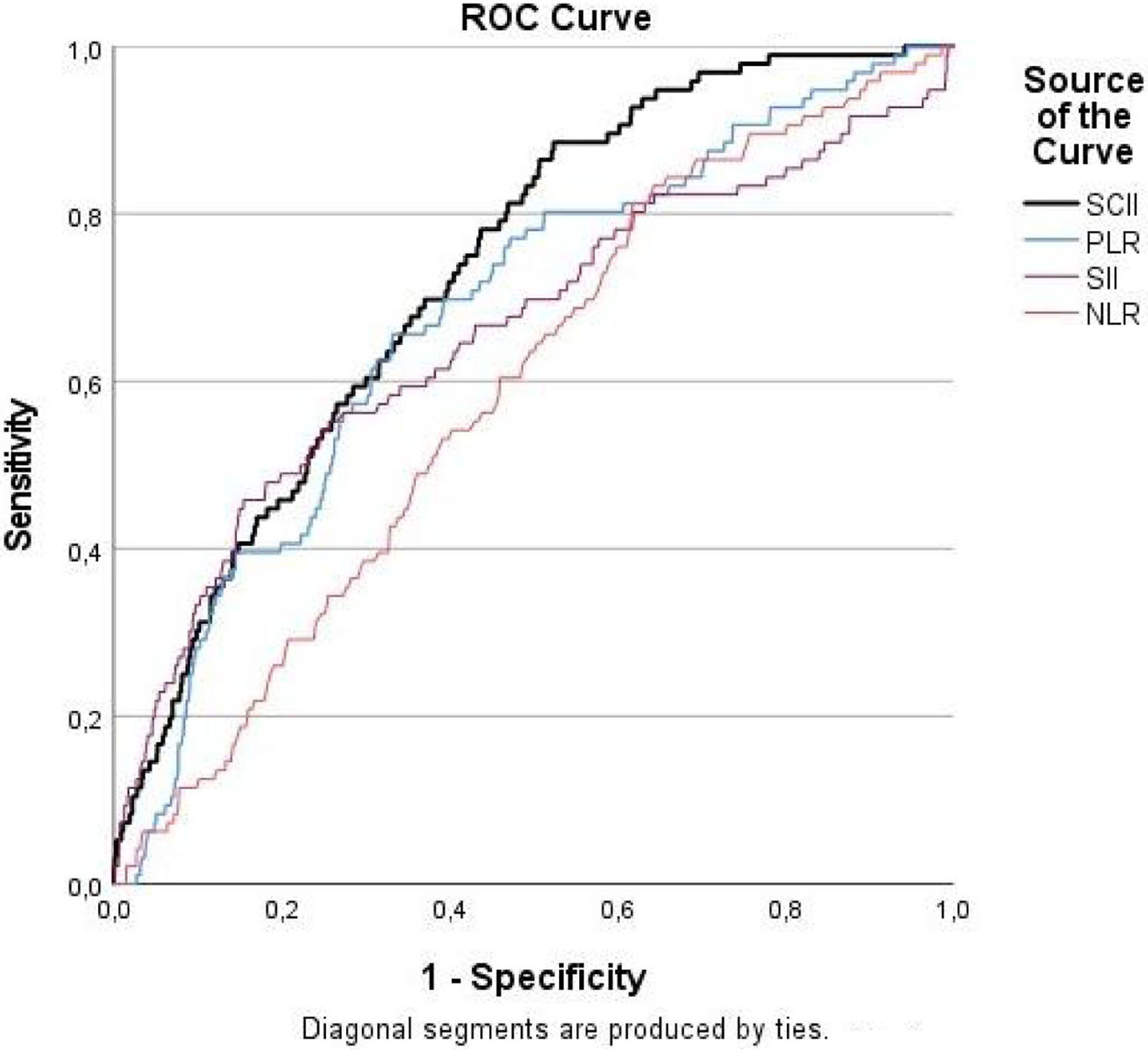
Results: RAO occurred in 96 patients (4.7%). Patients who developed RAO were younger (55.4 ± 11.4 vs. 60.5 ± 12.1 years, P < 0.001), more frequently diabetic (11.5% vs. 5.0%, P = 0.008), and had higher SCII values (120.7 ± 36.4 vs. 93.1 ± 41.5, P < 0.001). In multivariable analysis, age (odds ratio (OR): 0.966; 95% confidence interval (CI): 0.949–0.983; P < 0.001), diabetes mellitus (OR: 2.342; 95% CI: 1.203–4.560; P = 0.012), and SCII (per 10-unit increase; OR: 1.174; 95% CI: 1.120–1.228; P < 0.001) were independent predictors of RAO, whereas sex, percutaneous coronary intervention, C-reactive protein, and creatinine lost significance. SCII showed a moderate discriminative ability (AUC: 0.730; 95% CI: 0.686–0.774; P < 0.001) with a greater AUC than other inflammatory indices. A cut-off of 101.2 yielded 70.4% sensitivity and 57.7% specificity.
Conclusions: SCII is an independent predictor of RAO and shows moderate discriminative ability in patients undergoing transradial coronary procedures. As a marker readily derived from routine laboratory parameters, SCII may serve as a useful adjunct to existing clinical and procedural risk factors for the early identification of patients at increased risk of RAO. Multicenter, prospective studies are warranted to confirm these findings.
Published
Issue
Section
License
Copyright (c) 2026 The authors

This work is licensed under a Creative Commons Attribution 4.0 International License.