

Outcomes After Transcatheter Aortic Valve Implantation Using the Self-Expanding Allegra Valve in Daily Practice
DOI:
https://doi.org/10.14740/cr2291Keywords:
Transcatheter aortic valve implantation, Allegra, Aortic stenosis, Valve-in-valve, OutcomeAbstract
Background: Limited data are available of the self-expanding Allegra transcatheter heart valve (THV). The aim of this study was to investigate the safety and outcome of transcatheter aortic valve implantation (TAVI) using the Allegra THV in daily practice.
Methods: Between February 2018 and September 2024, 142 consecutive patients underwent Allegra TAVI at the Heart and Vascular Center, Bad Bevensen, Germany, either for native aortic stenosis (AS) (n = 117, median 82 (interquartile range 80–86) years) or degenerated aortic bioprostheses (n = 25, 80 (73–84) years) as valve-in-valve (ViV) procedures. Endpoints were defined according to Valve Academic Research Consortium-3 criteria.
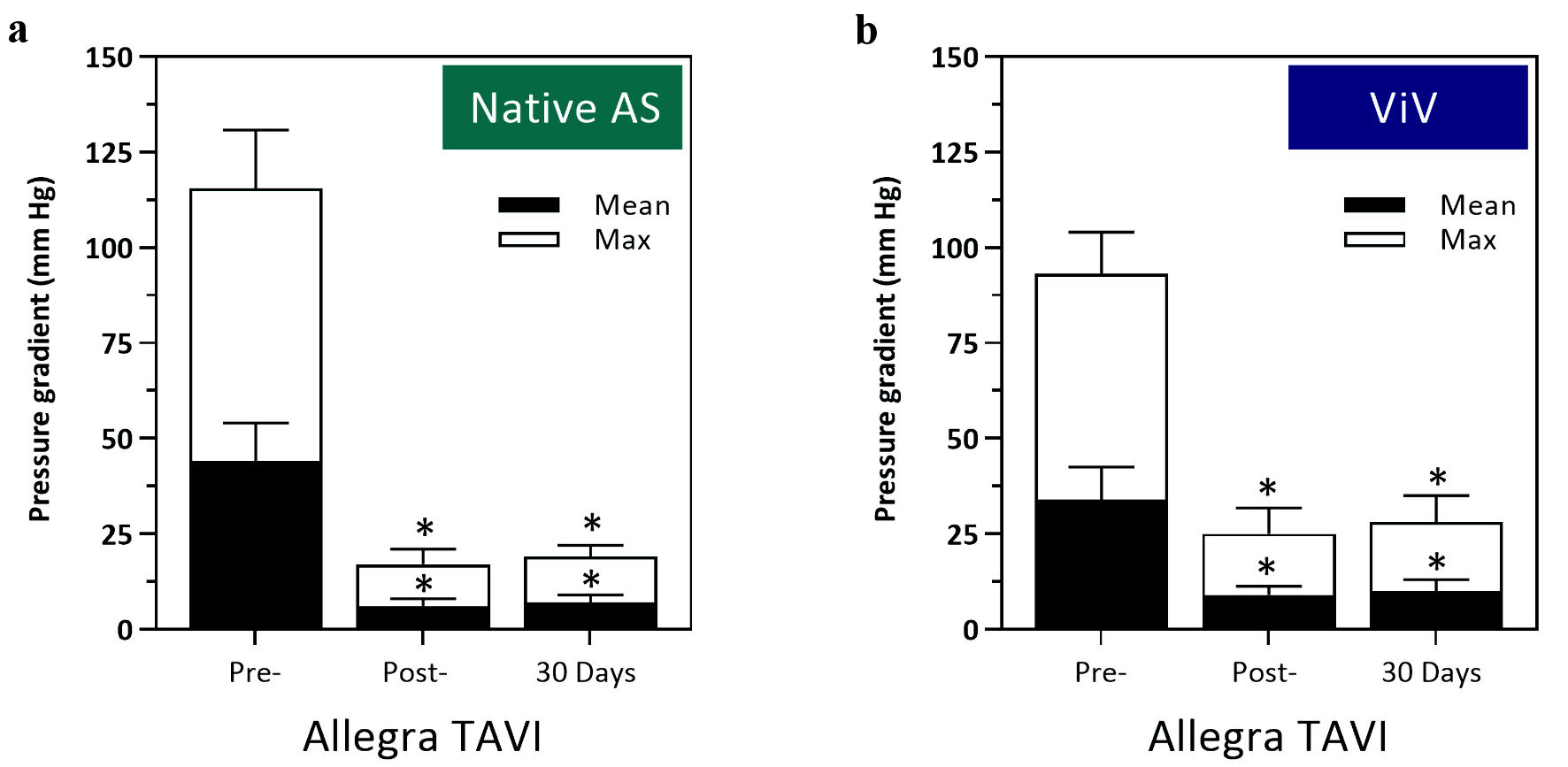
Results: The logistic EuroSCORE II was significantly higher in the cohort of patients with degenerated aortic bioprostheses than in those with native AS (14.4% (6.6–25.3%) versus 3.3% (2.5–5.7%), P < 0.01). Technical success was nearly identical in both cohorts (91.5% of patients with native AS and 92.0% of patients with ViV TAVI). Postinterventional aortic regurgitation ≥ moderate was found in 4.5% of patients with native AS and was not present in any patient with ViV TAVI. In the native AS cohort, mean and maximal aortic pressure gradients decreased from 44 (36–54) mm Hg and 72 (60–87) mm Hg before the intervention to 6 (5–9) mm Hg and 12 (9–15) mm Hg after Allegra TAVI. In the ViV cohort, mean and maximal transvalvular pressure gradients decreased from 34 (27–43) mm Hg and 59 (44–70) mm Hg to 9 (7–11) mm Hg and 16 (14–23) mm Hg, respectively. Periprocedural mortality rates (≤ 30 days) were 6.8% and 12.0% in the native AS and ViV cohorts, respectively. One-year and 3-year survival rates were 87.2% and 73.2% in the native AS cohort and 89.8% and 75.1% in the ViV cohort, respectively.
Conclusions: TAVI using the self-expanding Allegra THV system is safe and leads to acute hemodynamic improvements in patients with native AS or degenerated aortic bioprostheses.
Published
Issue
Section
License
Copyright (c) 2026 The authors

This work is licensed under a Creative Commons Attribution 4.0 International License.