| Cardiology Research, ISSN 1923-2829 print, 1923-2837 online, Open Access |
| Article copyright, the authors; Journal compilation copyright, Cardiol Res and Elmer Press Inc |
| Journal website https://cr.elmerpub.com |
Short Communication
Volume 17, Number 5, October 2026, pages 545-551

Regional Differences Between Drug-Coated Balloons and Drug-Eluting Stents in De Novo Coronary Disease
Gulshan Man Singh Dangola, h  , Quang Leb, Sajana Maharjana, Nathalia Schettino Samadc, Gianna Carolinne Graff Calettid, Mathews Rezende da Costae, Maria Eduarda Cavalcanti Souzaf, Kalgi Modig
aDepartment of Medicine, HSHS St. John’s Hospital, Springfield, IL 62701, USA
bUniversity of Kansas Medical Center, Kansas City, KS 66103, USA
cNew York University CAS, New York, NY 10003, USA
dUniversidade de Passo Fundo, Passo Fundo, RS, Brazil
eAmazonas State University, Manaus, Amazonas, Brazil
fUniversity of Pernambuco, Recife, Pernambuco, Brazil
gDivision of Cardiology, LSU Health Shreveport, Shreveport, LA 71115, USA
hCorresponding Author: Gulshan Man Singh Dangol, Department of Medicine, HSHS St. John’s Hospital, Springfield, IL 62701, USA
Manuscript submitted May 22, 2026, accepted July 15, 2026, published online August 31, 2026
Short title: Regional DCB-DES Signal Is Confounded
doi: https://doi.org/10.14740/cr2252
| Abstract | ▴Top |
Background: Randomized trials of drug-coated balloons (DCBs) versus drug-eluting stents (DESs) for de novo coronary artery disease (dnCAD) are confined to Europe and Asia, raising the question of whether outcomes vary by region. We aimed to examine whether outcomes differ between regions and, if so, whether any difference reflects geography itself or trial-level confounding.
Methods: PubMed, Embase, and Cochrane Central were searched for randomized trials comparing DCB with DES in dnCAD. Incidence rate ratios (IRRs) were pooled with a random-effects model (DerSimonian-Laird; Hartung-Knapp confidence intervals (CIs)). The pre-specified primary question was regional (Europe vs Asia) subgroup comparison of a harmonized device-oriented composite outcome (DOCO). To determine whether any regional signal reflected geography itself or trial-level confounding, we performed subgroup-aware leave-one-out analysis and examined two alternative explanations post-hoc: vessel-size inclusion and dominance of the single largest trial. We also descriptively examined comparator-DES generation across trials.
Results: Thirteen trials (4,673 randomized patients) were included; the primary DOCO analysis comprised 12 trials (4,396 patients). DOCO did not differ overall (IRR = 1.00; 95% CI, 0.70–1.44; I2 = 49.1%). The pre-specified regional difference was statistically significant (Europe IRR = 0.83; 95% CI, 0.44–1.57; Asia IRR = 1.48; 95% CI, 1.04–2.11; subgroup P = 0.04) but was not robust on subgroup-aware leave-one-out analysis: the subgroup-interaction P value rose above 0.05 in eight of 12 iterations, most prominently on omission of REC-CAGEFREE I (about 49% of randomized patients; subgroup P value from 0.04 to 0.46), indicating a regional contrast driven by trial-level imbalance rather than geography. Vessel size and comparator-DES generation differed systematically between regions. No secondary endpoint differed overall, including cardiac death (IRR = 1.20; 95% CI, 0.94–1.52). All 13 trials used paclitaxel-coated balloons.
Conclusions: The apparent regional difference appears largely attributable to trial-level confounding (vessel size, comparator generation, single-trial dominance) rather than to geography itself. Because the randomized evidence comes only from Europe and Asia, these findings show that the Europe–Asia difference is not robust, but do not rule out geographic effects in other regions. Because all current randomized evidence is paclitaxel-specific and confined to Europe and Asia, globally representative trials of limus-coated balloons against contemporary DES are required.
Keywords: Drug-coated balloon; Drug-eluting stent; De novo coronary artery disease; Regional differences; Confounding
| Introduction | ▴Top |
Drug-eluting stents (DESs) are the standard treatment for de novo coronary artery disease, but the permanent metallic scaffold carries a lifelong risk of in-stent restenosis and stent thrombosis. Drug-coated balloons (DCBs) deliver a lipophilic antiproliferative agent without a permanent implant, have established efficacy in in-stent restenosis, and are increasingly studied in de novo lesions. A recent meta-analysis reported overall equivalence between DCB and DES in this indication [1]. Because the randomized evidence is confined to European and Asian trials, the possibility of regional variation in outcomes—and whether any such pattern reflects geography itself or trial-level confounding—has not been formally examined. We conducted this meta-analysis to address that question directly.
| Materials and Methods | ▴Top |
This systematic review followed the Preferred Reporting Items for Systematic Reviews and Meta-Analyses (PRISMA) 2020 [2] and was prospectively registered in PROSPERO (CRD420251178732). Institutional review board approval was not applicable, as this study is a secondary analysis of published aggregate data and did not involve individual patient data or new human-subjects research. This study was conducted in compliance with the ethical standards of the responsible institution on human subjects as well as with the Helsinki Declaration.
PubMed, Embase, and the Cochrane Central Register were searched from database inception to November 18, 2025, with a targeted update in February 2026 limited to follow-up reports of already-included trials, so any newly eligible trial published thereafter would not have been captured (Supplementary Material 1, cr.elmerpub.com). Randomized trials enrolling adults with de novo coronary artery disease, comparing DCB with DES, with at least 6 months’ follow-up and at least one outcome of interest, were eligible. Trials of in-stent restenosis, bifurcation lesions, or DCB-versus-bare-metal-stent comparisons were excluded. Two reviewers screened titles/abstracts and full texts independently; disagreements were resolved by discussion with a third reviewer.
The primary outcome was a harmonized device-oriented composite outcome (DOCO), defined per trial as major adverse cardiovascular events (MACEs), target-lesion failure (TLF), or device-oriented clinical endpoint (DoCE); trial-specific labels and component definitions are listed here (Supplementary Material 2a, cr.elmerpub.com). Secondary outcomes were target-lesion revascularization (TLR), all-cause mortality, cardiac death, myocardial infarction, and target-vessel or stent thrombosis. For trials with serial follow-up publications, the longest available follow-up reported in a full peer-reviewed publication was used; the follow-up reports merged into each parent trial are listed (Supplementary Material 3, cr.elmerpub.com).
Incidence rate ratios (IRRs) per person-year were pooled with a random-effects model (DerSimonian-Laird τ2; Hartung-Knapp confidence intervals (CIs)). IRR was selected as the primary metric because follow-up varied widely across trials (6 months to 5 years) and incidence rates account for differential person-time at risk; conventional risk ratios (RRs) were computed as a sensitivity analysis. The log-IRR standard error was calculated as √(1/e1 + 1/e2); a 0.5 continuity correction was applied only when a study had a zero-event cell. Estimates for sparse-event outcomes (cardiac death, vessel thrombosis) are correspondingly sensitive to this correction. Person-years were reconstructed from the average number at risk over each reported follow-up interval (Supplementary Material 2b, cr.elmerpub.com). The number of trials contributing differs by outcome because not every trial reported every endpoint. The geographic subgroup analysis was pre-specified in the registered PROSPERO protocol and was the review’s principal question. To determine whether any regional difference was robust, we performed subgroup-aware leave-one-out analysis (recomputing the regional subgroup estimates and the subgroup-interaction P value with each trial omitted in turn) and examined two alternative explanations post-hoc: vessel size (small-vessel versus broader inclusion) and dominance of single largest trial; comparator-DES generation (first- versus second-generation) was described qualitatively. We additionally performed post-hoc univariable random-effects meta-regression of the primary outcome on follow-up duration, vessel-size category, and comparator-DES generation; a sensitivity analysis using conventional RRs; and a sensitivity analysis restricted to trials with target-lesion-revascularization–based composite definitions. Risk of bias was assessed using Risk of Bias 2 tool (RoB 2) [3]; certainty was assessed using Grading of Recommendations Assessment: Development and Evaluation (GRADE) [4]; small-study effects were assessed using Egger’s test for the primary outcome (k = 12). P values were two-sided, with a significance threshold of P < 0.05. Analyses were conducted using R 4.5.2 (meta package). Additional methods, per-trial event counts and person-years, device classification, GRADE summary, and robustness analyses are provided here (Supplementary Materials 1–6, cr.elmerpub.com)
| Results | ▴Top |
The search identified 1,160 records; 751 were screened after de-duplication and 44 underwent full-text review, yielding 13 randomized trials reported across 21 publications (Fig. 1; Supplementary Material 5, cr.elmerpub.com) [5–17]. Across the systematic review, 4,673 patients were randomized (DCB 2,343; DES 2,330); the primary DOCO analysis included 12 trials and 4,396 patients (Nishiyama et al [17] reported only TLR). Six trials were European and seven Asian; follow-up ranged from 6 months to 5 years. All 13 trials used a paclitaxel-coated balloon. Pooled estimates for all outcomes (overall and by region) are summarized in Table 1.
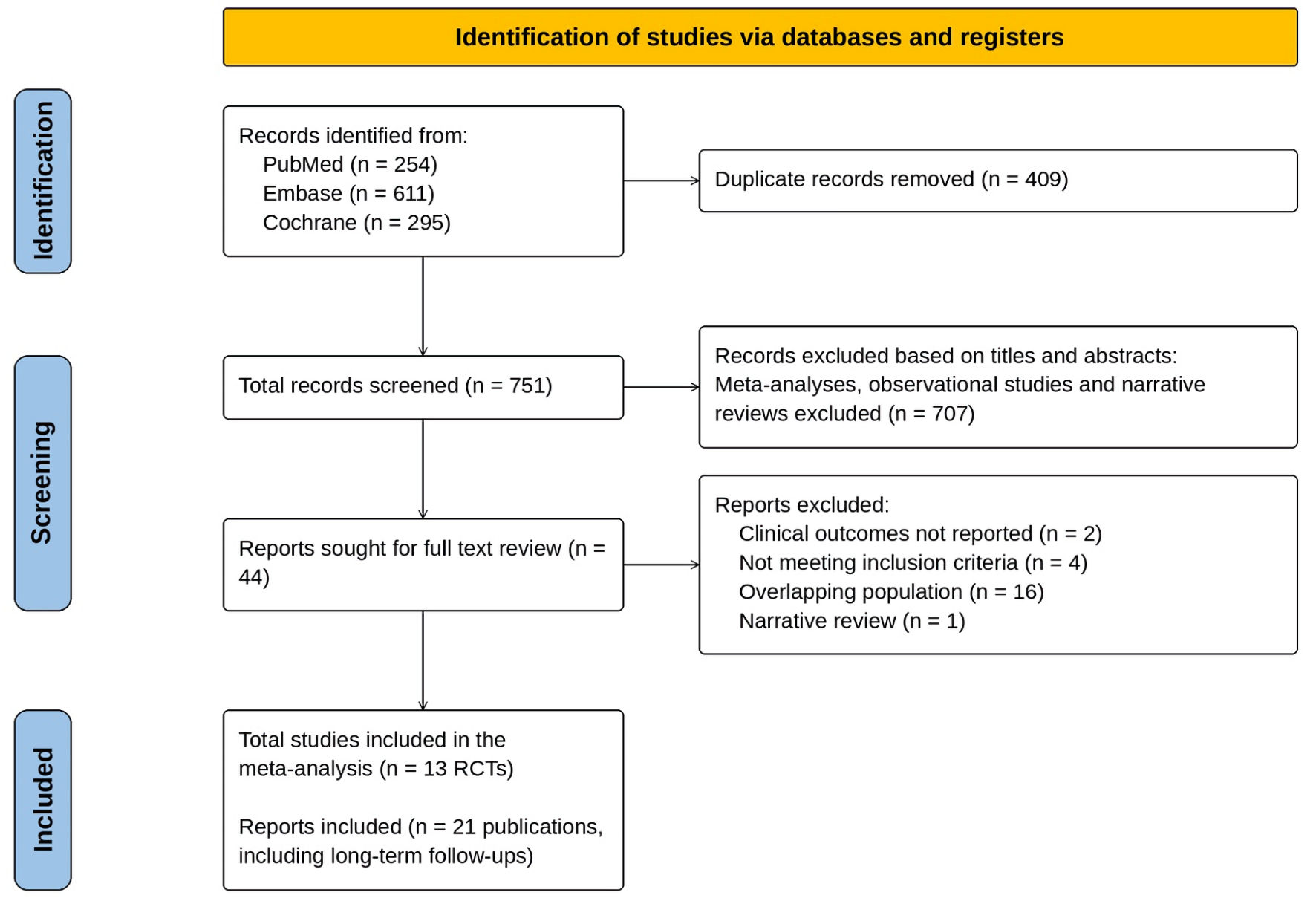 Click for large image | Figure 1. PRISMA 2020 flow diagram of study identification, screening, and inclusion. Records were identified from PubMed (n = 254), Embase (n = 611), and Cochrane Central (n = 295); after removal of 409 duplicates, 751 records were screened, of which 706 were excluded at title and abstract review. Forty-five reports underwent full-text review (clinical outcomes not reported, n = 2; inclusion criteria not met, n = 4; overlapping population, n = 16; narrative review, n = 1; excluded studies are listed (Supplementary Material 5, cr.elmerpub.com), yielding 13 randomized controlled trials reported across 21 publications. PRISMA: Preferred Reporting Items for Systematic Reviews and Meta-Analyses; RCT: randomized controlled trial. |
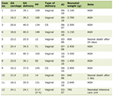 Click to view | Table 1. Pooled incidence rate ratios for DCB versus DES, overall and by region |
Primary outcome and regional difference
DOCO did not differ overall between DCB and DES (IRR = 1.00; 95% CI, 0.70–1.44; I2 = 49.1%). In the pre-specified regional subgroup analysis by geography, European trials showed no difference (IRR = 0.83; 95% CI, 0.44–1.57) while Asian trials favored DES (IRR = 1.48; 95% CI, 1.04–2.11), with a statistically significant subgroup difference (χ2 = 4.16, df = 1; P = 0.04) (Fig. 2). However, this regional signal was not robust. In subgroup-aware leave-one-out analysis, the subgroup-interaction P value rose above 0.05 in 8 of 12 iterations: three of six Asian trials (RESTORE SVD, DISSOLVE SVD, REC-CAGEFREE I) and five of six European trials (BELLO, BASKET-SMALL 2, PICCOLETO II, REVELATION, Gobic et al [10]) individually nullified the subgroup difference when omitted. The most extreme single-trial effect was observed for REC-CAGEFREE I, the largest trial (contributing about 49% of randomized patients), where omission shifted the subgroup-interaction P value from 0.04 to 0.46 (Supplementary Material 6a, b, cr.elmerpub.com). REC-CAGEFREE I nevertheless contributed only 18.4% of the random-effects weight (despite approximately 49% of randomized patients); with its removal, the pooled DOCO estimate was an IRR of 0.88 (95% CI, 0.61–1.27), and I2 fell from 49.1% to 21.4% (Supplementary Material 6c, cr.elmerpub.com). The breadth of this fragility indicates that the regional contrast is not a stable feature of the data but rather a consequence of trial-level imbalance. Second, vessel size differed systematically between regions: four of six European trials enrolled patients with small vessels (≤ 2.75 mm), in which DCB and DES perform similarly, compared with only two of seven Asian trials, whereas the largest Asian REC-CAGEFREE I trial enrolled patients irrespective of vessel size and found DCB inferior to DES, with the effect concentrated in larger vessels (Supplementary Material 6d, b, cr.elmerpub.com) [13]. Third, the comparator differed by era: early European trials largely used paclitaxel-eluting stents initially [5–7], whereas nearly all Asian trials used second-generation limus-eluting stents (Supplementary Material 4a, cr.elmerpub.com) [11–14, 16, 17]. Continent is thus collinear with vessel size, comparator generation, and one dominant trial. Univariable meta-regression identified no significant moderator of the primary outcome—follow-up duration (β = −0.008, P = 0.57), vessel-size category (β = −0.22, P = 0.54), and comparator-DES generation (β = −0.13, P = 0.74)—consistent with limited power (k = 11–12) and collinearity among these study-level factors and continent (Supplementary Material 4b, cr.elmerpub.com). Findings were materially unchanged using conventional RRs (RR = 1.00; 95% CI, 0.69–1.45; regional subgroup P = 0.05), and restricting the analysis to trials with target-lesion-revascularization–based composite definitions left the overall estimate null (IRR = 1.28; 95% CI, 0.82–2.00) while attenuating the regional contrast (subgroup P = 0.40) (Supplementary Material 4c, cr.elmerpub.com).
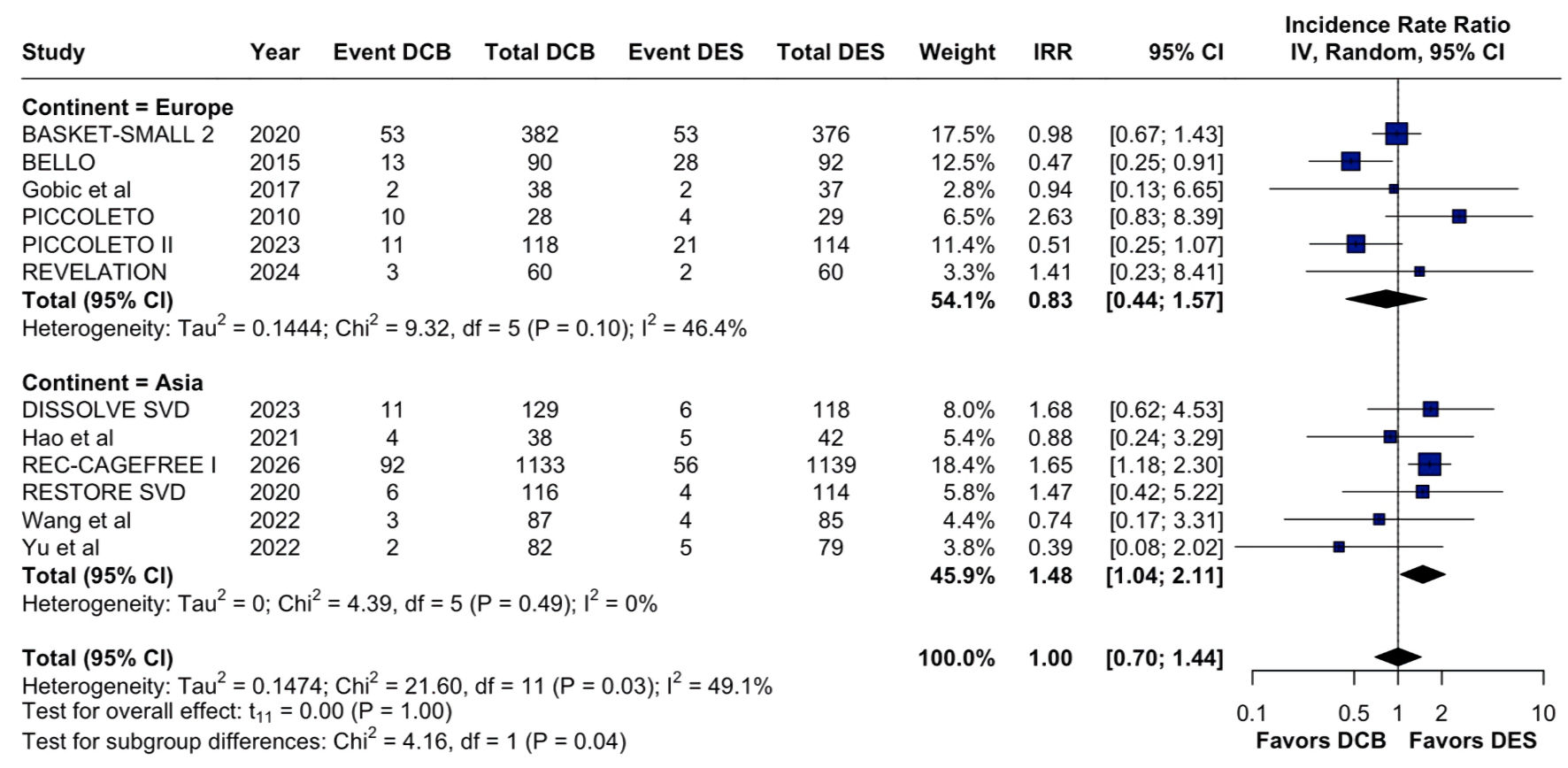 Click for large image | Figure 2. Random-effects forest plot of the device-oriented composite outcome (DOCO), with trials stratified by continent of enrollment (pre-specified subgroup, PROSPERO CRD420251178732). Overall IRR = 1.00 (95% CI, 0.70–1.44), I2 = 49.1%; Europe 0.83 (0.44–1.57); Asia 1.48 (1.04–2.11); test for subgroup differences χ2 = 4.16, df = 1, P = 0.04, k = 12. DCB: drug-coated balloon; DES: drug-eluting stent; CI: confidence interval; IRR: incidence rate ratio. |
Secondary outcomes
No secondary endpoint showed a robust overall difference (Table 1). TLR did not differ overall (IRR = 1.24; 95% CI, 0.72–2.14; I2 = 46.3%), although the Asian subgroup favored DES (IRR = 2.03; 95% CI, 1.19–3.44) while the European subgroup did not (subgroup difference P = 0.12). All-cause mortality did not differ (IRR = 1.10; 95% CI, 0.92–1.31). Cardiac death did not differ (IRR = 1.20; 95% CI, 0.94–1.52; I2 = 0%) and was directionally concordant with all-cause mortality. Myocardial infarction did not differ (IRR = 0.80; 95% CI, 0.62-1.03). Target-vessel or stent thrombosis did not differ overall (IRR = 0.64; 95% CI, 0.37–1.10); the thrombosis subgroup difference (Europe 0.37, Asia 1.03; subgroup P = 0.01) rests on very sparse events and is hypothesis-generating only.
Risk of bias, certainty, and small-study effects
Most trials were at low overall risk of bias; a minority raised some concerns due to deviations or missing data; none were at high risk (Supplementary Material 4d, cr.elmerpub.com). By GRADE, certainty was moderate for all-cause mortality, cardiac death, myocardial infarction, and thrombosis, and low for DOCO and TLR (Supplementary Material 4e, cr.elmerpub.com). Egger’s test for the primary outcome was nonsignificant (t = –0.76, P = 0.46).
| Discussion | ▴Top |
In 13 randomized trials and 4,673 patients, DCB and DES produced comparable overall outcomes for de novo coronary artery disease, consistent with the prior pooled estimate of O’Callaghan et al [1]. The pre-specified regional subgroup analysis by geography showed a statistically significant difference (P = 0.04). On further interrogation of this signal, the data did not support geography as a determinant of DCB-versus-DES outcomes; they showed that trial design, lesion selection, and comparator era drive the between-region appearance. The symmetry of the leave-one-out evidence should be acknowledged: the regional signal is fragile across multiple subgroup-aware iterations, and the overall null estimate is similarly sensitive to REC-CAGEFREE I, reflecting trial-level imbalance on both sides of the comparison rather than a stable regional or overall effect. Because individual patient data were unavailable, the associations with vessel size and comparator generation are ecological (study-level) and cannot establish patient-level causation; they are best interpreted as sources of confounding of the regional contrast rather than independently quantifiable effects. Antiplatelet regimens likewise differed across trials and regions—several Asian DCB-only protocols used abbreviated dual antiplatelet therapy—and, being unmeasured at the patient level, may further contribute to the between-region appearance.
A structural gap in the current evidence deserves emphasis: every randomized DCB arm to date uses paclitaxel; no completed randomized trial compares a limus-coated balloon with a contemporary DES in this indication. Pooled paclitaxel-DCB estimates should not be extrapolated to the limus devices increasingly used in practice; the TRANSFORM II and SELUTION DeNovo trials will likely provide globally representative, contemporary-comparator data [18, 19].
Limitations
Two limitations emphasized in this review warrant particular note. First, the pooled and regional estimates were disproportionately influenced by a single trial: REC-CAGEFREE I contributed roughly half of the randomized patients, though random-effects weighting reduced its share of the pooled estimate to 18.4%. Despite this downweighing, both the overall null and the regional signal remained sensitive to its inclusion, reflecting trial-level imbalance rather than a stable effect. Second, all included trials were conducted in Europe or Asia, with no randomized data from North America, South America, Africa, or Oceania; the present findings therefore bear on the robustness of the Europe–Asia contrast and cannot exclude geographic effects globally.
Aggregate (not individual-patient) data were used, so the composite endpoint had to be harmonized across partially differing trial definitions—combining trial-defined endpoints with different components (target-vessel- versus target-lesion-based revascularization)—and confounders could not be adjusted at the patient level; the associations with vessel size, comparator-DES generation, and continent are therefore ecological and hypothesis-generating rather than a patient-level causal decomposition. Because follow-up durations differed widely (6 months to 5 years), outcomes were pooled as incidence-rate ratios using person-years reconstructed from the average numbers at risk under a within-interval constant-hazard assumption, which could introduce bias if event rates varied over time. Univariable meta-regression was underpowered (k = 11–12) and, given the collinearity of continent, vessel size, and comparator generation, could not isolate their independent contributions. Finally, antiplatelet regimens differed across trials and regions—several Asian DCB-only protocols used abbreviated dual antiplatelet therapy—and, being unmeasured at the patient level, may further contribute to the between-region appearance.
Conclusions
The apparent Europe–Asia difference between DCB and DES for de novo coronary disease appears largely attributable to trial-level confounding—vessel size, comparator-DES generation, and dominance of a single large trial—rather than to geography itself. Because the randomized evidence comes only from Europe and Asia, these findings show that the Europe–Asia difference is not robust, but do not rule out geographic effects in other regions. Current randomized evidence remains paclitaxel-specific and confined to Europe and Asia. Globally representative trials of contemporary DCB platforms against current-generation DES, with balanced lesion selection, are required before any regional or class-level conclusions can be drawn.
| Supplementary Material | ▴Top |
Suppl 1. Database search strategies.
Suppl 2. Endpoint definitions and per-trial outcome data.
Suppl 3. Long-term follow-up reports merged into parent trials.
Suppl 4. Trial-level covariates, analyses, and quality assessment.
Suppl 5. Studies excluded at full-text review, with reasons (n = 23).
Suppl 6. Robustness and subgroup analyses of the primary outcome.
Acknowledgments
The abstract of this study was presented as an oral presentation at the Cardiovascular Research Technologies (CRT) 2026 Annual Meeting, Washington, DC.
Financial Disclosure
None to declare.
Conflict of Interest
None to declare.
Informed Consent
Not applicable; this study used secondary analysis of published aggregate data.
Author Contributions
GMSD: conception, analysis, drafting. QL, SM: screening, data curation, revision. NSS, GCGC, MRdC, MECS: literature review, data extraction. KM: supervision, critical revision. All authors approved the final manuscript.
Data Availability
All extracted data are available from the corresponding author on reasonable request.
AI Use Declaration
AI-based tools were used solely for language editing and grammatical refinement of the manuscript text; they were not used for study design, data extraction, statistical analysis, or formulation of conclusions. The authors verified all content and took full responsibility for the work.
Abbreviations
ACS: acute coronary syndrome; CCS: chronic coronary syndrome; CI: confidence interval; DAPT: dual antiplatelet therapy; DCB: drug-coated balloon; DES: drug-eluting stent; dnCAD: de novo coronary artery disease; DOCO: device-oriented composite outcome; DoCE: device-oriented clinical endpoint; GRADE: Grading of Recommendations Assessment, Development and Evaluation; IRR: incidence rate ratio; ISR: in-stent restenosis; MACE: major adverse cardiovascular events; MI: myocardial infarction; PCI: percutaneous coronary intervention; PRISMA: Preferred Reporting Items for Systematic Reviews and Meta-Analyses; PROSPERO: International Prospective Register of Systematic Reviews; RCT: randomized controlled trial; RoB 2: Risk of Bias 2 tool; TLF: target-lesion failure; TLR: target-lesion revascularization; TVR: target-vessel revascularization
| References | ▴Top |
- O'Callaghan D, Rai H, Giacoppo D, Coughlan JJ, Durand R, Paradies V, Colleran R, et al. Drug coated balloons versus drug-eluting stents in patients with de novo coronary artery disease. Catheter Cardiovasc Interv. 2025;106(3):1843-1853.
doi pubmed - Page MJ, McKenzie JE, Bossuyt PM, Boutron I, Hoffmann TC, Mulrow CD, Shamseer L, et al. The PRISMA 2020 statement: An updated guideline for reporting systematic reviews. Int J Surg. 2021;88:105906.
doi pubmed - Sterne JAC, Savovic J, Page MJ, Elbers RG, Blencowe NS, Boutron I, Cates CJ, et al. RoB 2: a revised tool for assessing risk of bias in randomised trials. BMJ. 2019;366:l4898.
doi pubmed - Schunemann HJ, Brozek J, Guyatt G, Oxman A. GRADE handbook for grading the quality of evidence and the strength of recommendations using the GRADE approach. The GRADE Working Group; 2013.
- Cortese B, Micheli A, Picchi A, Coppolaro A, Bandinelli L, Severi S, Limbruno U. Paclitaxel-coated balloon versus drug-eluting stent during PCI of small coronary vessels, a prospective randomised clinical trial. The PICCOLETO study. Heart. 2010;96(16):1291-1296.
doi pubmed - Latib A, Ruparelia N, Menozzi A, Castriota F, Micari A, Cremonesi A, De Felice F, et al. 3-year follow-up of the balloon elution and late loss optimization study (BELLO). JACC Cardiovasc Interv. 2015;8(8):1132-1134.
doi pubmed - Jeger RV, Farah A, Ohlow MA, Mangner N, Mobius-Winkler S, Weilenmann D, Wohrle J, et al. Long-term efficacy and safety of drug-coated balloons versus drug-eluting stents for small coronary artery disease (BASKET-SMALL 2): 3-year follow-up of a randomised, non-inferiority trial. Lancet. 2020;396(10261):1504-1510.
doi pubmed - Cortese B, Testa G, Rivero F, Erriquez A, Alfonso F. Long-term outcome of drug-coated balloon vs drug-eluting stent for small coronary vessels: PICCOLETO-II 3-year follow-up. JACC Cardiovasc Interv. 2023;16(9):1054-1061.
doi pubmed - Niehe SR, Vos NS, Van Der Schaaf RJ, Amoroso G, Herrman JR, Patterson MS, Slagboom T, et al. 5-year clinical outcomes of paclitaxel-coated balloon angioplasty vs DES in acute MI: the REVELATION trial. JACC Cardiovasc Interv. 2024;17(9):1185-1186.
doi pubmed - Gobic D, Tomulic V, Lulic D, Zidan D, Brusich S, Jakljevic T, Zaputovic L. Drug-coated balloon versus drug-eluting stent in primary percutaneous coronary intervention: a feasibility study. Am J Med Sci. 2017;354(6):553-560.
doi pubmed - Tian J, Tang YD, Qiao S, Su X, Chen Y, Jin Z, Chen H, et al. Two-year follow-up of a randomized multicenter study comparing a drug-coated balloon with a drug-eluting stent in native small coronary vessels: The RESTORE Small Vessel Disease China trial. Catheter Cardiovasc Interv. 2020;95(Suppl 1):587-597.
doi pubmed - Liu S, Zhou Y, Shen Z, Chen H, Qiu C, Fu G, Li H, et al. Comparison of drug-coated balloon and drug-eluting stent for the treatment of small vessel disease (from the Dissolve SVD Randomized Trial). Am J Cardiol. 2024;211:29-39.
doi pubmed - Tao L, He X, Shen G, Wu M, He Y, Ma L, Yang F, et al. Drug-coated balloon angioplasty vs up-front stenting for de novo CAD: 3-year follow-up of REC-CAGEFREE I trial. J Am Coll Cardiol. 2026;87(3):312-329.
doi pubmed - Yu X, Wang X, Ji F, Zhang W, Yang C, Xu F, Wang F. A non-inferiority, randomized clinical trial comparing paclitaxel-coated balloon versus new-generation drug-eluting stents on angiographic outcomes for coronary de novo lesions. Cardiovasc Drugs Ther. 2022;36(4):655-664.
doi pubmed - Hao X, Huang D, Wang Z, Zhang J, Liu H, Lu Y. Study on the safety and effectiveness of drug-coated balloons in patients with acute myocardial infarction. J Cardiothorac Surg. 2021;16(1):178.
doi pubmed - Wang Z, Yin Y, Li J, Qi W, Yu B, Xu Z, Zhu W, et al. New ultrasound-controlled paclitaxel releasing balloon vs. asymmetric drug-eluting stent in primary ST-segment elevation myocardial infarction - a prospective randomized trial. Circ J. 2022;86(4):642-650.
doi pubmed - Nishiyama N, Komatsu T, Kuroyanagi T, Fujikake A, Komatsu S, Nakamura H, Yamada K, et al. Clinical value of drug-coated balloon angioplasty for de novo lesions in patients with coronary artery disease. Int J Cardiol. 2016;222:113-118.
doi pubmed - Greco A, Sciahbasi A, Abizaid A, Mehran R, Rigattieri S, de la Torre Hernandez JM, Alfonso F, et al. Sirolimus-coated balloon versus everolimus-eluting stent in de novo coronary artery disease: Rationale and design of the TRANSFORM II randomized clinical trial. Catheter Cardiovasc Interv. 2022;100(4):544-552.
doi pubmed - Spaulding C, Krackhardt F, Bogaerts K, Urban P, Meis S, Morice MC, Eccleshall S. Comparing a strategy of sirolimus-eluting balloon treatment to drug-eluting stent implantation in de novo coronary lesions in all-comers: Design and rationale of the SELUTION DeNovo Trial. Am Heart J. 2023;258:77-84.
doi pubmed
This article is distributed under the terms of the Creative Commons Attribution 4.0 International License (CC BY 4.0), which permits unrestricted use, distribution, and reproduction in any medium, including commercial use, provided the original work is properly cited.
Cardiology Research is published by Elmer Press Inc.