

Impact of Patent Foramen Ovale on In-Hospital Outcomes in Acute Pulmonary Embolism
DOI:
https://doi.org/10.14740/cr2130Keywords:
Pulmonary embolism, Patent foramen ovale, Stroke, Paradoxical embolismAbstract
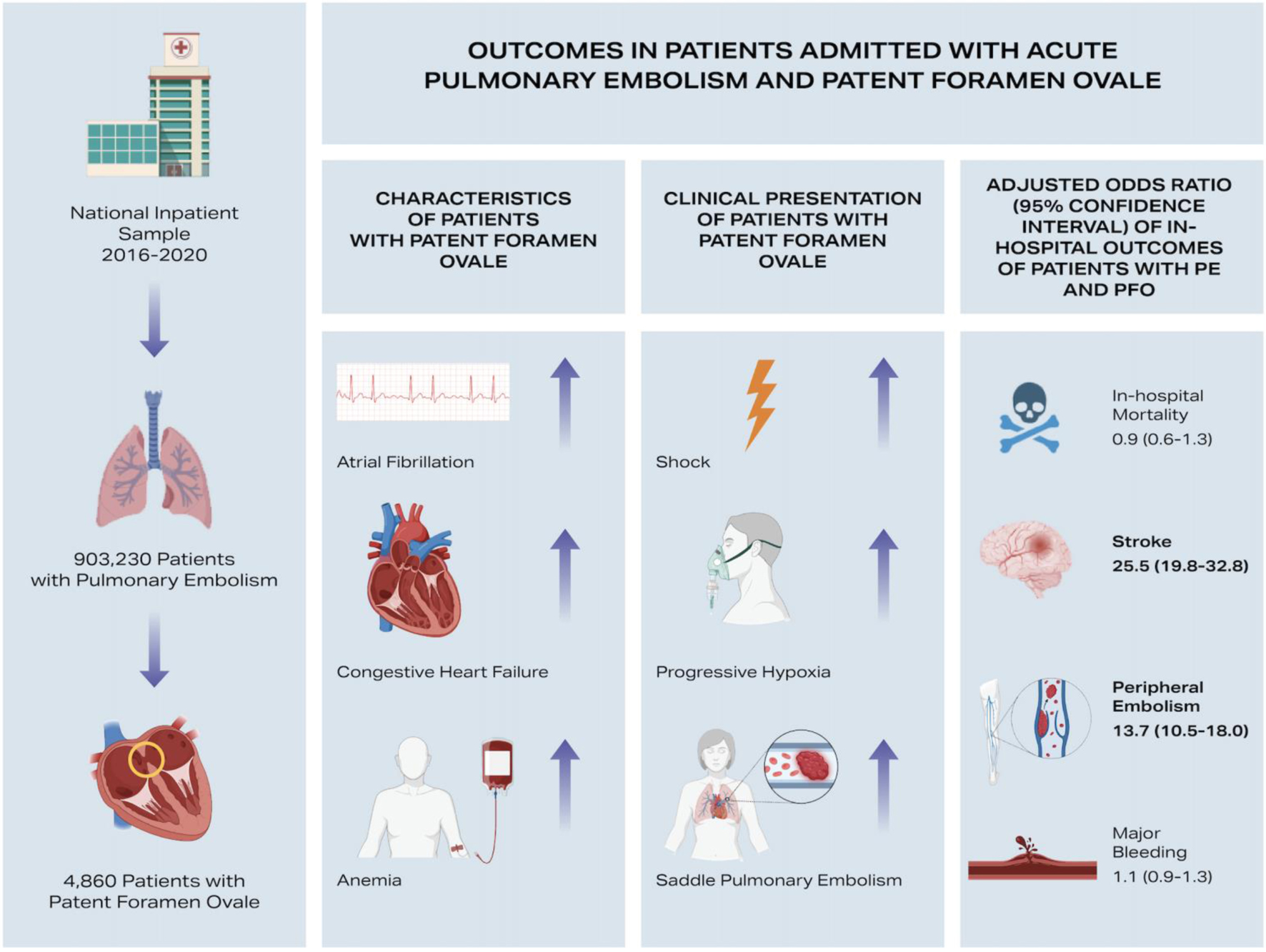
Background: Patent foramen ovale (PFO) may complicate acute pulmonary embolism (PE) by enabling paradoxical embolism, but its clinical impact remains unclear. We evaluated the characteristics, management, and outcomes of patients hospitalized with PE with or without PFO.
Methods: Using the National Inpatient Sample database, adult patients admitted with acute PE between 2016 and 2020 were identified via ICD-10 codes. Patients were grouped based on whether they had concomitant PFO. Clinical characteristics, advanced therapies, and in-hospital outcomes were compared between patients with and without PFO. Multivariable logistic regression analyses were adjusted for demographics and comorbidities, with outcomes reported as adjusted odds ratios (aORs) and 95% confidence intervals (CIs).
Results: We identified 903,230 adult patients hospitalized with acute PE, among whom 4,860 (0.54%) had a PFO. Patients with concomitant PE and PFO were younger (59.4 ± 15.9 vs. 63 ± 16.5 years, P < 0.001) and presented with more severe clinical features, including higher rates of saddle PE (17.7% vs. 9%, P < 0.001) and cor pulmonale (17.9% vs. 8.3%, P < 0.001). They required significantly more frequent interventions, such as catheter-directed thrombolysis (7.4% vs. 3.8%, P < 0.001). After multivariable adjustment, PFO presence was associated with significantly increased odds of stroke (aOR 25.5, 95% CI 19.8 - 32.8; P < 0.001) and peripheral embolism (aOR 13.7, 95% CI 10.5 - 18.0; P < 0.001) but not increased in-hospital mortality (aOR 0.9, 95% CI 0.6 - 1.3; P = 0.702).
Conclusion: In this nationwide study, PFO in patients with acute PE was linked to greater clinical severity and more frequent advanced interventions. Prospective studies are needed to define optimal screening strategies.
Published
Issue
Section
License
Copyright (c) 2025 The authors

This work is licensed under a Creative Commons Attribution-NonCommercial 4.0 International License.