


Association Between Hepatitis C Virus Infection and Coronary Artery Disease: A Systematic Review and Meta-Analysis
DOI:
https://doi.org/10.14740/cr2280Keywords:
Cardiovascular disease, Coronary artery disease, Meta-analysis, Systematic review, HIV co-infection, Direct-acting antivirals, Hepatitis C virusAbstract
Background: Hepatitis C virus (HCV) infection has been associated with cardiovascular disease, but its relationship with coronary artery disease (CAD) remains uncertain.
Methods: This systematic review included observational studies reporting adjusted effect estimates for CAD outcomes among HCV-infected and HCV-uninfected adults. Adjusted hazard ratios, risk ratios, and odds ratios were combined on the logarithmic scale using a random-effects model and are presented as a summary relative association estimate with 95% confidence intervals (CIs). Prespecified subgroup analyses were performed by study design, human immunodeficiency virus (HIV) co-infection status, and CAD outcome type; meta-regression evaluated follow-up duration, mean age, and the proportion of male participants.
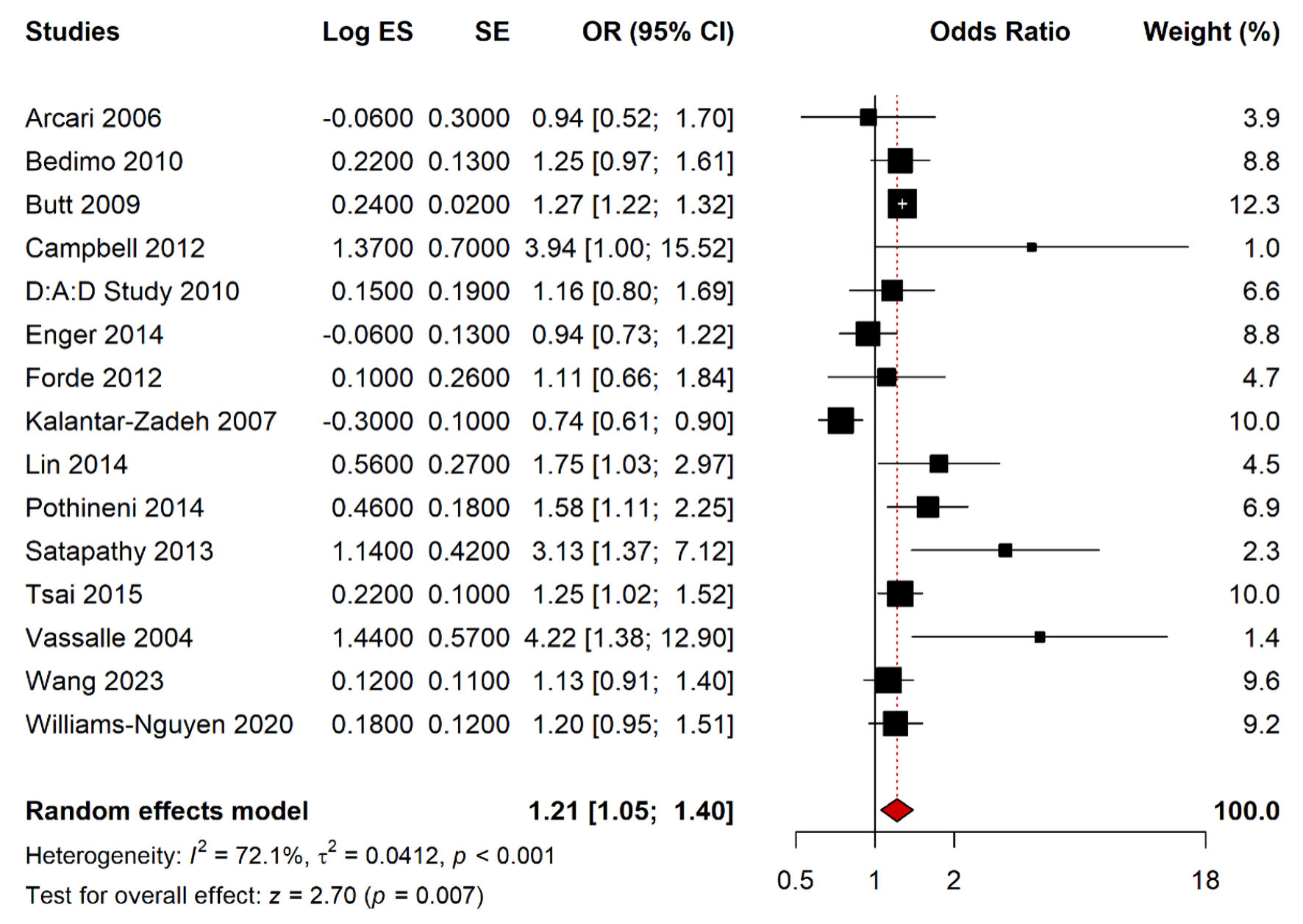
Results: Twenty-one studies were included, representing diverse populations including veterans, people living with HIV, dialysis patients, and community-based cohorts. Fifteen studies contributed adjusted estimates to the quantitative synthesis. HCV infection was associated with a modest increase in the pooled relative estimate for CAD (summary estimate 1.21; 95% CI, 1.05–1.40; P = 0.007), with substantial heterogeneity (I2 = 72.1%). The association was statistically significant in cohort studies and in both HIV-specific and non-HIV-specific subgroups, although the HIV-specific subgroup was based on four studies. The myocardial infarction (MI)-specific subgroup was not statistically significant, whereas studies using broader CAD outcomes showed a significant association.
Conclusions: Chronic HCV infection was associated with a modest increase in the pooled relative estimate for CAD. However, substantial heterogeneity, differences in endpoint definitions and populations, residual confounding, and the combination of different effect measures limit causal interpretation and make the clinical importance uncertain. The nonsignificant MI-specific analysis further supports a cautious interpretation. These findings do not establish a cardiovascular benefit of antiviral therapy; prospective studies with standardized CAD endpoints and detailed data on renal disease, antiviral exposure, and lipid-lowering therapy are needed.
Published
Issue
Section
License
Copyright (c) 2026 The authors

This work is licensed under a Creative Commons Attribution 4.0 International License.