Predictive Value of the Pulmonary Artery Pulsatility Index in Pulmonary Arterial Hypertension: REVEAL Analysis
DOI:
https://doi.org/10.14740/cr2225Keywords:
Pulmonary arterial hypertension, Pulmonary artery pulsatility index, Risk assessmentAbstract
Background: There is growing interest in developing risk assessment tools/metrics to improve treatment, management, and outcomes for pulmonary arterial hypertension (PAH). This study investigated the association of the pulmonary artery pulsatility index (PAPi) with patient characteristics, hospitalization, and mortality.
Methods: Data collected from the US-based Registry to Evaluate Early and Long-Term PAH Disease Management were stratified/analyzed according to baseline PAPi quartiles (36-month follow-up).
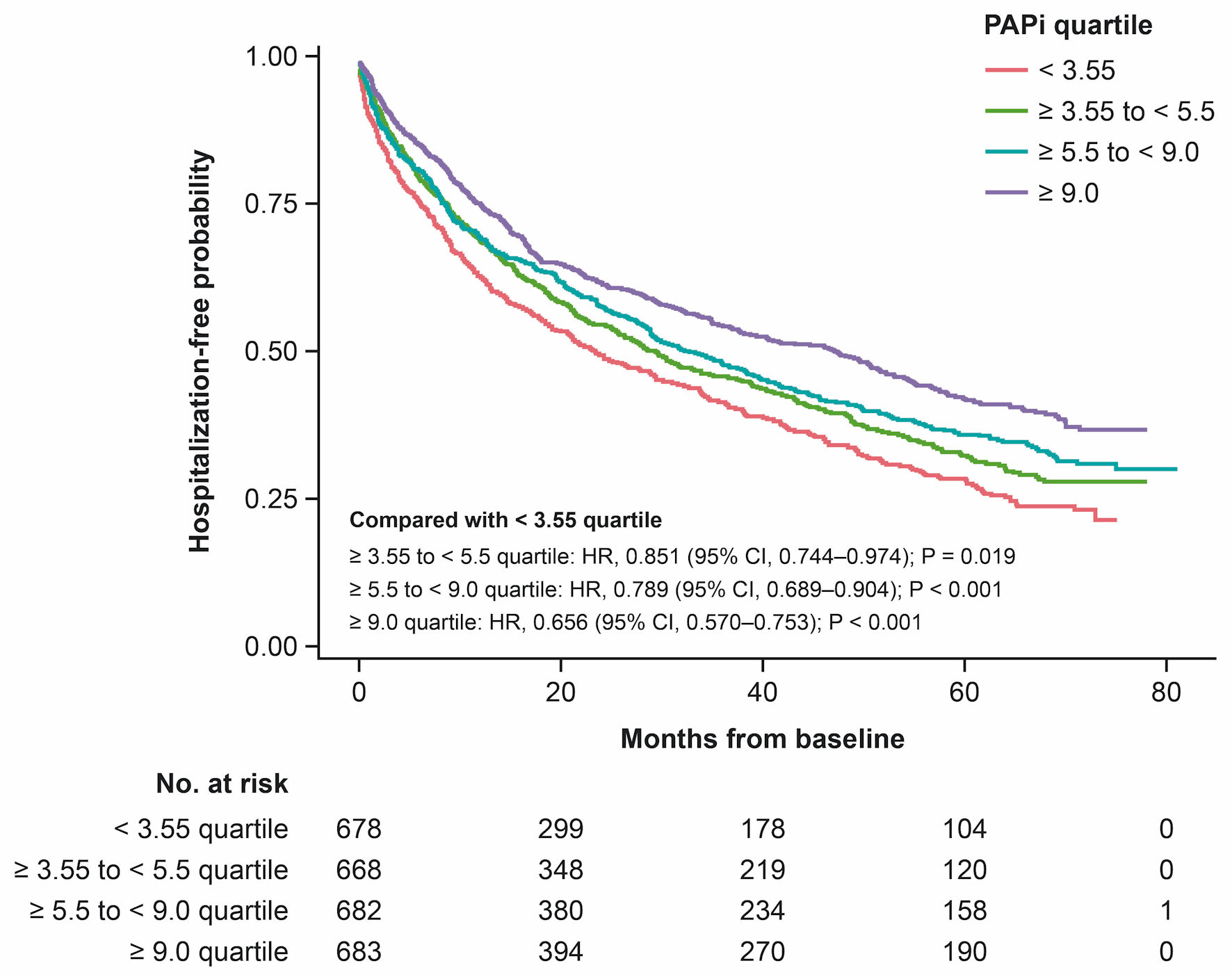
Results: In total, 2,711 patients were included. Baseline demographic/clinical characteristics were similar; however, the lowest quartiles (< 3.55; ≥ 3.55 to < 5.5) had higher New York Heart Association/World Health Organization functional class, while those in the highest quartiles (≥ 5.5 to < 9.0; ≥ 9.0) had longer 6-min walk distance. Of 2,414 patients assessed for hospitalization, 1,326 (54.9%) were hospitalized. Lower PAPi correlated with increasing hospitalization probability (≥ 9.0 quartile, n = 291 (48.0%); ≥ 5.5 to < 9.0 quartile, n = 333 (54.8%); ≥ 3.55 to < 5.5 quartile, n = 340 (57.2%); and < 3.55 quartile, n = 362 (59.7%)). Of 681 (28.1%) patients who died, 150 (24.1%) were in the ≥ 9.0 quartile, 154 (25.5%) the ≥ 5.5 to < 9.0 quartile, 157 (26.7%) the ≥ 3.55 to < 5.5 quartile, and 220 (35.9%) the < 3.55 quartile (P < 0.001). Compared with the < 3.55 quartile, there was a 35.6%, 25.8%, and 23.3% reduction in mortality in the ≥ 9.0, ≥ 5.5 to < 9.0, and ≥ 3.55 to < 5.5 quartiles, respectively.
Conclusions: PAPi may be a useful prognostic tool and long-term predictor of clinical events in PAH.
Published
Issue
Section
License
Copyright (c) 2026 The authors

This work is licensed under a Creative Commons Attribution 4.0 International License.